
Ahmed El Shamsy@a_el_shamsy
May 21, 2021
12 tweets
The design of the ISIS flag can be traced back to shady Orientalists in the 1850's...
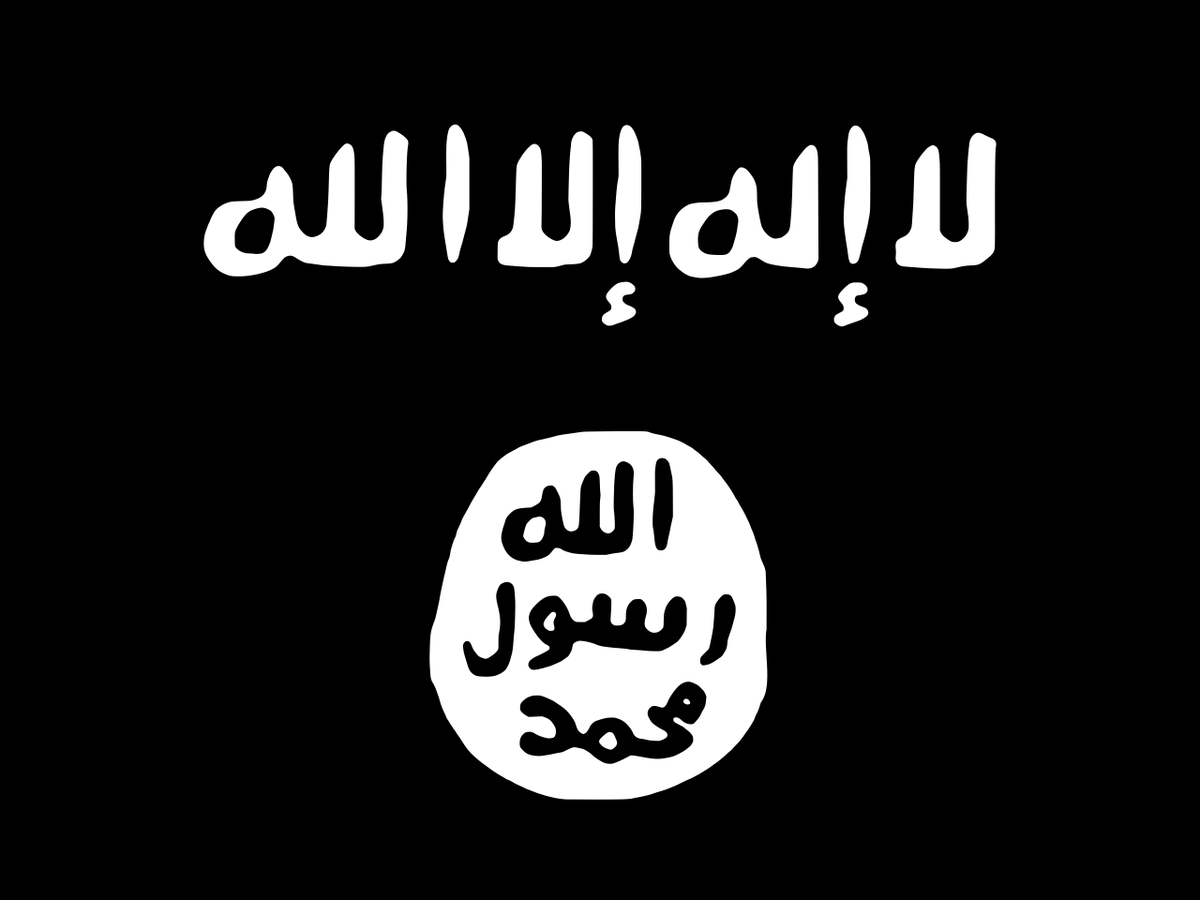
In 1854 the Journal Asiatique published an article by the French Orientalist François Alphonse Belin, telling the story of a junior compatriot, Etienne Barthelemy, who discovered an original letter of Muhammad to the head of the coptic church in Egypt in a coptic monastry.

The letter caused a sensation, the Ottoman sultan bought it, in his 1860 Geschichte des Qorans, Theodor Nöldeke declared that the letter's authenticity "could not be doubted."

A few years later a similar letter of Muhammad, this time to the ruler of Bahrain, was 'discovered' by an Italian in Damascus, which he also managed to sell to the Ottomans.

in 1863 H.L. Fleischer pointed out that this letter was written by someone very inept trying to imitate kufic Arabic script, and a clear forgery.

Nöldeke got the memo and in the second edition of his History of the Quran stated that these letters "were obviously NOT authentic" Duh!

Fast forward to 2014, ISIS is looking for a flag and chooses the image of Muhammad's seal from the alleged letter by Muhammad to the head of the copts. They were really going for authenticity!

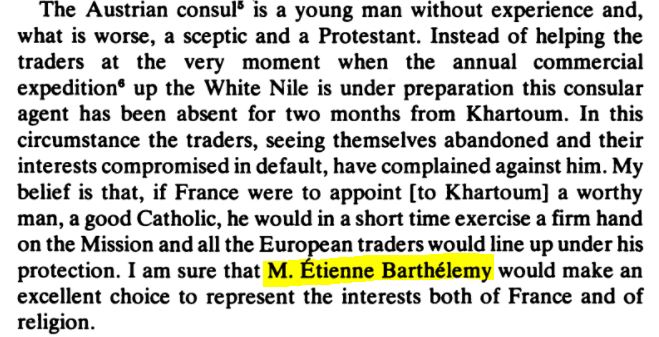
Who forged this letter? Curiously, I have found no trace of this Etienne Barthelemy other than Belin's article. Is it possible that Belin invented a person, and named him after two great French Orientalists: his own professor (Etienne Quatremere), and Barthelemy d'Herbelot?
with @Sean W. Anthony's help I have found evidence that Etienne Barthelemy really did exist. Here is a 1851 letter from an Italian bishop suggesting that Barthelemy should be hired as the French consul to Khartoum. This would explain why he made no mark in Oriental studies.
One of the puzzling things about these letters is the seal, and to be more precise, the word order: The early Muslim sources claim that Muhammad's seal contained the words Muhammad rasul Allah in three lines, but these letters have it upside down. Why?

A popular biography of Muhammad in the nineteenth century was the Insan al-'uyun by al-Halabi (d. 1635), a fanciful account with all kinds of fictionalizations of Muhammad's life.
In it, al-Halabi at one point describes the seal of Muhammad to have the words Muhammad rasul Allah, starting from the bottom to the top (so that the word Allah is on top). This indicates that the forger relied on this later source.


Missing some tweets in this thread? Or failed to load images or videos? You can try to .