
Kevin Mitchell@WiringTheBrain
Jul 17, 2022
20 tweets
I see lots of great papers coming out analysing the functions of specific brain areas (sometimes several at a time) in behavioral control, using all the amazing tools now to hand in rodents... 1/n
The focus may be the thalamic reuniens nucleus or the lateral habenula or periaqueductal gray or central amygdala or orbitofrontal cortex, and on an on... 2/n
Here's a nice example from this morning: twitter.com/bertogliolab/s
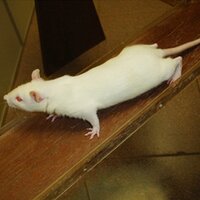

Each of these is a huge amount of work and highlights particular control signals or other information carried by or cognitive operations performed by various brain regions and circuits. 4/n
And, when other activity/context is controlled for, it is often possible to ascribe function to isolated elements... 5/n
That can give a sense of activity in various circuits *driving* behavior in fairly direct and deceptively simple ways... 6/n
The reality of course (still very simplified!) looks more like this (from George and Koob 2010)... 7/n

All of those areas are talking to each other, changing each other's constraints, shaping the attractor landscapes in each region, bottom-up, top-down, all-around, all the time... 8/n
All these regions comprise a massive set of interlocking dynamical systems all trying to satisfy their own local imperatives, but yoked to a common purpose of optimal behavioral control over nested timeframes... 9/n
It still feels like a mammoth task to assemble our growing data on what kinds of info each region is interested in into a global model of the whole system... 10/n
I guess we're still at the stage of gathering the necessary data on all the bits, but these efforts sometimes seem very disconnected... 11/n
There's so much work to do to figure out what the claustrum is doing, or the mediodorsal nucleus of the thalamus, or the anterior cingulate cortex, that it's a tall order to expect individual researchers to put it all together... 12/n
But I wonder if anyone's trying? Chris Eliasmith's SPAUN model seems like a genuine effort. Are there others out there? 13/n
I guess given we can't yet do this for C. elegans, with only 302 neurons and, like, five behaviors, it's maybe too much to ask for a mouse brain! 14/n
But maybe we can approach it that way, with simpler brains first (worms, flies, fish), ground our concepts and models and complicate as we go... 15/n
At a conceptual level, Paul Cisek's work comes closest for me to trying to build up this understanding of what brains are really doing, by following an evolutionary path... 16/n link.springer.com/article/10.375
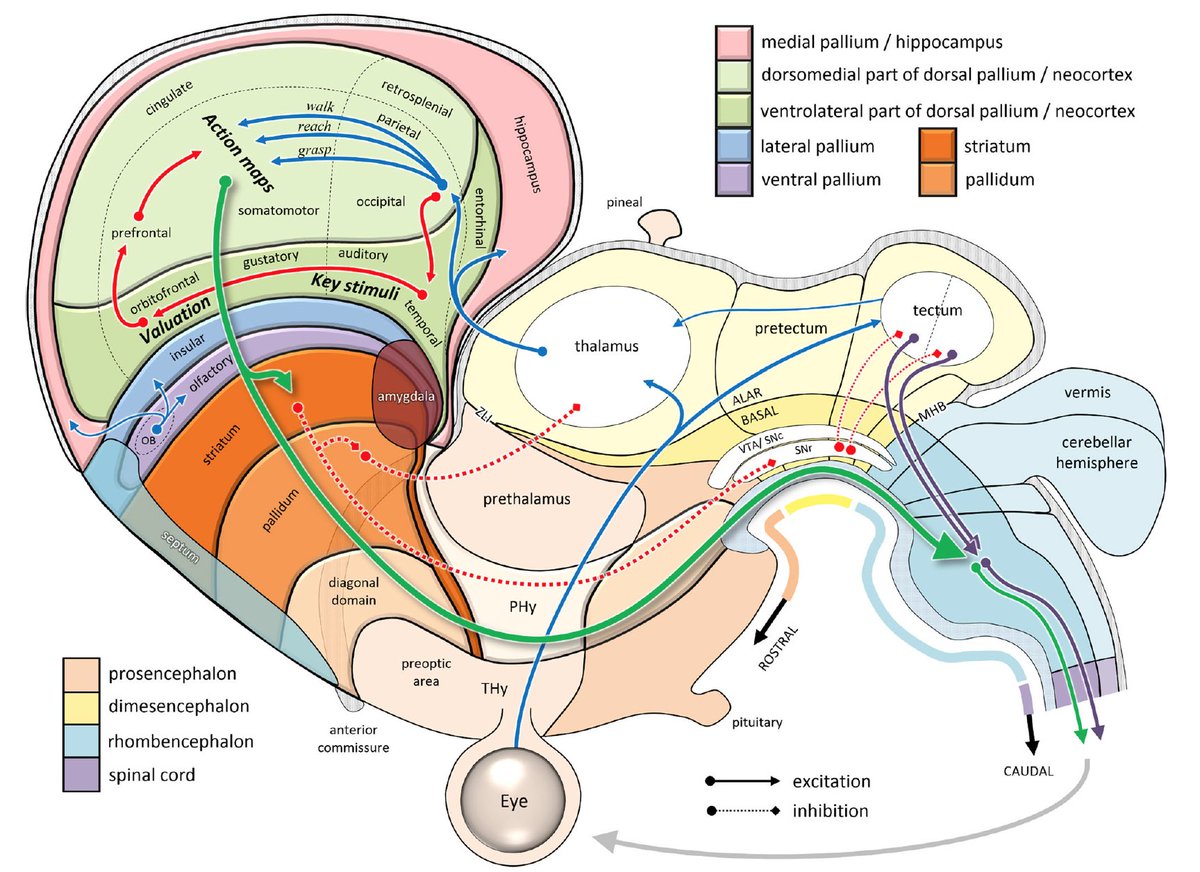

It would be nice to see those ideas, and our growing data on individual regions/circuits formalised into global models of decision-making and behavioral control... 17/n
My own view is such models will have to instantiate much more dynamical systems thinking (optimising constraint satisfaction across interlocking regions) and move beyond ideas of directional driving activity... 18/n
...to really capture how organisms behave as endogenously active, sense-making, self-directing agents. 19/19
I should have mentioned Luiz Pessoa @Luiz Pessoa 's work trying to tie stuff together in this way, and his new book: The Entangled Brain mitpress.mit.edu/books/entangle


Kevin Mitchell
@WiringTheBrain
I am a neurogeneticist interested in the genetics of brain wiring and its contribution to variation in human faculties. Author of INNATE (2018). https://t.co/GjDT4WTDIQ
Missing some tweets in this thread? Or failed to load images or videos? You can try to .