
Frederik H. Verbrugge@FH_Verbrugge
Oct 9, 2022
14 tweets
What is your take on #vasodilators in acute #HeartFailure? The upcoming November issue of #EHJACVC will bring you a PRO/CON "Vasodilator therapy in acute heart failure revisited"
As our PRO paper was published in advanced access, a sneak preview Tweetorial below...
@EHJACVC Editor-in-Chief
First some background...
Current @European Society of Cardiology guidelines state (IIb, B): "In patients with AHF and a systolic blood pressure (SBP) >110 mmHg, intravenous vasodilators may be considered as an initial therapy to improve symptoms and reduce congestion."
Only 1 flowchart has them in...

So far, I consider this a fair recommendation... In hyper/normotensive pulmonary oedema, they might be helpful in some cases, with their main benefit a reduced need for (non-)invasive ventilation!
Beautiful (older) trial by Gad Cotter on this: thelancet.com/journals/lance
Our PRO viewpoint however is more a critique of this flowchart. Personally, I am really annoyed by this updated version in the guidelines, which carries the risk of increasing the already inappropriately high use of #inotropes or even worse #vasopressors...

Great effort by @Simon Vanhentenrijk to write this piece, discussing pathophysiology & reasons for vasodilators in AHF, explaining why we need trials in the RIGHT population (low cardiac output w increased systemic vascular resistance).
Super mentorship by @venu menon @W. H. Wilson Tang, MD
First, know your drugs, not all #vasodilators are alike...
Organic nitrates: mainly preload reduction, afterload at higher dose
Hydralazine: pure afterload reduction
Nitroprusside: balanced preload/afterload reduction (my favorite in AHF)

If You remember 1 thing from our paper, let it be: "SBP = awful marker of #afterload or ventriculo-arterial coupling, making it pretty useless in decision to employ #vasodilators"
If anything vasodilators work best in patients with LOW SBP: link.springer.com/article/10.100 @Alexandre Mebazaa

Why is this? Need pressure-volume loops in here:
In preserved CO/SV (steep Ees~contractility), reducing afterload (Ea) has little impact on stroke volume (SV), which is already high. However, marked impact on BP (preload dependency!)

In low CO/SV (more flat Ees) however, despite lower SBP to start from, impact of reducing afterload (Ea) on BP is minimal, because lower vascular tonus is compensated by a massive increase in SV (afterload dependency!)

Thus, as the Great Guyton has teached us:
Blood pressure is not the same as #Perfusion
So we need to employ vasodilators in patients who are very vasoconstricted with low #CardiacOutput, typically w low SBP, low #PulsePressure & preserved MAP
90/70 mmHg means MAP=77 mmHg!!!

If you have understood this well, who gets vasodilator therapy from you?
Let's give it some time to reflect... Will come up with the answer tomorrow!
We finish this perspective w indications for which vasodilators seem as good as their alternatives (diuretics, inotropes, vasopressors mechanical support) for which the line of evidence is thin as well.
 Optimise renal perfusion to enhance decongestion
Improve perfusion to prevent end-organ damage
Enabling early optimization of disease-modifying treatments (switch from IV nitroprusside to oral sac/val!)
Reduce surgical risk by reducing lung water & optimized hemodynamics
Optimise renal perfusion to enhance decongestion
Improve perfusion to prevent end-organ damage
Enabling early optimization of disease-modifying treatments (switch from IV nitroprusside to oral sac/val!)
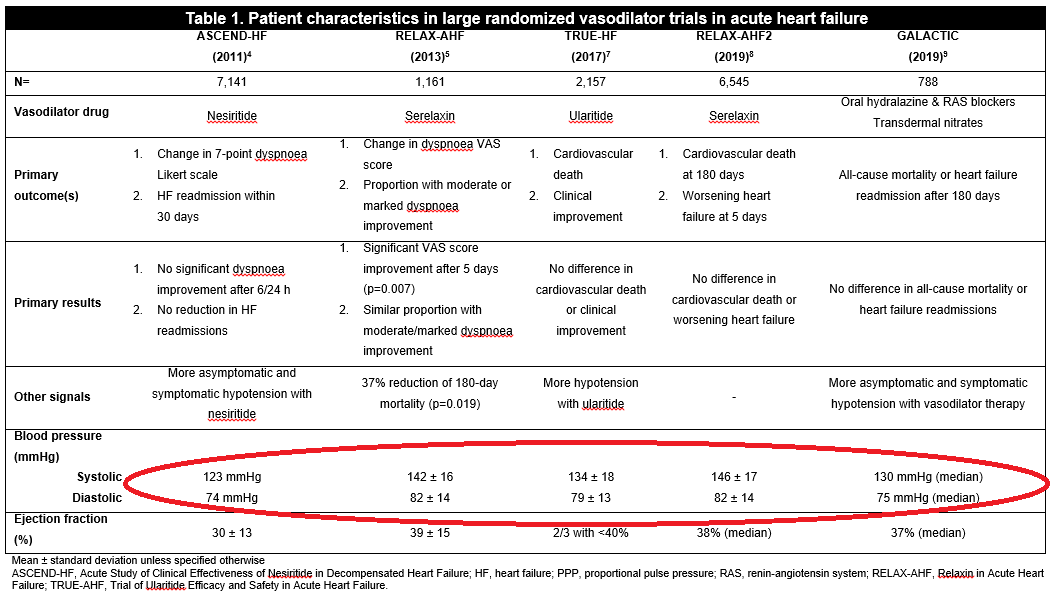
Reduce surgical risk by reducing lung water & optimized hemodynamicsThe CON party, will undoubtedly point towards failing trials with vasodilators in AHF, but look who they recruited, this is no low output #Heartfailure!

Frederik H. Verbrugge
@FH_Verbrugge
Cardiology & ICU @HeartBrussels @UZBrussel | Research @MayoClinicCV | Deputy Editor EHJ ACVC | Editorial Consultant JACC Heart Fail | #hemodynamics #cardiorenal
Missing some tweets in this thread? Or failed to load images or videos? You can try to .