
Craig S. Kaplan@cs_kaplan
Mar 21, 2023
6 tweets
How small can a set of aperiodic tiles be? The first aperiodic set had over 20000 tiles. Subsequent research lowered that number, to sets of size 92, then 6, and then 2 in the form of the famous Penrose tiles. youtu.be/48sCx-wBs34 1/6
Penrose's work dates back to 1974. Since then, others have constructed sets of size 2, but nobody could find an "einstein": a single shape that tiles the plane aperiodically. Could such a shape even exist? en.wikipedia.org/wiki/Einstein_ 2/6
Taylor and Socolar came close with their hexagonal tile. But that shape requires additional markings or modifications to tile aperiodically, which can't be encoded purely in its outline. en.wikipedia.org/wiki/Socolar%E 3/6

In a new paper, David Smith, Joseph Myers, Chaim Goodman-Strauss and I prove that a polykite that we call "the hat" is an aperiodic monotile, AKA an einstein. We finally got down to 1! arxiv.org/abs/2303.10798 4/6
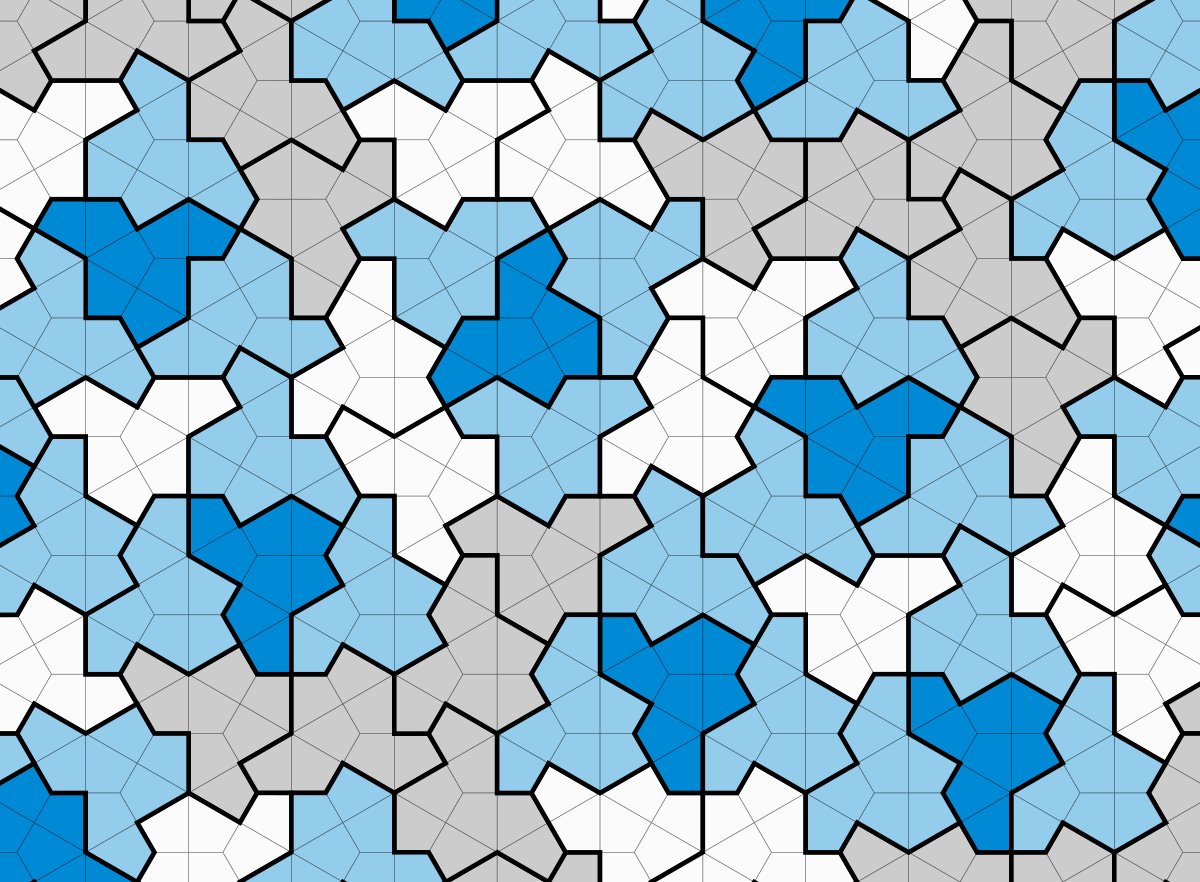
Please visit cs.uwaterloo.ca/~csk/hat/ for more information. There you'll find an interactive, browser-based application for constructing your own patches of hats. 5/6
The paper includes two proofs of aperiodicity. The first is a computer-assisted, case-based analysis of the structure of tilings by hats. The second makes use of the fact that the hat is one member of a continuum of aperiodic monotiles! youtu.be/W-ECvtIA-5A 6/6

Craig S. Kaplan
@cs_kaplan
Computer science professor at the University of Waterloo and frequent dabbler. Also @csk@mathstodon.xyz
Missing some tweets in this thread? Or failed to load images or videos? You can try to .