


 Dave Burton@ncdave4life
Dave BurtonJun 26, 2023
29 tweets
1/ Good grief, Cheryl, surely you don't believe that Karin Kirk disinformation?
The claim that "more CO2 in the atmosphere hurts crops" is a plain lie. Agronomists have tested EVERY major crop, and they ALL benefit from elevated CO2. There are no exceptions.

2/ The fact that higher CO2 levels are EXTREMELY beneficial for agriculture has been settled science for a full century. Here's a 1920 Scientific American @Scientific American article about it:
Gradenwitz (1920). doi:10.1038/scientificamerican11271920-549
sealevel.info/ScientificAmer

3/ Thousands of rigorous scientific studies disprove Karin Kirk's lies. Here's a paper about wheat:
ncbi.nlm.nih.gov/pubmed/26929390
![Wheat production will be impacted by increasing concentration of atmospheric CO2 [CO2 ], which is expected to rise from about 400 μmol mol(-1) in 2015 to 550 μmol mol(-1) by 2050. Changes to plant...](https://pbs.twimg.com/card_img/1672194912115204096/Uiyzteg3?format=jpg&name=420x420_2)
4/ Here's how eCO2 benefits corn (which, significantly, is a C4 crop):
tandfonline.com/doi/abs/10.108
5/ Elevated CO2 ("eCO2") is especially beneficial for legumes, like beans, peas, and alfalfa, which are grown for their protein content. So eCO2 helps mitigate protein shortages in poor countries. Here's a paper:
frontiersin.org/articles/10.33

6/ Improved global food security, in significant part thanks to the higher current CO2 level, is saving MANY lives.
sealevel.info/learnmore.html
7/ Rising CO2 levels are also highly beneficial for natural ecosystems. They're greening the Earth, especially in arid regions, like the Sahel.
sealevel.info/learnmore.html

8/ NASA measures the greening trend from satellites.
● sealevel.info/greening_earth
● nasa.gov/feature/goddar
9/ Here's NASA's video about it:
youtube.com/watch?v=zOwHT8
10/ CO2 levels are believed to have been well above the current 420 ppmv for >98% of Earth's history, without causing "runaway" warming, acidic oceans, or any other catastrophe.
twitter.com/ncdave4life/st
Dave Burton@ncdave4life
Dave BurtonJun 24 23
View on Twitter
4/4. During the lush Cretaceous, when complex life flourished, including aquatic life, atmospheric CO2 levels are believed to have averaged nearly four times the current level. During the equally lush Jurassic, CO2 levels were even higher.
twitter.com/ncdave4life/st
11/ The best evidence is that manmade climate change is modest and benign, and CO2 emissions are beneifical, rather than harmful. The benefits are large and well-measured, and the supposed major harms are all merely hypothetical, and mostly implausible.
sealevel.info/learnmore.html
12/ Scientists call the periods of highest temperatures "climate optimums," because they're BETTER.
That includes times substantially warmer than now, like the Eemian Optimum, which is thought to have been, on average, several degrees warmer than our current climate.

13/ We'll never get anywhere near that much warming, from the effects of burning fossil fuels. We might, plausibly, get 1°C of additional warming, but probably not in your lifetime or mine. Do you understand how miniscule that is?
14/ 1°C is the outdoor temperature change ("climate change") from an elevation change of ≈ 500 feet. (That's based on an average temp/altitude lapse rate of 6.5°C/km; 1000 / 6.5 = 154 meters.)
That's 2.8× the climate industry's claimed 0.36°C limit (that they call "1.5°").
(That's based on an average temp/altitude lapse rate of 6.5°C/km; 1000 / 6.5 = 154 meters.)
That's 2.8× the climate industry's claimed 0.36°C limit (that they call "1.5°").
(That's based on an average temp/altitude lapse rate of 6.5°C/km; 1000 / 6.5 = 154 meters.)
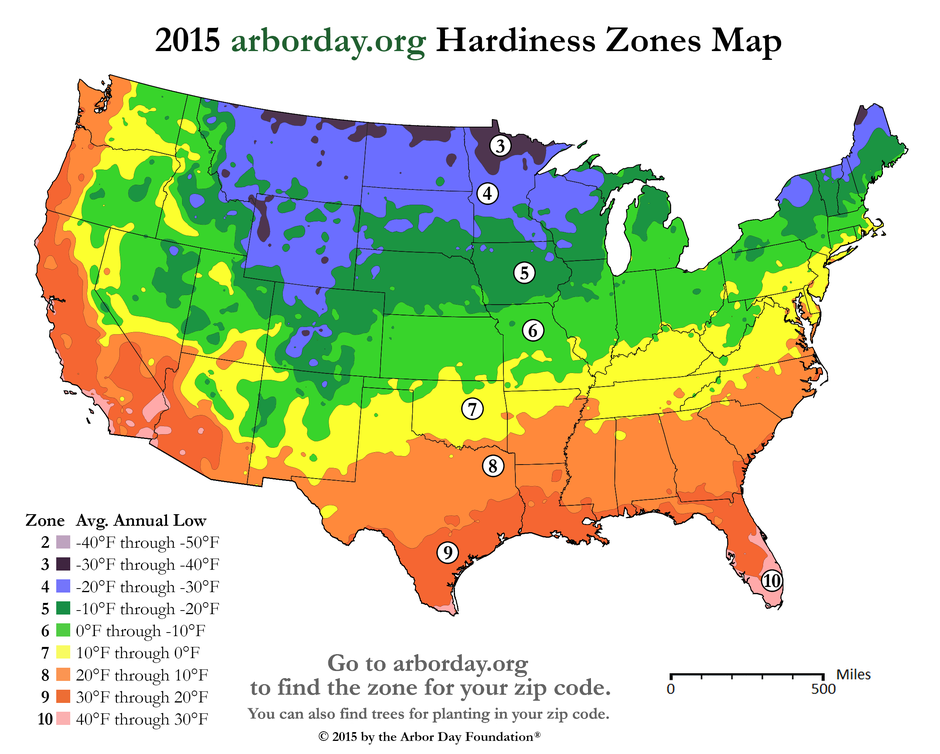
That's 2.8× the climate industry's claimed 0.36°C limit (that they call "1.5°").15/ At mid-latitudes, 1°C is about the temperature change you get from a latitude change of only 60 miles (100 km).
(How different is the climate, or the plants or wildlife, 60 miles away from where you live?)
sealevel.info/2015_zones_hig

16/ 1°C is less than the "hysteresis" (a/k/a "dead zone") in your home thermostat, which is probably 2-3°F. Your home's "constant" indoor temperatures are continually fluctuating that much, and you probably don't even notice it.

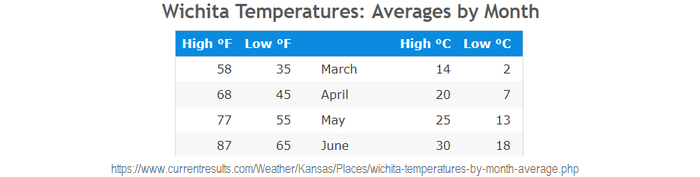
17/ In the American Midwest, farmers can fully compensate for 1°C of climate change by adjusting planting dates by about six days.
sealevel.info/wichita_spring

18/ Growing ranges for most important crops include climate zones with average temperatures that vary by tens of °C. Major crops like corn, wheat, potatoes and soybeans are produced from Mexico to Canada. Compared to that, 1°C is negligible.

19/ What's more, a fortuitous thing about global warming is that it isn't very global. It disproportionately warms frigid winter nights at high latitudes ("Arctic amplification"). The tropics warm less, which is nice, because they're warm enough already.
sealevel.info/learnmore.html

20/ There's no downside to rising CO2 levels. CO2 levels are believed to have been well above the current 420 ppmv for >98% of Earth's history, without causing "runaway" warming, acidic oceans, or any other catastrophe.
twitter.com/ncdave4life/st
Dave Burton@ncdave4life
Dave BurtonJun 24 23
View on Twitter
4/4. During the lush Cretaceous, when complex life flourished, including aquatic life, atmospheric CO2 levels are believed to have averaged nearly four times the current level. During the equally lush Jurassic, CO2 levels were even higher.
twitter.com/ncdave4life/st
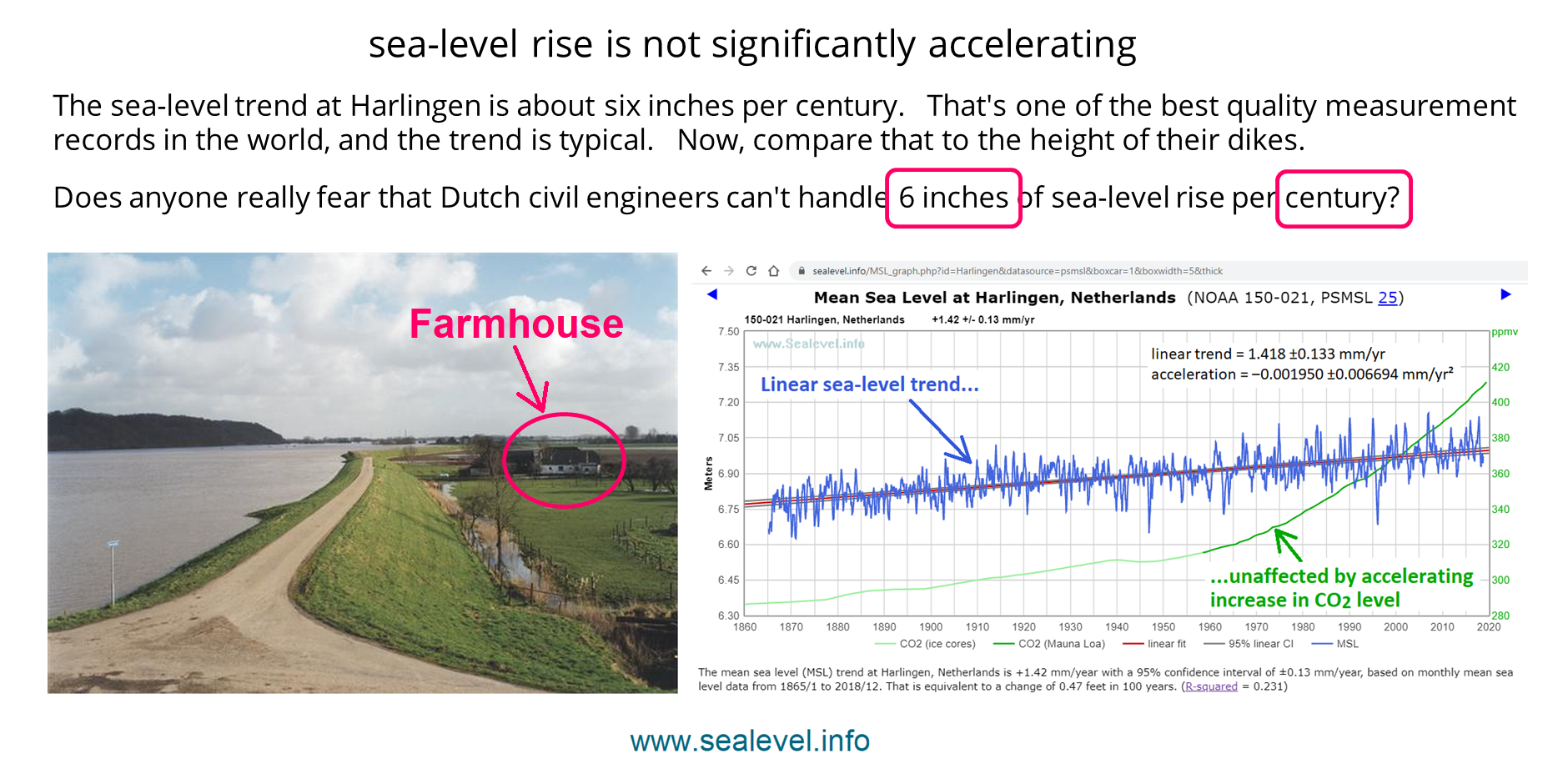
21/ The major benefits of rising CO2 levels are well-measured and extremely important.
The major harms are all merely hypothetical, and mostly implausible. They're just climate industry marketing FUD.
sealevel.info/MSL_graph.php?
sealevel.info/Dutch_dike_vs_

22/ None of the supposed major harms predicted to result from manmade climate change are actually happening.
sealevel.info/learnmore.html

23/ MOST importantly: Rising CO2 levels are helping to make famines rare for the first time in human history!
Famine is the Third Horseman of the Apocalypse. Throughout all of human history, famine (usually due to drought) was a Damoclean sword hanging over mankind — until now!

24/ When I was a child, horrific famines were often in the news, in places like Bangladesh. But Bangladesh and India now have food surpluses, every year.
Rising CO2 level is one of the major reasons.
sealevel.info/learnmore.html

25/ Here's what CO2 & manmade climate change are doing in Africa. This is what climate activists are campaigning against:
“’Before, there was not a single scorpion, not a single blade of grass… Now you have people grazing their camel…"
sealevel.info/Owen2009_Sahar

26/ Here's another article about it:
sealevel.info/Pearce2002_Afr

27/ Ending famine is a VERY Big Deal, comparable to ending war and disease. Compare:
● Covid-19 killed 0.1% of world population.
● 1918 flu pandemic killed about 2%.
● WWII killed 2.7%.
● The near-global drought & famine of 1876-78 killed about 3.7% of the world population.
28/28 So the question is, Cheryl, do you care?
Do you care that you're campaigning for a harsher, browner world? Do you care that you are campaigning for a poverty and famine? Do you care how many people your decarbonization policies would kill?
sealevel.info/FOIA/README.tx.
###


Cheryl Bozarth BSc @CherylBozarth@mastodon.online@CherylBozarth
@CherylBozarth@mastodon.onlineJun 26 23
View on Twitter
You just unrolled your own comments as a thread
 I’ll stick to climate scientist’s take
As for ag; it evolved under relatively stable climate conditions. Extreme events reek havoc.
Too much CO2 isn’t good in the real world. Ie yaleclimateconnections.org/2020/12/more-c
ncbi.nlm.nih.gov/pmc/articles/P
I’ll stick to climate scientist’s take
As for ag; it evolved under relatively stable climate conditions. Extreme events reek havoc.
Too much CO2 isn’t good in the real world. Ie yaleclimateconnections.org/2020/12/more-c
ncbi.nlm.nih.gov/pmc/articles/P
I’ll stick to climate scientist’s take
As for ag; it evolved under relatively stable climate conditions. Extreme events reek havoc.
Too much CO2 isn’t good in the real world. Ie yaleclimateconnections.org/2020/12/more-c
ncbi.nlm.nih.gov/pmc/articles/P

Dave Burton
Dave Burton@ncdave4life
My preferred pronoun is "harmless data drudge." https://t.co/YTkK6vaHGs Tel: +1 919-481-0098.
Missing some tweets in this thread? Or failed to load images or videos? You can try to .