


 Dave Burton@ncdave4life
Dave BurtonJul 3, 2023
15 tweets
1/15⟧ IPCC used to claim 4.4 W/m² / doubling (FAR p.52 & SAR p.320). They've lowered that to 3.7 ±0.4 W/m² / doubling ("3.7" is from Myhre 1998, but nobody believes his claimed 1% CI, so the IPCC uses 10%).
That's still too high, 3.0 is more realistic.
x.com/ncdave4life/st
Dave Burton@ncdave4life
Dave BurtonJun 30 23
View on Twitter
1⦆ Ben, IPCC's figure of 3.7±0.4 W/m² / CO2 doubling is from Myhre 1998, tho with a larger (less unrealistic) uncertainty. (In AR5 it's §8.3.2.1.)
But both measurements & better calculations suggest that's too high. 3.0 W/m² / doubling is more realistic:
sealevel.info/Radiative_Forc

2⟧ The Stefan-Boltzman relation gives
ΔE = ε⋅σ⋅(T₂⁴-T₁⁴)
σ = 5.670374419e-8 W/m²K⁴
emissivity ε ≈ 0.96
ΔE ≈ 3.0 W/m²
Initial temperature T₁ is a bit tricky. Earth's average surface temperature is about 288K (roughly 15°C), but its average emission temp is about 255K.
3⟧ That's because much of the emissions come from high in the atmosphere, where the air is colder.
So if T₁ = 255K
Solve for T₂:
T₂⁴ = (ΔE/(ε⋅σ)) + T₁⁴
T₂ = ∜(ΔE/(ε⋅σ) + T₁⁴)
T₂ = ((3/(0.96×5.670374419e-8)) + 255⁴)⁰·²⁵
= 255.8269K
google.com/search?q=%28%2
4⟧
T₂ - T₁ = 255K - 255.8269K = 0.8269°C
That's a lot less than 3°C.
(If you use the surface temperature of 288K, instead, you'll calculate T₂ - T₁ = only 0.5750°C.)
5⟧ Feedbacks increase it, but to nowhere near 3°C. The only important positive feedback is water vapor feedback, which MODTRAN estimates contributes a +60% amplification.
160% × 0.8269°C =
google.com/search?q=160%2
1.3230°C per doubling of CO2.
x.com/ncdave4life/st
Dave Burton@ncdave4life
Dave BurtonJun 27 23
View on Twitter
MODTRAN ignores many complexities, but it can be used to calculate a first order approximation of radiative effects. I used U. Chicago's MODTRAN interface and found an estimate of +38% for water vapor feedback, which yields a +60% amplification of forcing.
x.com/ncdave4life/st
6⟧ AR5 considered Water Vapor and Lapse Rate feedbacks together (§7.2.5, p.587). It gave an estimated range of +0.96 to +1.22 W/m² per 1°C for the net effect of the two feedbacks.
sealevel.info/feedbacks.html

7⟧ If 3 W/m² yields +0.8269°C before feedbacks, feedbacks add another 0.8269 × (0.96 to 1.22) = 0.7938 to 1.0088 W/m², before compounding. That's +26.46% to +33.63% positive feedback. With compounding that would amplify warming by 1/(1-ƒ) ⇒ 35.98% to 50.66% (vs MODTRAN's 60%).
8⟧
135.98% × 0.8269°C =
google.com/search?q=135.9
1.1246°C per doubling of CO2.
150.66% × 0.8269°C =
google.com/search?q=150.6
1.2458°C per doubling of CO2.
9⟧ So we've calculated equilibrium warming figures ranging from 1.125°C to 1.323°C per doubling of CO2.
That's obviously far short of the IPCC's 3°C figure. But it's only slightly less than what you'd expect from the observed warming trend.
10⟧ AR6 estimates 79.59% of warming since 1750 was from CO2.
NCA4 estimates we've had 1.02 to 1.27 °C average warming since the late Little Ice Age (which they call "pre-industrial"). Their best estimate is 1.14°C (and temps haven't risen since then).
sealevel.info/IPCC_AR6_WGI_F
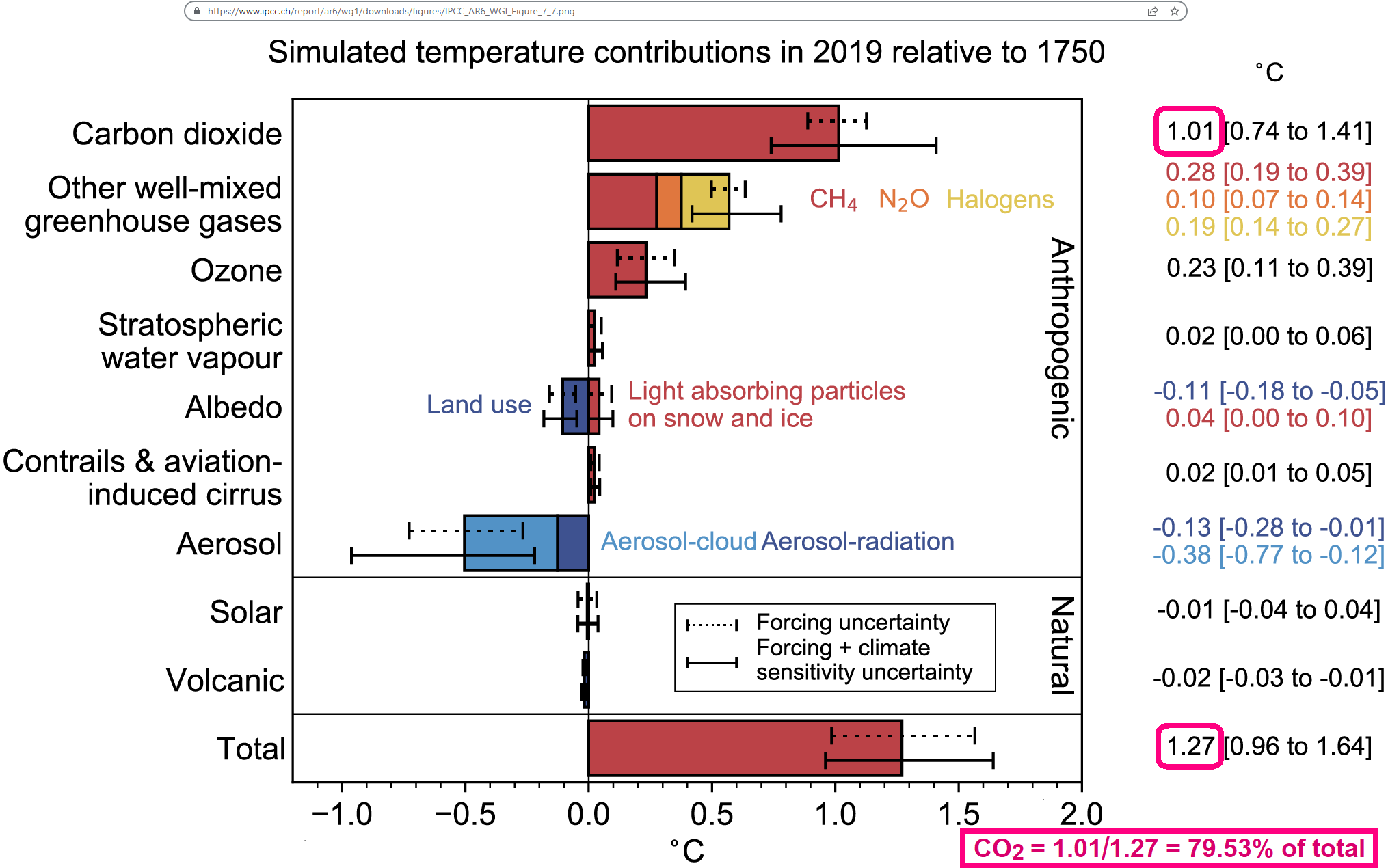

11⟧ If we accept those figures, then:
79.59% of 1.14°C = 0.91°C
That's "observed warming" from 58.5% of the forcing we'd get from a doubling of CO2. So we should expect 0.91/0.585 = 1.55°C "practical climate sensitivity" for full doubling of CO2.
google.com/search?q=(0.79
12⟧ That's somewhere between TCR and ECS.
(ECS is obviously > observed warming rate. CO2 levels have been rising at only about 0.6% per year, and TCR assumes a much faster 1%/year growth rate TCR is necessarily < than observed warming rate.)
13⟧ If we assume observed warming is halfway between TCR & ECS rates, and ECS ≅ 1.5×TCR, then TCR = 80% of observed warming rate, and ECS = 120% of observed warming rate. So:
ECS = 120% of 1.55 = 1.86°C per doubling.
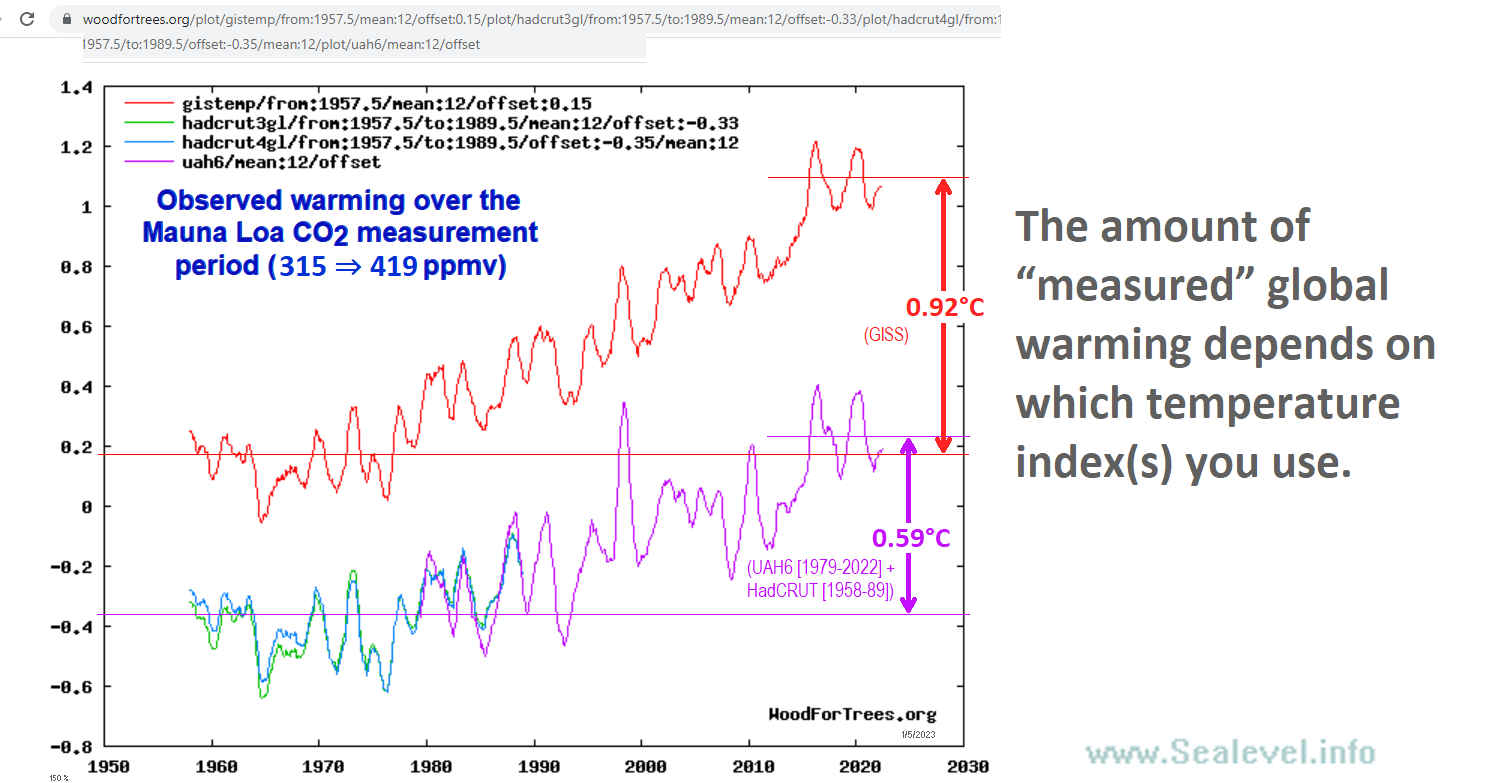
14⟧ That's calculated using an ECS/TCR ratio which might be too high, and an "observed" warming estimate which also might be too high. If either of them are too high, that makes this calculated ECS value too high, as well.
journals.ametsoc.org/view/journals/
sealevel.info/GISS_vs_UAH_an


Ian Bell@ClimateRetorts
Jul 02 23
View on Twitter
No. One degree.
Your citations aren't about radiative forcing. Climate sensitivity includes fairy tale feedbacks.
15/15⟧ The bottom line is that multiple lines of evidence strongly suggest that the IPCC's ECS climate sensitivity estimate of 3.0°C (per doubling of CO2) is way too high.
###
@Thread Reader App @Rattibha رتبها @Thread Blue unroll

Dave Burton
Dave Burton@ncdave4life
My preferred pronoun is "harmless data drudge." https://t.co/YTkK6vaHGs Tel: +1 919-481-0098.
Missing some tweets in this thread? Or failed to load images or videos? You can try to .