


 Dave Burton@ncdave4life
Dave BurtonOct 23, 2023
10 tweets
1/10. That Grauniad article is disinformation. I'll see you their "11,000 scientists" and raise you over 30,000 scientists who know better.
quora.com/Did-30-000-sci
The best scientific evidence shows that manmade climate change is modest & benign, and CO2 emissions are beneficial, not harmful. Over 30,000 American scientists signed a petition attesting to those facts. I'm one of them.

2/10. Climate change does not threaten coral reefs. In fact, most coral thrive best in the warmest water. Even the very warm southern Red Sea is dotted with healthy coral reefs (unlike the cooler Mediterranean).
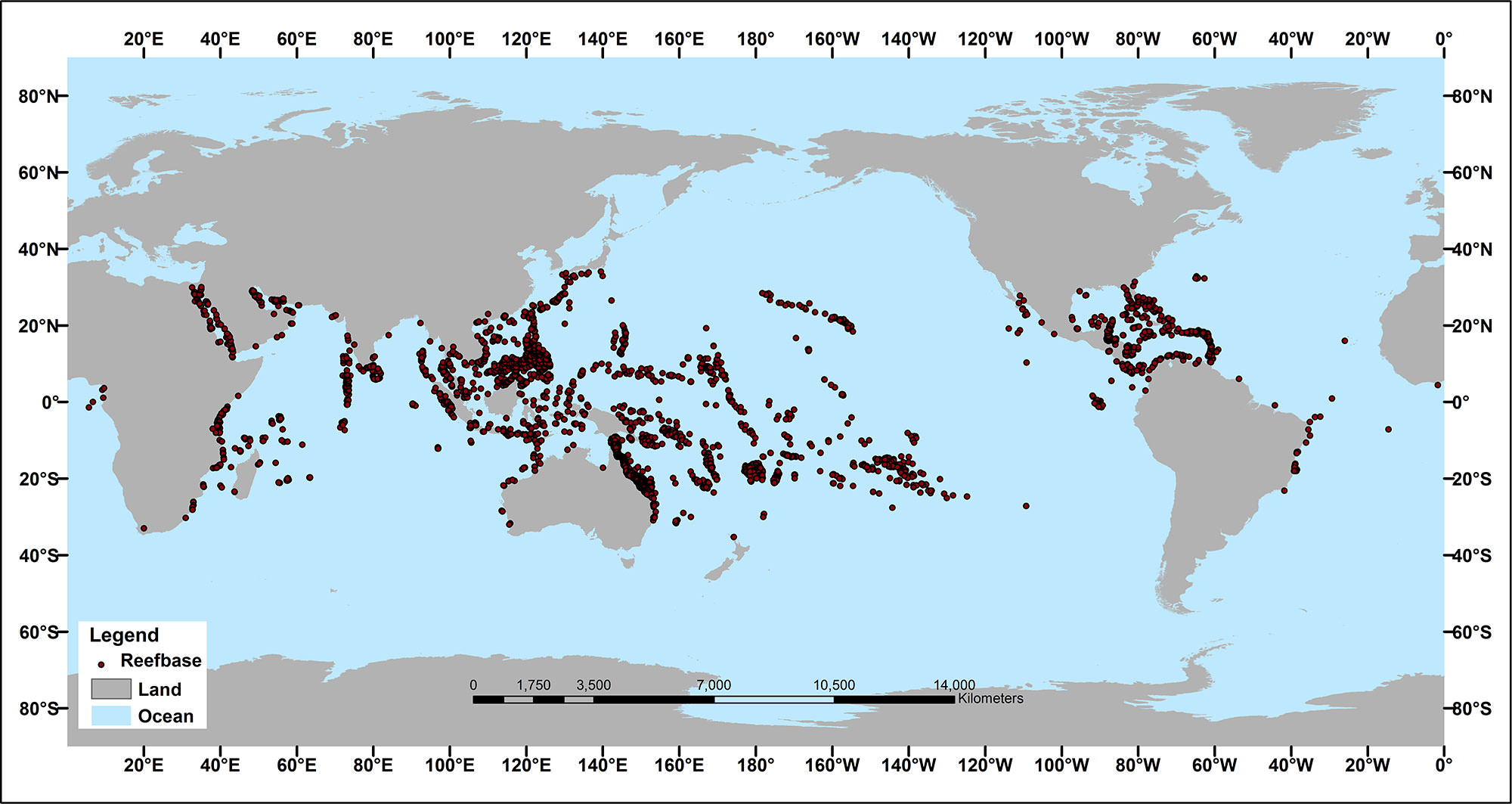
If you look at a map of coral reef locations, you'll see that they're clustered around the equator.
sealevel.info/coralreefmap.j

3/10. Some coral inhabit temperate zones, but most prefer tropics. In fact, where there are seasons, corals grow fastest in summer.
youtu.be/vSOLDf1a9dA
At 7:20 in this BBC video you can hear how wonderfully healthy the coral are in warmest part of the very warm southern Red Sea, off Eritrea.
4/10. The world's largest coral reef is Australia's Great Barrier Reef. Contrary to what you might have heard, it is doing fine.
It's about 20 million years old, and it has withstood CO2 levels both much higher and much lower, and temperatures both substantially warmer and much colder, and water levels both higher and much lower, than present. We needn't worry that a degree or two of anthropogenic warming will destroy it.
5/10. Coral reefs are highly resilient ecosystems, with almost 800 identified species of reef-building coral, and highly mobile polyps. Claims that coral reefs are changed by slight differences in water temperature are based on "lab tests," which artificially eliminate that mobility, and hence that resiliency. In other words, they're "junk science."
6/10. If you want to learn more about the GBR, the go-to experts are Australian Drs. Jennifer Marohasy, Peter Ridd, and Walter Starck.
Dr. Marohasy's FB page is here:
facebook.com/JenniferMaroha
Here's her web site:
jennifermarohasy.com

7/10. Dr. Ridd is a Member of the CO2 Coalition:
co2coalition.org/teammember/pet

8/10. Here's a great lecture by Dr. Ridd:
youtube.com/watch?v=9XMB_K
9/10. The fear of a "methane tipping point" is based on ignorance, not science. You can learn about methane climate feedbacks here:
sealevel.info/feedbacks.html
tl;dr: They are strongly negative (stabilizing).

Jeppe Have Rasmussen@Jeppespip
Oct 22 23
View on Twitter
How self centered are you?
Do you not realize global warming is not just about how warm we feel?
It is very much about eco systems dying (e.g. corral reefs), tipping points (e.g. methane emissions increasing dramatically as the permafrost thaws) and more
theguardian.com/environment/20

10/10. In fact, all fears of "climate tipping points" or "runaway" warming are based on ignorance.
The field which studies these matters is called "systems science." (My undergrad degree is in it.) There are two general types of feedbacks: negative and positive:
sealevel.info/feedbacks.html
Negative feedbacks attenuate (reduce) the effect of input changes (often called "forcings" in the climate biz).
Positive feedbacks amplify the effect of input changes.
Some people imagine that if positive feedbacks exceed negative feedbacks a system becomes unstable. That's wrong. Positive feedbacks less than +100% merely amplify, they do not cause instability.
Most systems are approximately linear over small input ranges, and a feedback f causes an amplification or attenuation equal to 1/(1-f). (E.g., a feedback of +20% causes an amplification of 1/(1-0.2) = 1.25×, which is +25%.) Linear systems have no “tipping points.”
That's certainly true of the Earth's climate, in the context of anthropogenic carbon emissions and consequent climate change. CO2 levels are believed to have been well above the current 420 ppmv for >98% of Earth's history, without triggering “tipping points,” or causing runaway warming, acidic oceans, or any other catastrophe.
During the lush Cretaceous, when complex life flourished, including aquatic life, atmospheric CO2 levels are believed to have averaged nearly four times the current level. During the equally lush Jurassic, CO2 levels were even higher. Yet, even with those much higher atmospheric CO2 levels, the oceans were still alkaline, rather than acidic, and there's no evidence that the high atmospheric CO2 levels were harmful to any living thing.
As CO2 levels rise...
● The warming effect of additional CO2 diminishes logarithmically.
● But the main negative (stabilizing) feedbacks accelerate:
Radiative emissions (which cool the Earth) are proportional to the 4th power of temperature, per the Stefan-Boltzman relation: E = ε⋅σ⋅T⁴
Also, the negative feedbacks which remove CO2 and CH4 from the air (terrestrial greening, dissolution into the oceans, rock weathering, CH4 oxidation, etc.) dramatically accelerate as the levels of CO2 and CH4 in the atmosphere rise. A rule of thumb is that for each 20 to 25 ppmv increase in atmospheric CO2 concentration the net rate at which those natural sinks remove CO2 from the atmosphere increases by another 1 PgC per year (1 PgC = 0.4696 ppmv).
Those facts mean as the Earth's climate warms, it becomes more stable, rather than less, which is incompatible with hypothetical "tipping points" or "runaway" warming.


Dave Burton
Dave Burton@ncdave4life
My preferred pronoun is "harmless data drudge." https://t.co/YTkK6vaHGs Tel: +1 919-481-0098.
Missing some tweets in this thread? Or failed to load images or videos? You can try to .