


 Dave Burton@ncdave4life
Dave BurtonFeb 14, 2024
4 tweets
1/4. We've discussed this before, Mark. Don't you remember this thread?
twitter.com/ncdave4life/st
E.g., do you REALLY believe that global average temperatures 3000 years ago are known with a 1σ uncertainty of just 0.2°C, and 2σ (95%) of just 0.4°C? You've GOT to know that's absurd!
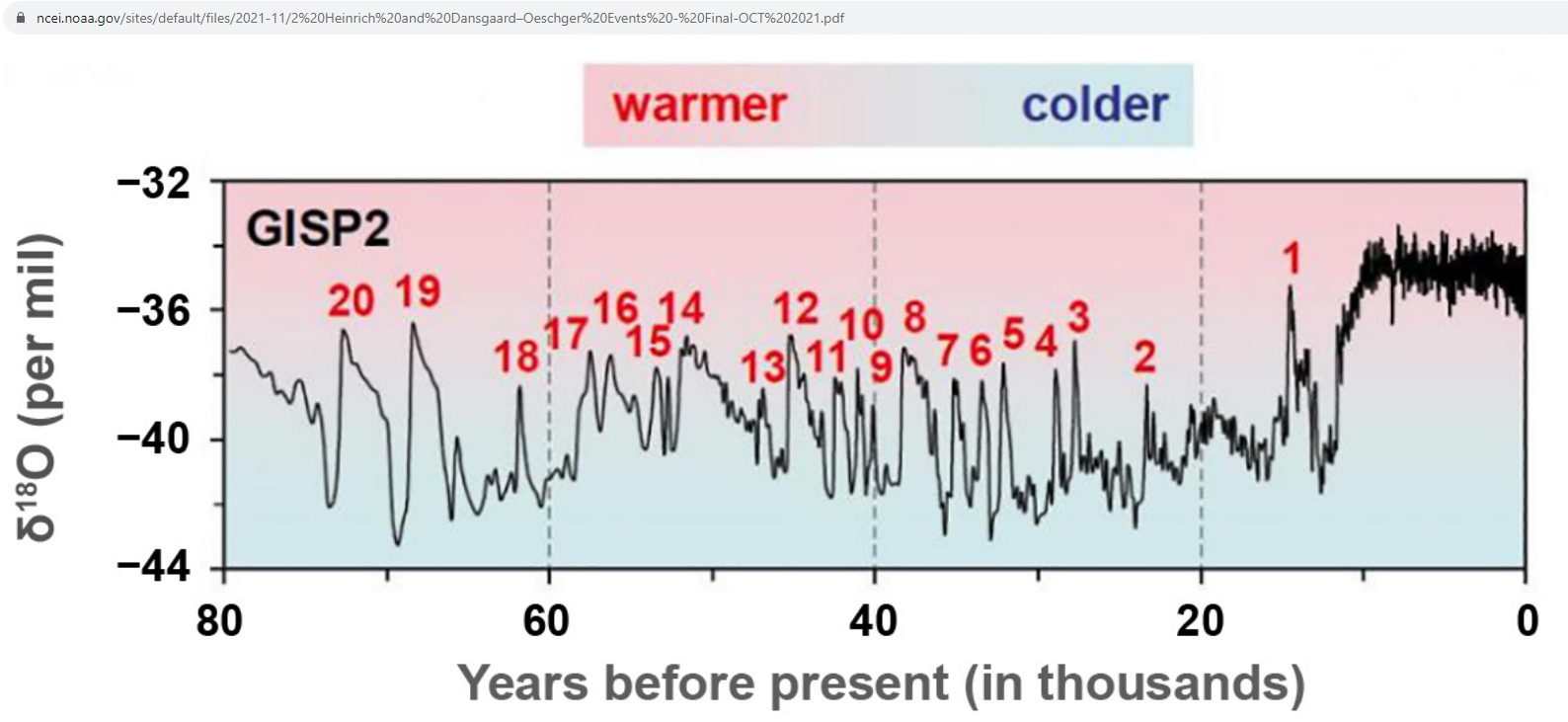
The Hockey Team even completely erased Dansgaard-Oeschger event #1, which was the HUGE warming event, recorded in ice cores, that you can see in this NOAA plot:
sealevel.info/Dansgaard-Oesc

Dave Burton@ncdave4life
Dave BurtonSep 03 23
View on Twitter
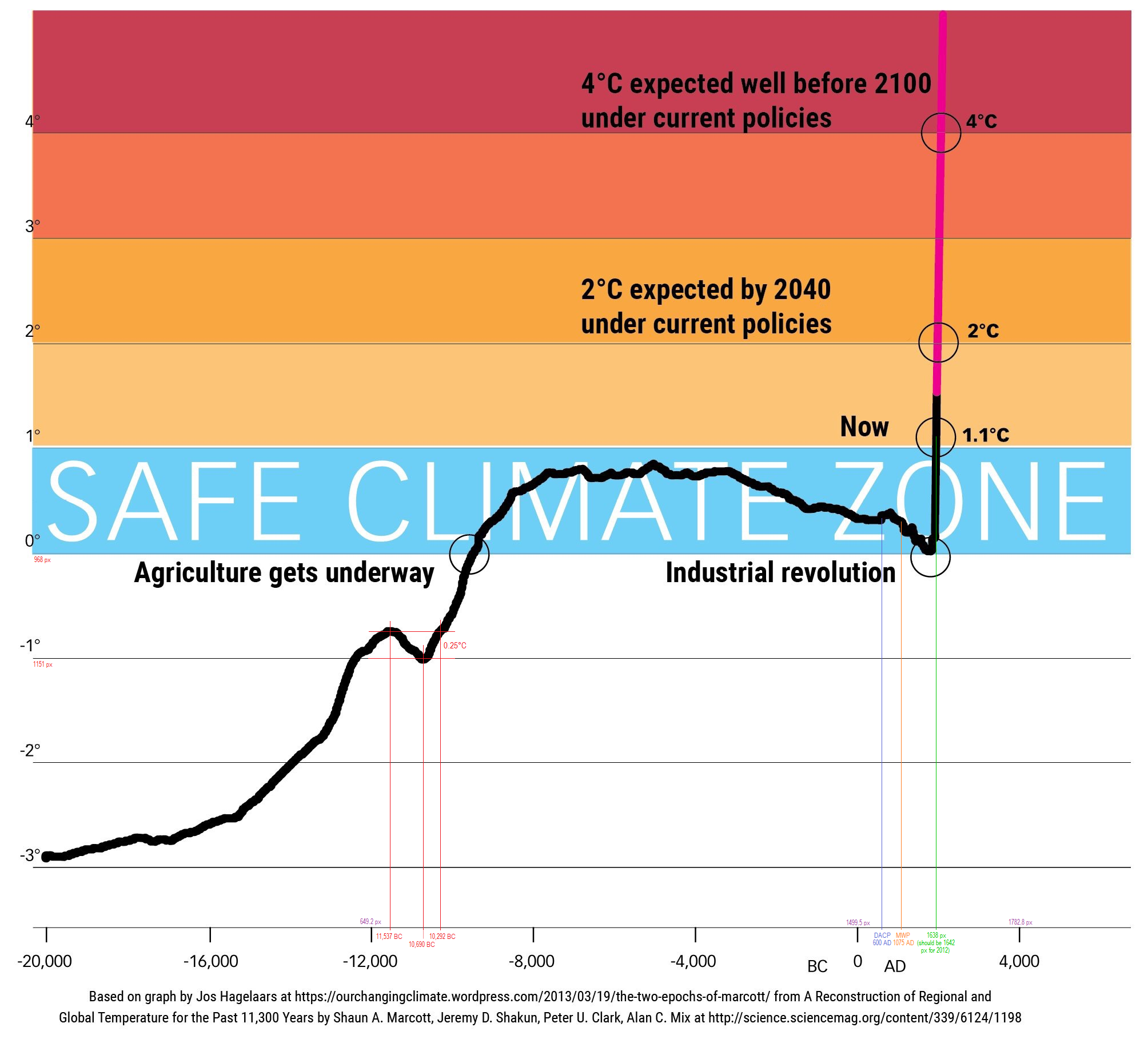
1/7. It tells a tall tale, Mark.
twitter.com/ncdave4life/st
Here's a higher resolution version of that "tall tale," which I annotated (in very tiny print), to identify the DACP, MWP & Younger Dryas.
sealevel.info/safe_climate_z

2/4. It is certainly sad that so much politicized drek gets churned out in the name of "paleoclimatology."
twitter.com/ncdave4life/st
Dave Burton@ncdave4life
Dave BurtonDec 28 23
View on Twitter
The revisionist "hockey stick" narrative represents the substitution of political & pecuniary interests for historical evidence. History records the cycles that you deny:
IACP 🡕 RWP 🡖 DACP 🡕 MWP 🡖 LIA 🡕 Modern Optimum
Come on, do you REALLY believe that, contrary to all historical evidence, the Dark Ages Cold Period (circa 400 to 800 A.D.) was as warm as the Medieval Warm Period (850-1300 AD) and the Roman Warm Period (250 BC - 350 AD)?
Here are some papers about the DACP, which you apparently don't believe in:
scholar.google.com/scholar?hl=en&
Here are some resources to learn about the near-global MWP, which you apparently don't believe in, either:
co2science.org/data/mwp/mwpp.
3/4. There's a huge body of evidence in support of the climate variations which the "hockey teams" (Jones/Mann/Osborn/Bradley/Hughes/Briffa, Pages 2K, etc.) want to erase from history, with their revisionist straightened hockey stick handles.
twitter.com/ncdave4life/st
Dave Burton@ncdave4life
Dave BurtonDec 27 23
View on Twitter
Despite the creativity of the Pages2K crowd, the reality is that there are no proxies at all which can determine past northern Arctic air temperatures.
There is some very limited evidence regarding water temperatures, but, in the Arctic, air and water temperatures frequently move in opposite directions, because ice coverage causes warmer water but colder air.
People tend to find what they're looking for, and the Pages2K mission biases their results. The purpose of Pages2K is to straighten the hockey stick handle by erasing the MWP, DACP, RWP, etc. from history. The Pages 2K Network was created in 2008, to compile evidence for the merely “regional nature of the Medieval Warm Period and the Little Ice Age.” That dubious contention is quoted from the caption on Fig. 1 of their poster, though they more frequently use the revisionist term, “Medieval Climate Anomaly” or MCA:
pastglobalchanges.org/download/docs/
Canadian scientist Steve McIntyre has written an excellent multi-part critique of the Pages2K project here:
climateaudit.org/?s=PAGES2K
He's also compiled a large collection of “hockey stick study” resources here:
climateaudit.org/multiproxy-pdf
The Hockey Team wants you to think that the MWP was merely regional, and confined to the northern North Atlantic, especially Europe and Greenland. The problem is that there's a wealth of evidence for a MWP elsewhere.
For instance, here are Law Dome (Antarctic) ice core data, back to year 1010:
www1.ncdc.noaa.gov/pub/data/paleo
Scroll down past “CO2, 75 Year Smoothed.” Those measurements show smoothed CO2 levels peaked at ≈284.1 ppmv circa 1170 (MWP), and fell to their lowest level of ≈275.3 ppmv circa 1615 (LIA).
That's a problem for the Pages2K claim that the MWP was confined to the North Atlantic region, because they cannot explain it showing up in CO2 records all the way down in Antarctica.
An 8.8 ppmv swing is 1/10 of the entire 90 ppmv CO2 level variation that we see across glaciation cycles, and it occurred over a much shorter period of time, and without the benefit of ice sheet burial of organic material. So it suggests a global temperature decline from MWP peak to LIA bottom of around 1°C — which, coincidentally, is similar to the supposedly all-anthropogenic warming since the late Little Ice Age.

Mark Lunn@Mark_A_Lunn
Feb 14 24
View on Twitter
Well I guess you’ll have to wrestle with more than 60 paleoclimate reconstructions (and counting) that resulted in hockey stick temperatures
Many have tried, all have failed
G’luck
4/4. The debunking of that junk science has not "failed." It has simply been ignored by climate activists.
For instance, recall Marcott 2013, and its many obvious problems.
rogerpielkejr.blogspot.com/2013/03/fixing
Marcott completely erased the well-documented Dark Ages Cold Period & Iron Age Cold Period from history. It also showed a slight temperature DIP around the time of Christ -- which was actually during the Roman WARM Period (a/k/a Roman Climate Optimum, or RCO). According to Marcott's "reconstruction," and contrary to overwhelming historical evidence, the RCO was the COLDEST period that the Earth had seen in over 8000 years!
climateaudit.org/2013/03/16/the
They'd also have you believe that globally averaged temperatures varied by only about ≈0.7° over a span of 10,000 years, which is obviously preposterous.
The problems with that paper were so severe and so obvious that it raised eyebrows even at the Washington Post:
washingtonpost.com/news/capital-w
Yet even though Marcott et al 2013 has been thoroughly debunked, it hasn't been retracted, and climate activists continue to cite it as if it were credible. That's because it supports the climate industry's political narrative.


Dave Burton
Dave Burton@ncdave4life
My preferred pronoun is "harmless data drudge." https://t.co/YTkK6vaHGs Tel: +1 919-481-0098.
Missing some tweets in this thread? Or failed to load images or videos? You can try to .