


 Dave Burton@ncdave4life
Dave BurtonFeb 28, 2024
4 tweets
1/4. The claim that manmade climate change threatens bees is a brazen lie, one of many from the climate industry's FUD marketing campaign.
Don't give your money to bee scare scammers!
nypost.com/2021/09/18/why
nypost.com/2021/09/18/why

2/4. Wild bees have withstood glaciations & deglaciations, in times when the Earth was much colder, and warmer, than our climate today. They are not threatened at all by manmade climate change.
sealevel.info/negative_socia
sealevel.info/negative_socia

3/4. To understand a politicized issue like climate change, you need balanced information. If you think CO2 emissions are harmful, that means you aren't getting it. But I'm here to help.
nypost.com/2021/09/18/why
twitter.com/ncdave4life/st

Dave Burton@ncdave4life
Dave BurtonAug 31 21
View on Twitter
To learn about #ClimateChange see:
sealevel.info/learnmore.html
It has:
● accurate intro climatology info
● in-depth science from BOTH skeptics & alarmists
● links to balanced debates between experts on BOTH sides
● info about climate impacts
● links to best blogs on BOTH sides


Cat, Reigning Typo Queen NO DMs@typocatCA
NO DMsFeb 28 24
View on Twitter
Steve Savage's scientific "data" has not only been proven wrong, but "spectacularly wrong" according to two scientists who checked it. His "data" about bees is being examined. He's retracted articles. Why's he writing for pro-business media and not science journals? Hmm?
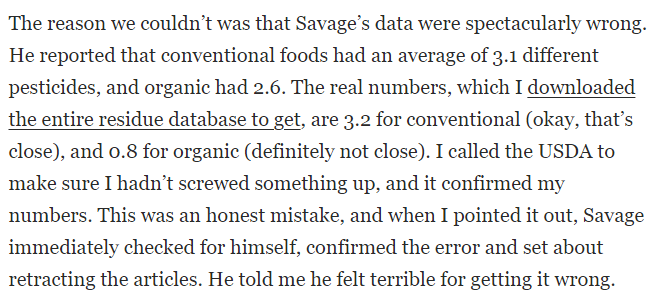
4/4. So don't give your money to the bee scammers!
twitter.com/ncdave4life/st
Dave Burton@ncdave4life
Dave BurtonFeb 28 24
View on Twitter
That's untrue.
It's estimated that there are roughly 20,000 species of wild bees. As far as is known, manmade climate change has not caused any species of bee (or any species of anything else) to go extinct.
sealevel.info/learnmore.html
The claim that "humans have destroyed 80%" of bees is a lie.
Roughly 2000 species of bees are native to Mexico. Only about 800 species of bees are native to Canada.
(What does that tell you about the supposed "threat" of 1-2° of warming?)
Domestic honeybees are not native to North America, but they are not in decline, either.
twitter.com/ncdave4life/st
The WMO estimates that since the “pre-industrial” mid-to-late-1800s (late Little Ice Age) the Earth has warmed an average of 1.15±0.13 °C. So, what is the significance of that?
1°C is the temperature change you get from an elevation change of about 500 feet.
At mid-latitudes, 1°C is about the temperature change you get from a latitude change of about 60 miles.
1°C is less than the hysteresis (a/k/a “dead zone” or “dead band”) in your home thermostat, which is probably 2-3°F. Your home's “constant” indoor temperatures are continually fluctuating that much, and you probably don't even notice it.
In the American Midwest, farmers can fully compensate for 1°C of climate change by adjusting planting dates by about six days.
Growing ranges for most important crops include climate zones with average temperatures that vary by tens of °C. Major crops like corn, wheat, potatoes and soybeans are produced from Mexico to Canada.
Compared to that, 1°C is negligible.
sealevel.info/learnmore.html

Dave Burton
Dave Burton@ncdave4life
My preferred pronoun is "harmless data drudge." https://t.co/YTkK6vaHGs Tel: +1 919-481-0098.
Missing some tweets in this thread? Or failed to load images or videos? You can try to .