David George@hypatiusbrontes
Apr 20, 2024
41 tweets
Muhammad as the Paraclete: Does 'Abraham Fulfilled' (2024)’s arguments work?
[Warning: Long Thread  ]
]
] 
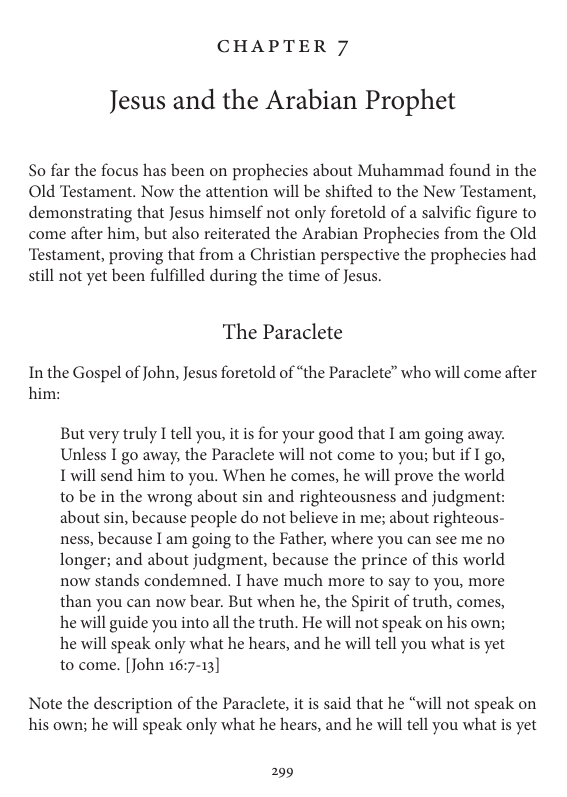
The relevant chapter begins by connecting Muhammad with each of the details concerning the Paraclete. For example, “he will testify about me” is describing how Muhammad confirms the messiahship of Jesus: tactically ignoring the reference to Jesus sending the Paraclete (see end).
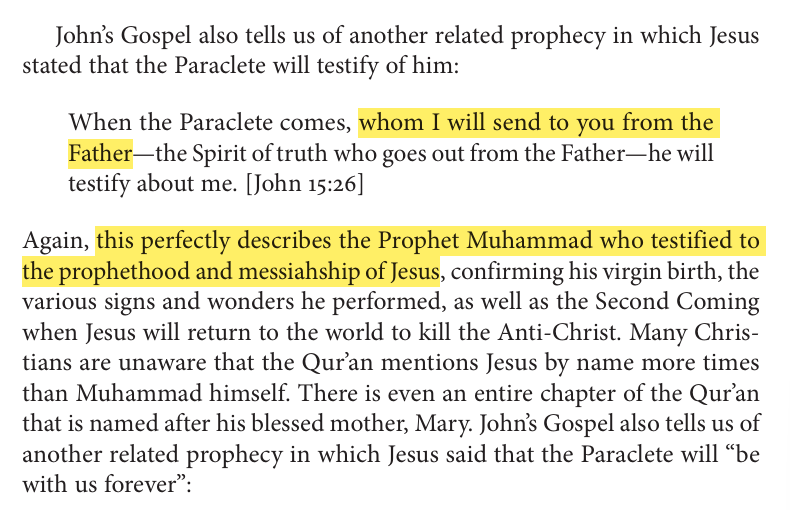
Similarly, the detail of the Paraclete “abiding forever” is taken as a reference to his teachings being present in world forever, rather than an eternal physical presence: however, the very next verse clarifies that the Paraclete is a spiritual being who abides in the Believers.

After such eisegesis that leads the work to conclude that the Gospel of John presents “a picture of a special individual… a multi-functional teacher-prophet”, it moves on to the scholarly disagreement on interpreting Gr. παράκλητος (parakletos).

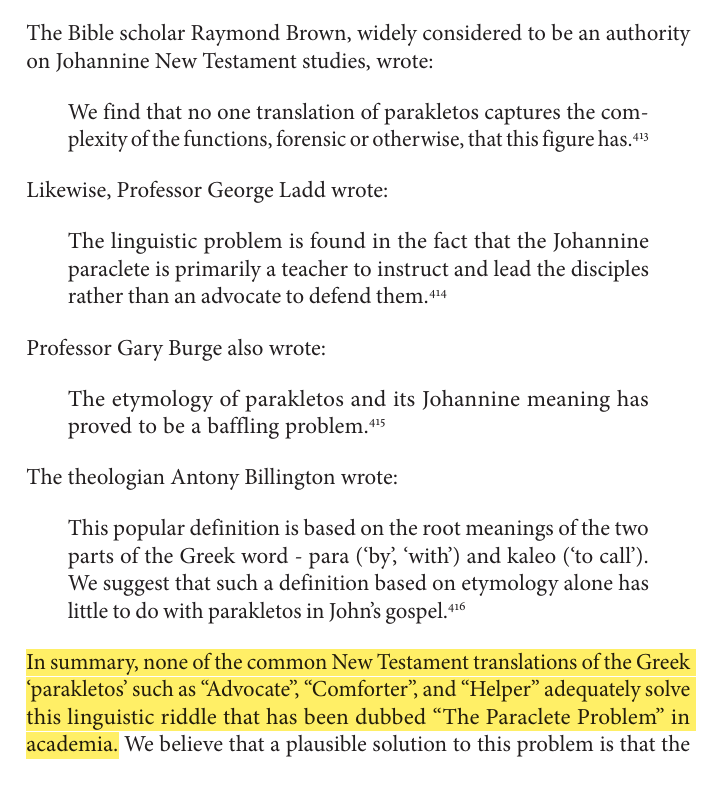
Since the precise meaning of Gr. παράκλητος is supposedly disputed, a new solution is posited, based on the Qur’an: παρά is taken to mean “more than” or “beyond”, and κλητος as “praised or glorified”, and the result is “praised more than/in excess”, i.e. the Ar. 'Aḥmad' (61:6):
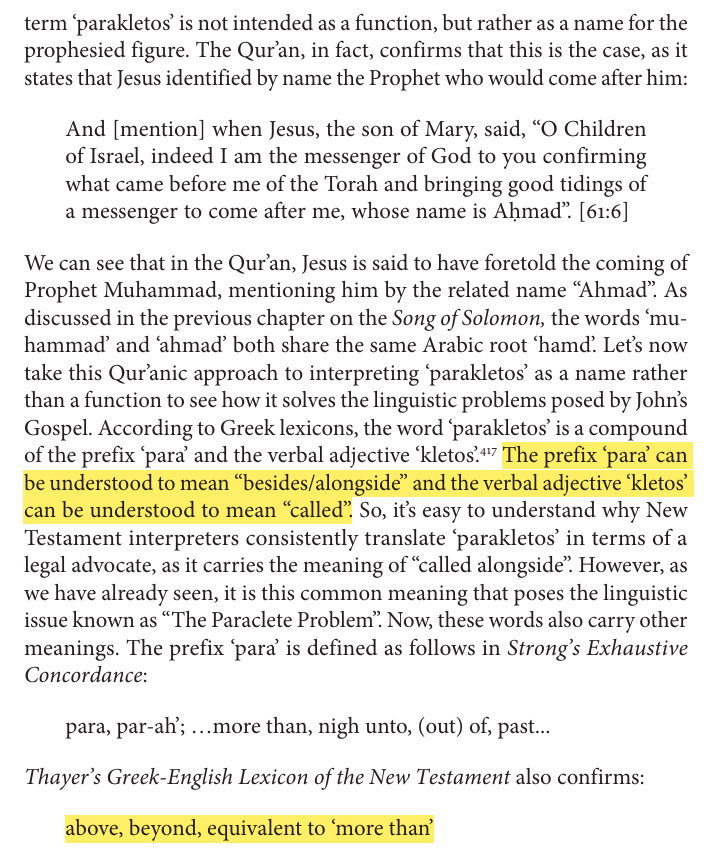
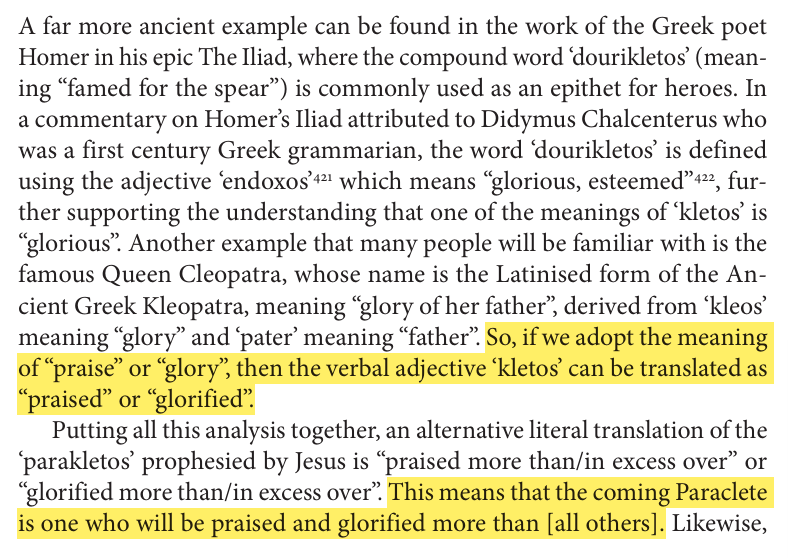
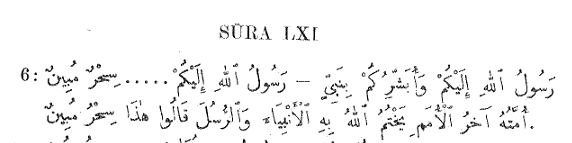
Before looking at παράκλητος and this new definition: it is to be noted that Ubay ibn Ka’ab’s mushaf of the Qur’an seems to omit the phrase ٱسْمُهُۥٓ أَحْمَدُ ۖ (“his name is Aḥmad”), as Arthur Jeffery notes in his Materials for the History of the Text of the Qur’an (p. 170):
If one looks at the list of scholars that is cited to prove that there exists significant confusion among scholars and translators on interpreting παράκλητος, every single one of them is written in the 20th century: the most recent being Billington’s 1995 essay.
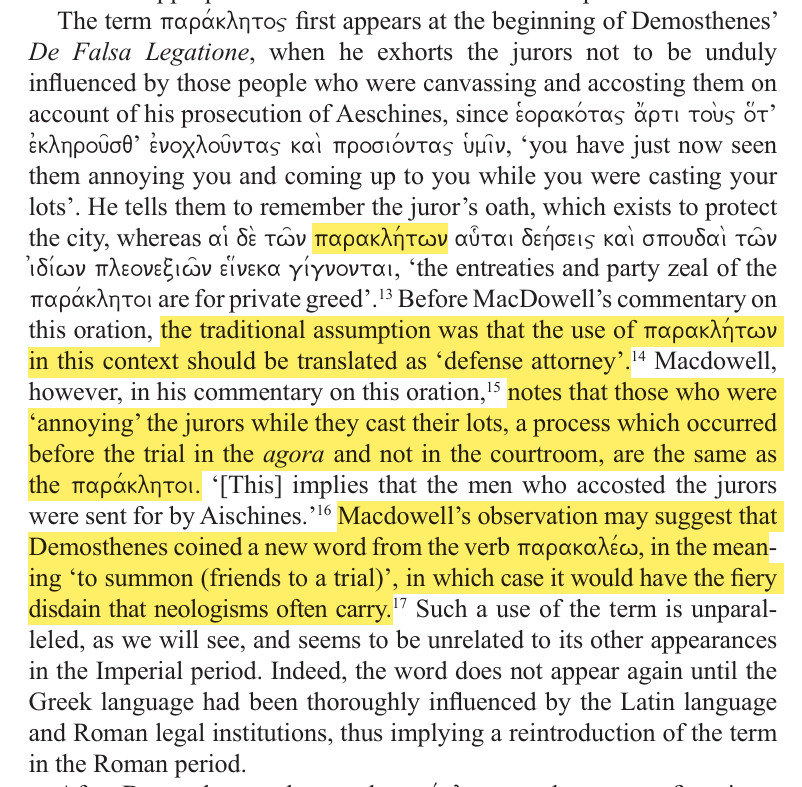
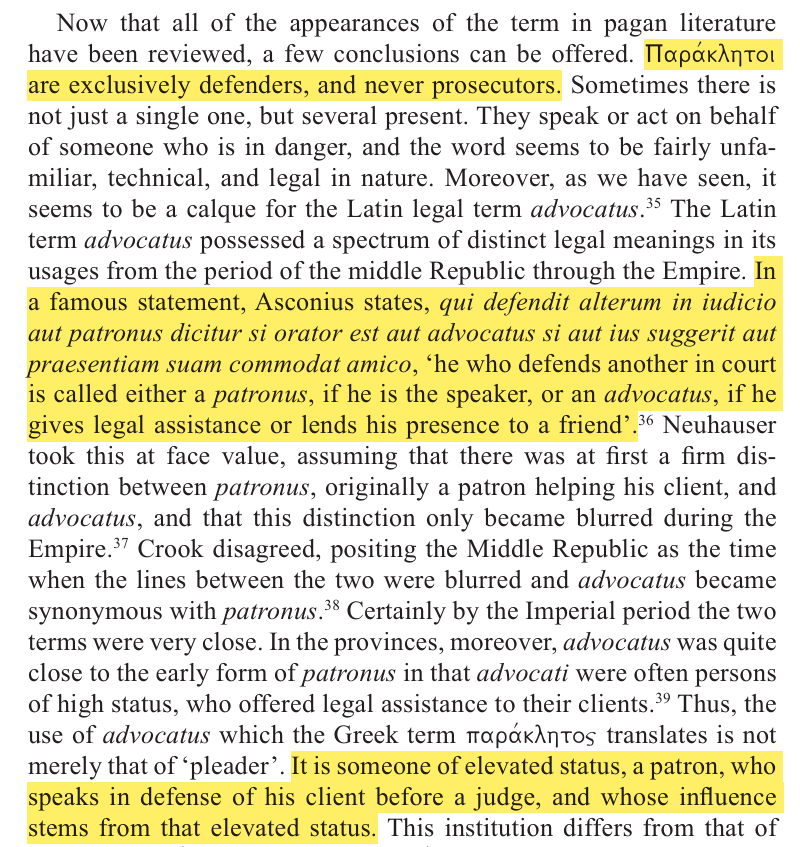
Lochlan Shelfer’s 2009 ‘The Legal Precision of the Term παράκλητος’ analyzes each occurance of the verb in classical literature: from Demosthenes to textual fragments of Greco-Roman paganism, παράκλητος is consistently taken to mean “advocate” or “intercessor”:

Hellenistic Jewish writers such as Philo, Rabbinic Jewish literature including the Targums, and early Latin Christian writers including Tertullian and Cyprian, understood the term to mean “intercessor”:
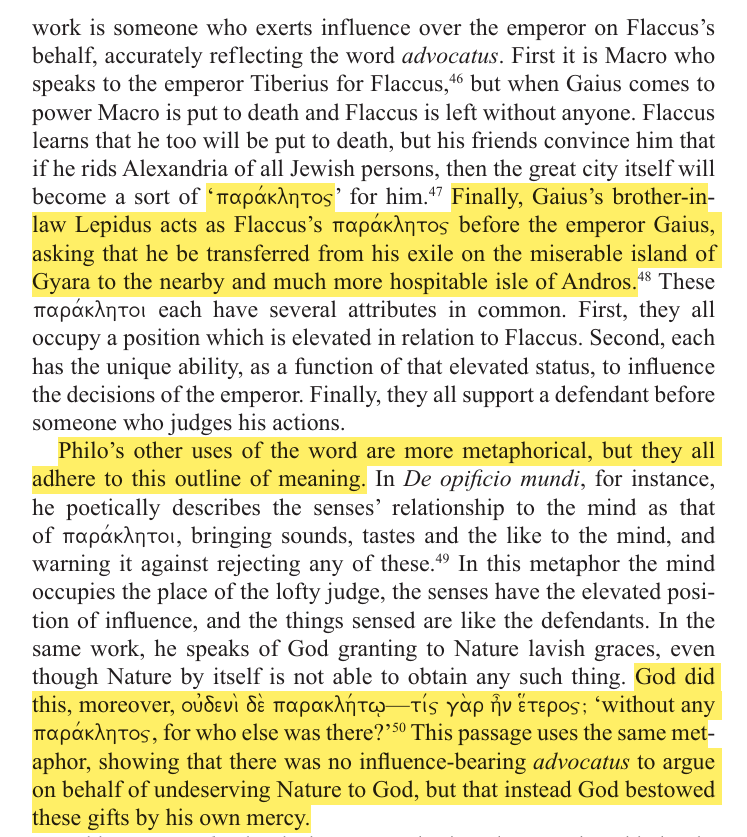

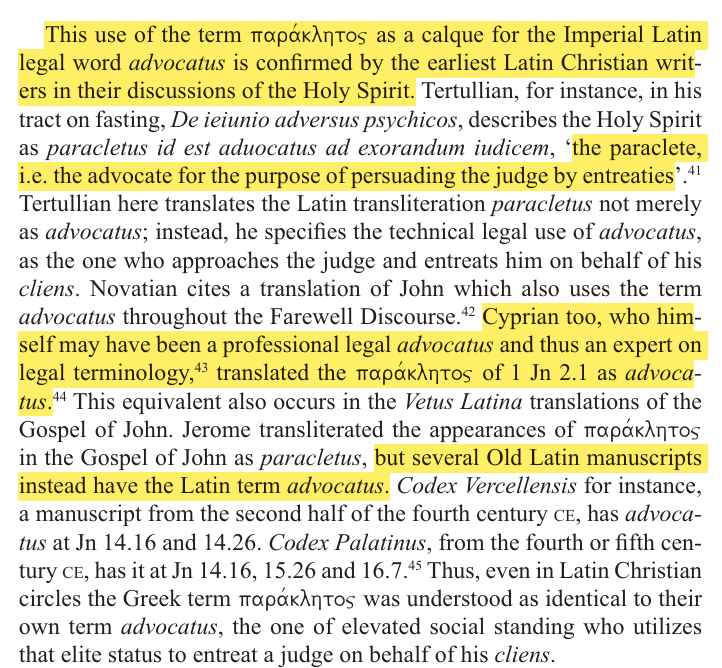
As Shelfer notes, ‘not every attribute of the Spirit.. is encapsulated in the single term παράκλητος, nor should such a meaning be sought’: the overwhelming evidence and the surrounding context supports interpreting the Johannine παράκλητος as a witness, an intercessor.


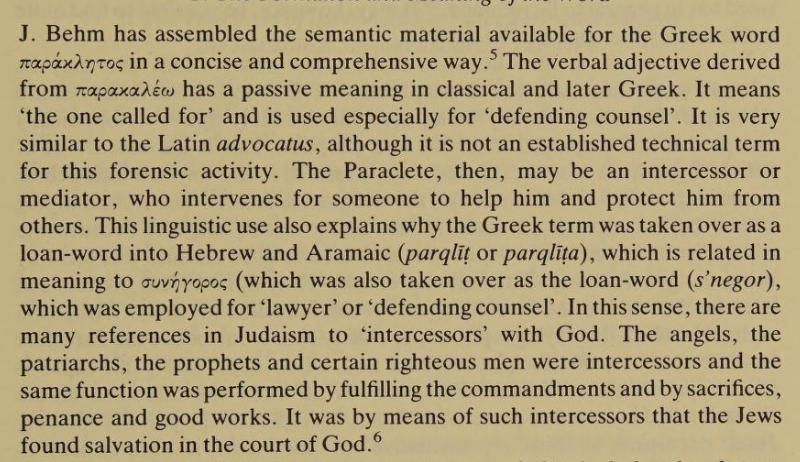
This is not a new or minority opinion in scholarship. J. Behm had already listed and discussed the semantic material for the Gr. παράκλητος, and concluded that it invariably meant “intercessor” or “defender” in 1954. As Schnackenburg 1982 notes:
Beth Sheppard’s 1999 PhD thesis at Sheffield, ‘Gospel of John: A Roman legal and Rhetorical Perspective’, concludes — after discussing the classical sources, objections raised by Brown, and the Johannine context — that the παράκλητος is an advocatus for the Believers.
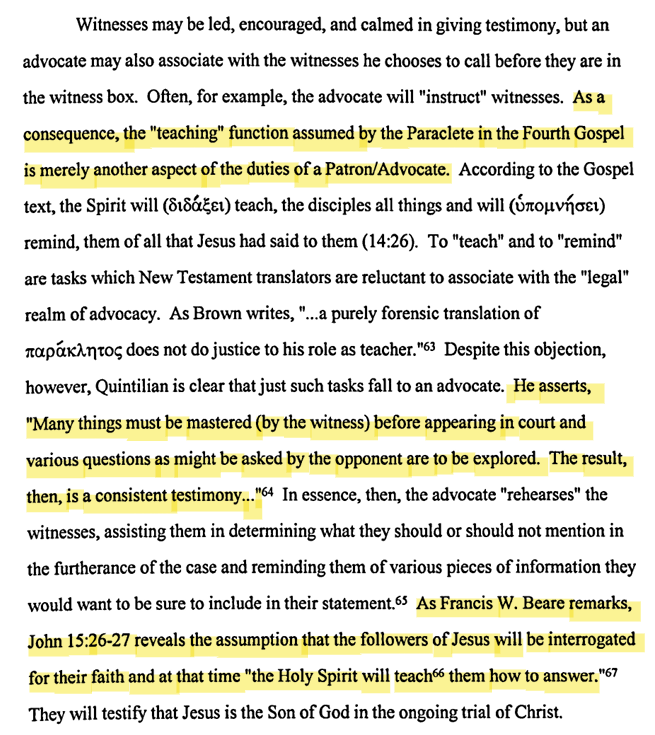

Marianne Thompson’s ‘The Paraclete Will Teach You all Things’ in 'The Spirit Says: Inspiration and Interpretation in Israelite, Jewish, and Early Christian Texts' (De Gruyter, 2021) briefly summarizes why the term παράκλητος should be understood in a legal or forensic sense:
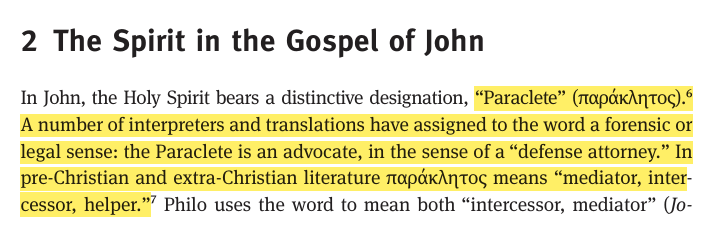
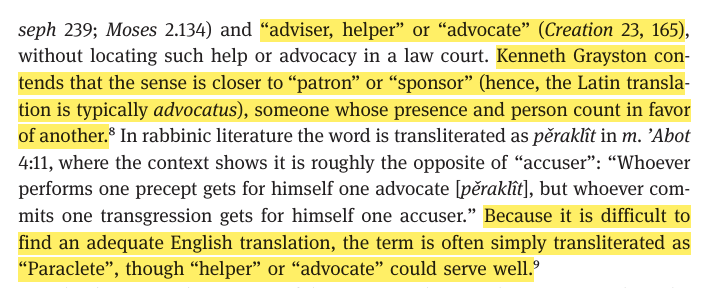
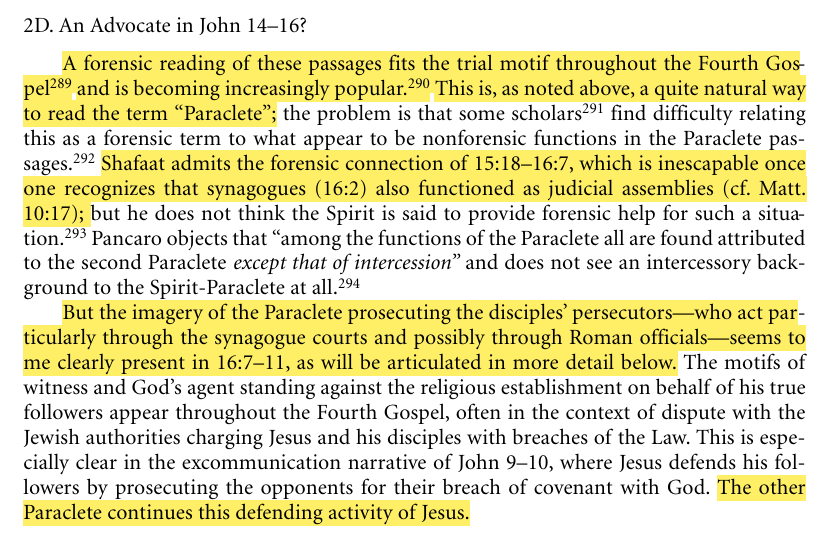
As Craig Keener notes in his ‘The Gospel of John: A Commentary’ (2003), p. 961, a forensic interpretation is ‘becoming increasingly popular’ among Johannine scholars, and it is the quite natural reading of the text:
Bauer’s Greek-English Lexicon of the New Testament and other Early Christian Literature (2021), pp. 680-81, confirms that understanding παράκλητος as “helper” or “intercessor” is suitable and fits the intent of all occurrences:
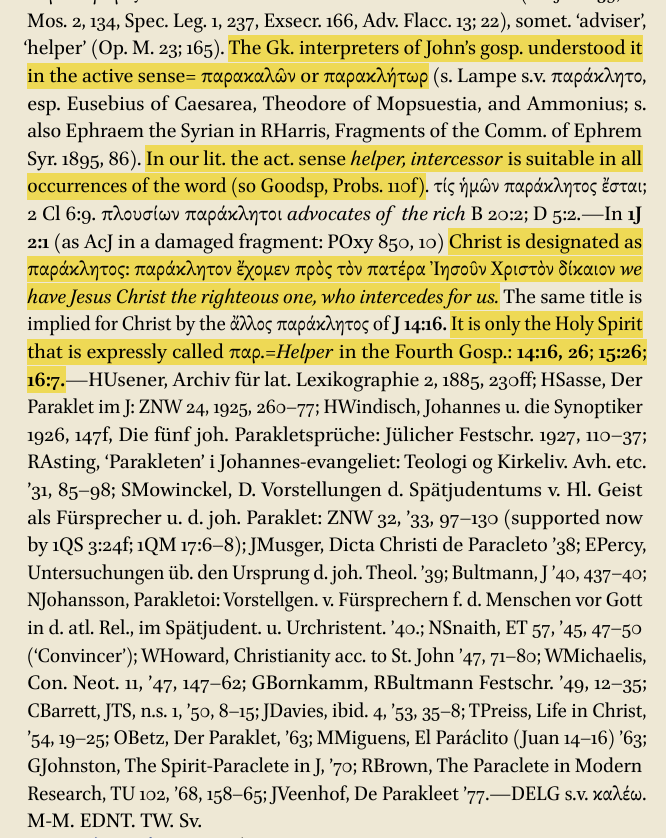
This interpretation adequately takes into account all the data in Johannine corpus — including παράκλητος being named as the “Spirit of Truth” (cf. 1QS) and Christ himself being a παράκλητος — without having to posit a ‘climate-change’ or multiple stages of redaction.
A question, then, naturally arises: if there actually does not exist much of a ‘Paraclete Problem’ which Rashid et al. claim does, why do we even require a new solution based on the suggestions of Qur’an, which originates from a completely different milieu?
Apart from this, I find three major weaknesses with interpreting παράκλητος as “More Praised”.
One: as seen above, there are numerous occurrences of παράκλητος and its forms in classical writings. Is it ever — even once — used to mean “praised more [than]”? The answer is, no.
Two: is κλητος ever — even once — taken to mean “praised” or “glorified” in a) the New Testament, b) early Christian literature, or c) Hellenistic Jewish writers (e.g. Philo)? The answer is, again, no.
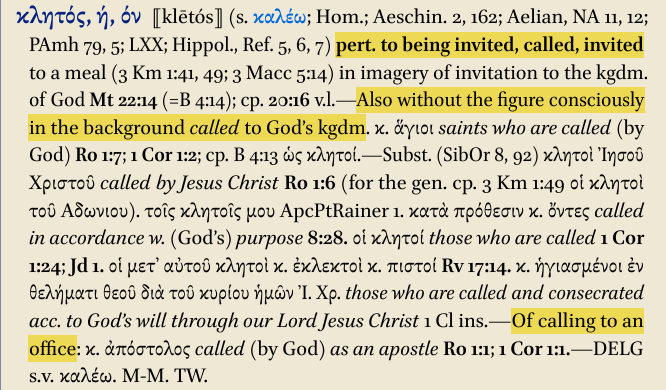
It is also to be noted that δόξα is the verb consistently used to mean or imply “glory” or “praise” in the Gospel of John (2:11; 8:49-50; 8:54; 11:40; 16:14; etc.).
Three, and this is an actual question: did Jesus say παράκλητος in Greek? If not, what did he originally say, in Aramaic (or Hebrew)? It would be interesting, since Muslim apologists often make the claim that Jesus spoke Aramaic, since he was a Semite.
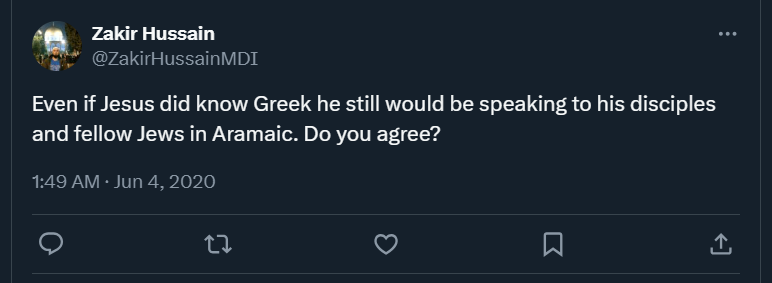
When one recognizes this to be the fact, there is no longer ground for the new, much ahistorical Praised-Ahmed interpretation. Keeping this in mind, let’s move on to the next section, where theological objections are raised against identifying the Paraclete as the Holy Spirit.
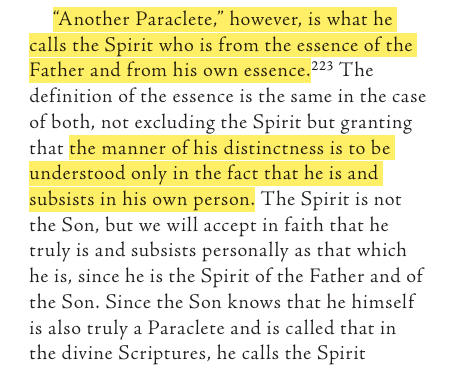
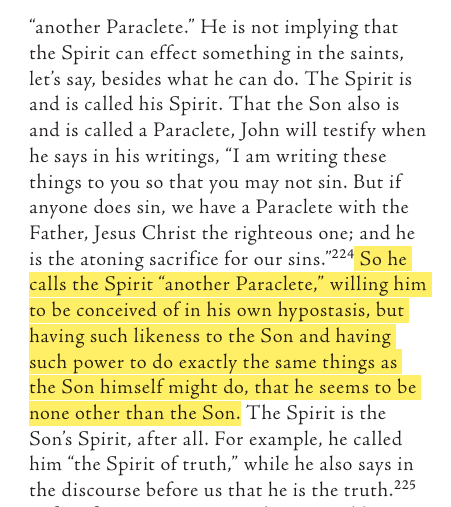
The first objection is that since Jesus is described as ἄλλον παράκλητον ("another Paraclete"), it stands to reason that the Paraclete will also be a human figure. However, Christian commentators have historically argued the opposite from the same (cf. Cyril of Alexandra):
The second objection is that if the Holy Spirit is God as Christians claim, he is being restricted as “he will speak only what he hears” (16:13). This makes little sense, since the text only implies that the Spirit will not proclaim a teaching contradictory to what Jesus taught.
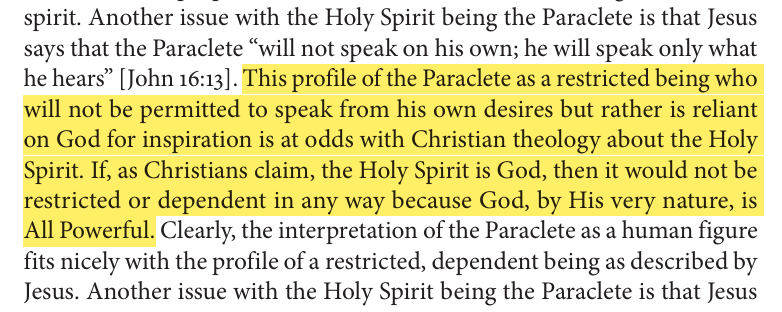
From the perspective of Orthodox Christian theology, this is identical to Christ saying that “I can do nothing on my own”: there is a single will within the Trinity, that flows and originates from the Father. The Son and the Spirit are not seen as independent agents or gods.
The third objection is simpler: how can the Spirit be the Paraclete who appears after Jesus departs, when the New Testament describes Jesus to be filled by the Spirit (Luke 4:1) and the disciples to have received the Spirit before Jesus departed (John 20:22)?
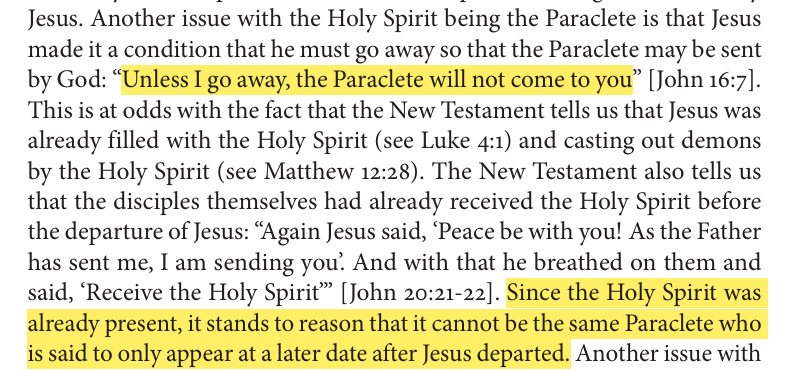
The answer to this is found in Brown 1970: ‘Paraclete’ is simply a particular role, or an economic manifestation, of the Spirit — as the very presence of Christ with his disciples and followers (cf. Matthew 28:20). Note: Cyril of Alexandria seems to suggest something similar.
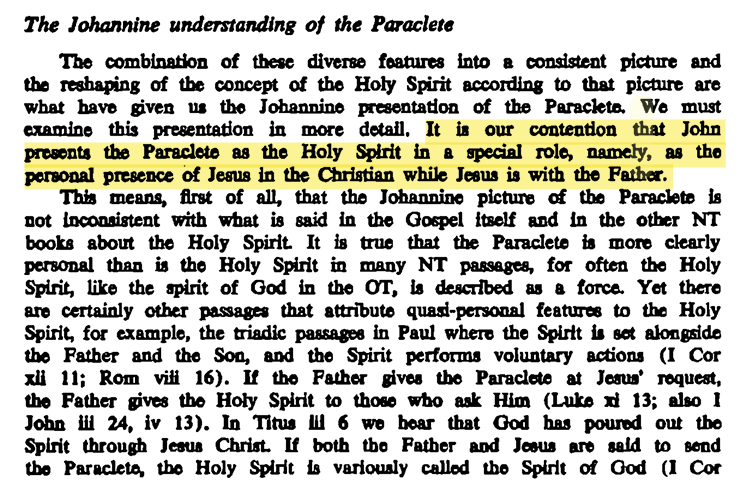
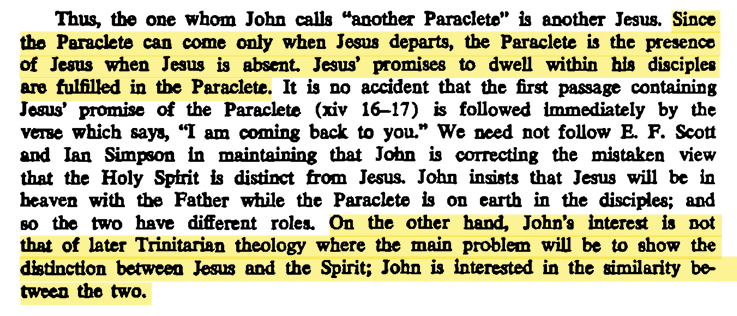
The fourth and last objection is literary: when elsewhere in the New Testament, the Spirit is referred to using neuter pronouns, why is Paraclete referred to with masculine pronouns? Precisely because Gr. πνεῦμα is neuter, and Gr. παράκλητος is masculine.
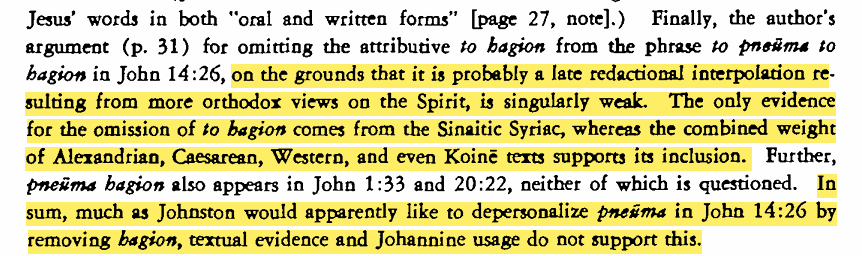
It then goes on to make a textual point based on Johnston 1970 who suggests that τὸ ἅγιον (”holy”) is a scribal addition to John 14:26 — making the text read simply “the Paraclete, the Spirit”. However, this is simply improbable: as Peel 1970 notes in his review of Johnston:
R. Brown lists a couple of scholars who have “doubted” identifying the Paraclete as the Spirit, and instead suggest a salvific figure: Rashid et al. summarize it as “Brown mentioned a list of renowned scholars who ‘believed’ Paraclete was originally a human figure”.
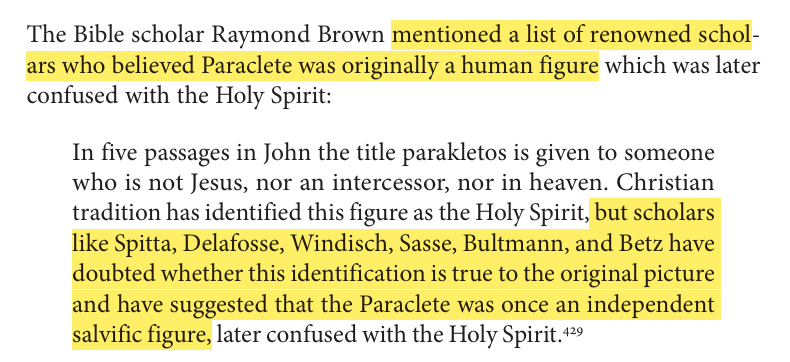
The funnier part in this is that Brown goes on to argue why this identification is original to the Johannine text and not a later redactorial mistake (pp. 1135-1143): this is already quoted above, while pointing out that Paraclete is an economic manifestation of the Spirit.
The work then quotes Swete 1912 who states that Origen records ‘some of his disciples’ maintaining that the “Paraclete” is to be identified with apostle Paul. However, when one looks at the source cited, which is Origen’s Twenty-Fifth Homily on Luke:

Origen doesn’t identify the “others” as his disciples: if anything, they might be semi-Marcionites who revere Paul in an extravagant manner, similar to the Montanists who revered Montanus.
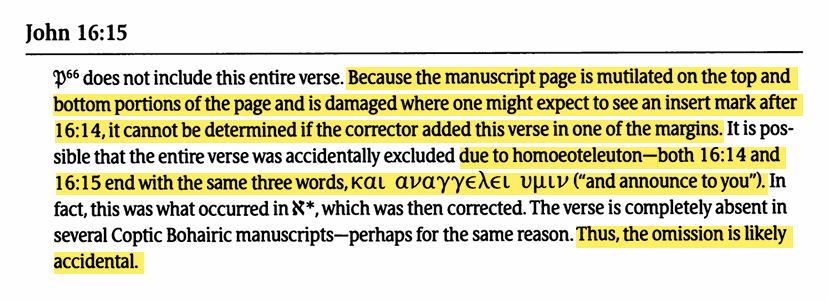
It then moves on to other theological objections from Christians regarding the Praised-Ahmed identification, some of which I skip. In response to an objection citing John 16:15 where Jesus speaks as if he is God, it is considered to be an interpolation citing the omission in P66:
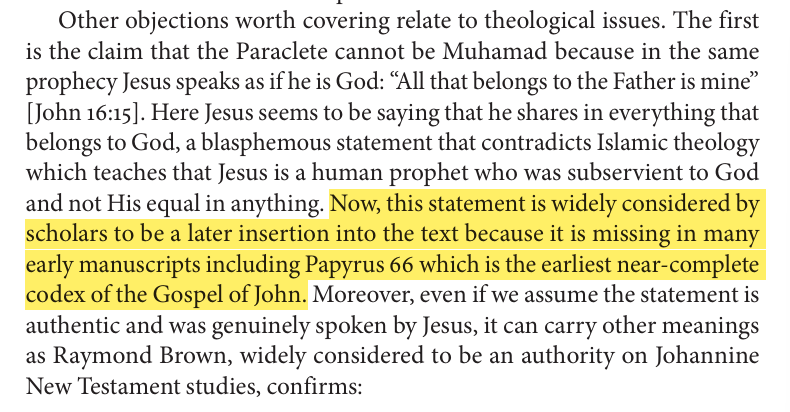
Philip Comfort, New Testament: Text and Translation (2008) points out why the omission in P66 is likely accidental:
Lastly, then, the book attempts to respond to two objections that I raised in the beginning: a) the Paraclete dwelling “in” the disciples, and b) the Paraclete being invisible.
Taking a look at (a):
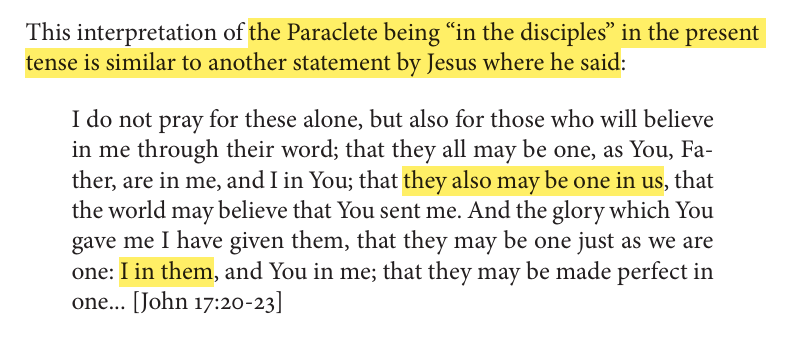
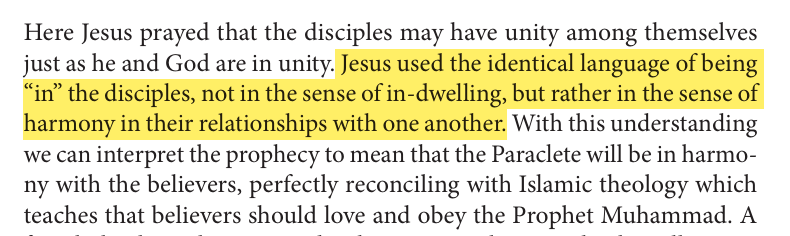
A significant point needs to be raised: why should the “being-in” language not be taken in the sense of in-dwelling? As I wrote above, citing Brown (there are more: e.g. Morris 1971, p. 651), the Paraclete is the Spirit of Jesus dwelling in his believers (cf. Ephesians 4:2-6).
Then we turn to (b): “seeing” should not be taken as literal perception, since in John 14:9, Jesus says perceiving him equals seeing the Father.

Let’s grant that “seeing” here is a metaphor for knowing or mental perception: it seems reasonable enough. However, this still has to work around with the detail of indwelling, since the relevant response, as noted above, does not address it adequately.
To wrap this thread around: we looked at how παράκλητος is used by John in a forensic sense, and why the Praised-Ahmed connection as detailed by ‘Abraham Fulfilled’ (2024) is implausible due to various reasons.
End:
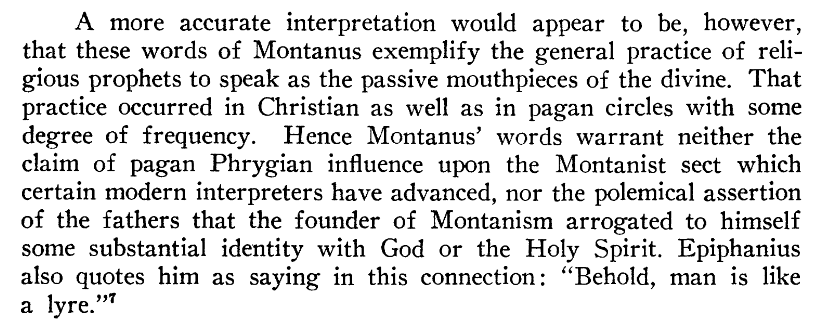
Even the supposed self-identifications from Montanus and Mani are only mentioned by later, fourth-century sources such as Epiphanius and Didymus. As Pelikan 1956 notes while commenting on such records: end/

Missing some tweets in this thread? Or failed to load images or videos? You can try to .