


 Dave Burton@ncdave4life
Dave BurtonJun 5, 2024
7 tweets
1/7. I've already showed you the proof that the greening of the Earth is continuing apace, as CO2 levels continue to rise. Here's a recent paper about it:
sciencedirect.com/science/articl
Chen et al (2024). The global greening continues despite increased drought stress since 2000. Global Ecology and Conservation, Volume 49, 2024, e02791, doi:10.1016/j.gecco.2023.e02791.

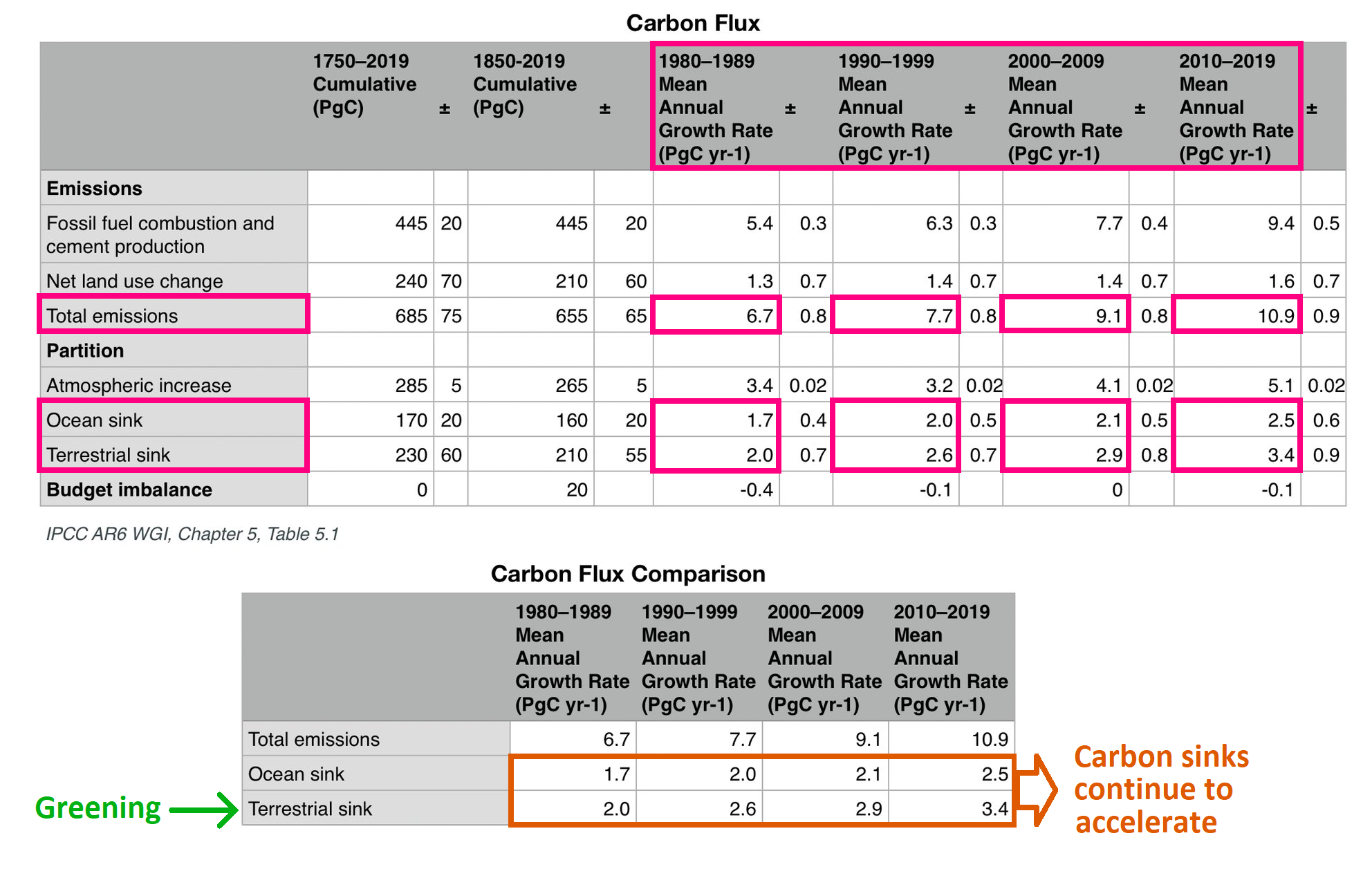
2/7. I've also already explained to you why the natural sinks which remove CO2 from the air will continue to accelerate as long as CO2 levels continue to rise.
x.com/ncdave4life/st
Dave Burton@ncdave4life
Dave BurtonOct 31 23
View on Twitter
1/9. The beneficial effects of rising CO2 levels are not "reversing." Don't let Bonus mislead you, Jim. He really just doesn't care about facts.
Here's AR6 WG1 Table 5.1, which shows how natural CO2 removals are accelerating:
ipcc.ch/report/ar6/wg1
I annotated it here:
sealevel.info/AR6_WG1_Table_

3/7. Natural CO2 removal mechanisms, which already remove at least (5.4 Gt CO2 / 2.1294 Gt/ppmv) = 2.5 ppmv/year, accelerate by an additional 1 ppmv/year for every 40-50 ppmv increase in atmospheric CO2 concentration.
x.com/ncdave4life/st
That's a very powerful "negative feedback" which limits the rise in CO2 concentration, and ensures that the temperature increase will remain modest and benign.
Refs:
ipcc.ch/report/ar6/wg1
sealevel.info/carbon/carbonf
sealevel.info/feedbacks.html
Dave Burton@ncdave4life
Dave BurtonMay 28 24
View on Twitter
Carbon is fungible.
x.com/ncdave4life/st
The natural sinks which remove CO2 from the air do not remove some "fraction of the CO2 produced by humans." They remove mixed CO2 from the atmosphere, with negligible discrimination between anthropogenic CO2 and CO2 which was already there.
There's no practical limit to the amount of carbon that the oceans and terrestrial biosphere / soil can take up. The oceans contain about 50× as much CO2 as the atmosphere. So the movement of CO2 from air to water affects the air far more than it affects the water.
The usual concern expressed about CO2 dissolved into the oceans is "ocean acidification." But that's both a red herring, and a misnomer. The oceans are alkaline (caustic), everywhere. They are not acidic, anywhere, and ocean chemistry ensures that the oceans can never become acidic.
Freshwater lakes and rivers are often slightly acidic, and so is rain, but never oceans.
"Ocean acidification" is a red herring because the effect is both minuscule & benign. It's a misnomer because it doesn't even acidify the oceans according to any dictionary's definition of the word:
acidify. v. To make or become acid.
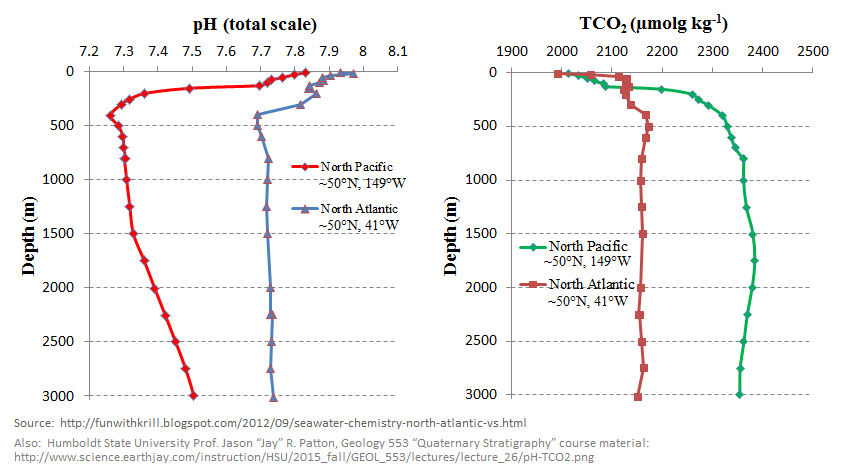
It's estimated that, as a consequence of 70 years of CO2 emissions, average ocean surface water pH has declined a measly and harmless 0.1 pH point.
That estimate is from modeling, not measurements, because the trend is too slight and slow to measure with confidence, and because the tiny change is dwarfed by natural seasonal & diurnal pH variation, pH variation with depth, and even pH differences between ocean basins:
sealevel.info/ocean_pH_vs_de
What's more, so-called ocean acidification is confined almost entirely to the part of the ocean which is most caustic (alkaline): the surface layer. That means so-called "ocean acidification" really just reduces the extreme high end of ocean pH variation, slightly.
What's more, through >98% of the Earth's history, atmospheric CO2 levels were far higher than they are now, and, in fact, far higher than we could ever raise them, by burning recoverable fossil fuels. During the lush Cretaceous, when complex life flourished, including aquatic life, atmospheric CO2 concentrations are believed to have averaged nearly four times the current level. During the equally lush Jurassic, CO2 levels were even higher.
Yet, even with those much higher atmospheric CO2 levels, the oceans were still alkaline, rather than acidic, and there's no evidence that the high atmospheric CO2 levels were harmful to aquatic life.
4/7. We've also already covered that VPD red herring. Rising CO2 levels make plants more water-efficient and drought-hardy, and more resilient to "water vapor pressure deficit" (dryness).
x.com/ncdave4life/st
Dave Burton@ncdave4life
Dave BurtonMar 04 21
View on Twitter
5/9. Also, there's no reason to expect higher VPD in a warming climate. In fact, droughts have been decreasing, slightly:
sealevel.info/learnmore.html

5/7. Droughts used to be catastrophically destructive.
● Covid-19 killed ≈0.1% of world population.
● The 1918 flu pandemic killed ≈2%.
● WWII killed ≈2.7%.
● The global drought & famine of 1876-78 killed ≈3.7% of the world population, when CO2 level (determined from ice cores) averaged only about 289 ppmv (compared to the current 422 ppmv).
Thankfully that no longer happens, and the rising CO2 level is one of the main reasons for that extraordinary blessing.
6/7. Droughts still happen, of course, but elevated CO2 mitigates the adverse effects vapor pressure deficit (dryness) on plants. That's why the global greening trend is most pronounced in the driest regions, like the Sahel.
x.com/ncdave4life/st
Dave Burton@ncdave4life
Dave BurtonFeb 03 24
View on Twitter
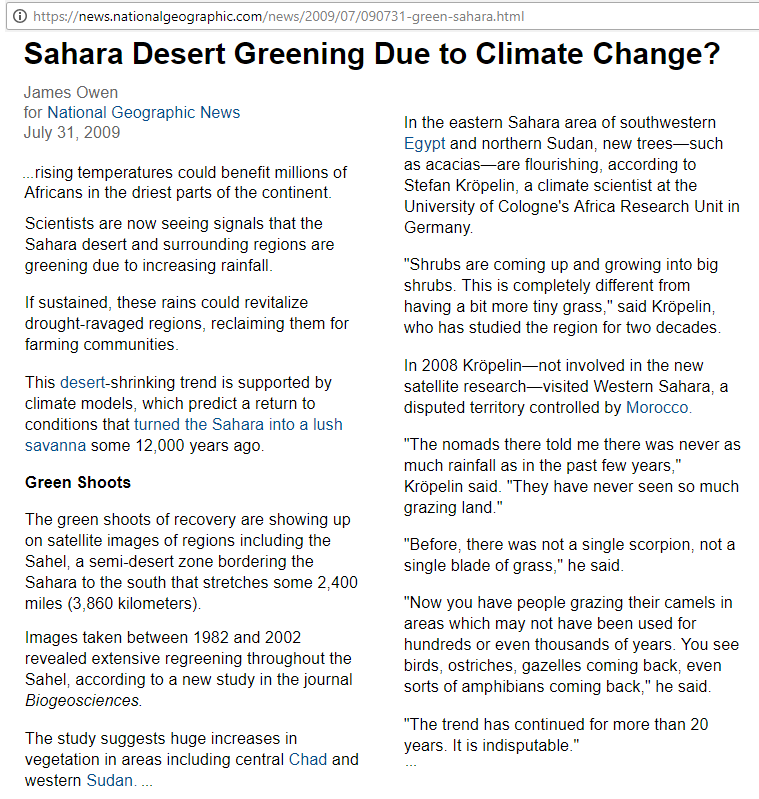
15/18》 Here's what manmade climate changes is doing in Africa. This is what climate activists are campaigning against:
“’Before, there was not a single scorpion, not a single blade of grass… Now you have people grazing their camel…"
sealevel.info/Owen2009_Sahar
sealevel.info/090731-green-s


Anymouse @zzr.bsky.social@Anymous84861064
Jun 05 24
View on Twitter
So the land & oceans act as sinks for CO2.
Currently absorbing 13 Gt & 9Gt of CO2 per year.
Current GHG emissions are 36Gt!
Exactly how long do you expect those sinks to continue?
You know the planet is now browning? Right?
science.org/doi/10.1126/sc

7/7. To understand a politicized topic like #ClimateChange, you need balanced information. I'm here to help:
sealevel.info/learnmore.html
That resource list has:
● accurate introductory climatology information
● in-depth science from both skeptics & alarmists
● links to balanced debates between experts on both sides
● accurate information about impacts of CO2 & climate change, such as the effects on crop yields
● links to the best blogs on both sides of the climate debate

Dave Burton
Dave Burton@ncdave4life
My preferred pronoun is "harmless data drudge." https://t.co/YTkK6vaHGs Tel: +1 919-481-0098.
Missing some tweets in this thread? Or failed to load images or videos? You can try to .