
Andreas Backhaus@AndreasShrugged
Aug 29, 2024
10 tweets
I'll go on a little rant about this paper in @QJE if only for its treatment of the literature. As it's clearly not the first paper to analyze Black economic progress after slavery, we'll focus on the value-added over previous research. An important reference here is Sacerdote (ReStat 2005) "Slavery and the Intergenerational Transmission of Human Capital".


Philipp Heimberger@heimbergecon
Aug 25 24
View on Twitter
Black families whose ancestors were enslaved until the Civil War have considerably lower education, income and wealth today than Black families whose ancestors were free before the Civil War.
Evidence in this new QJE paper
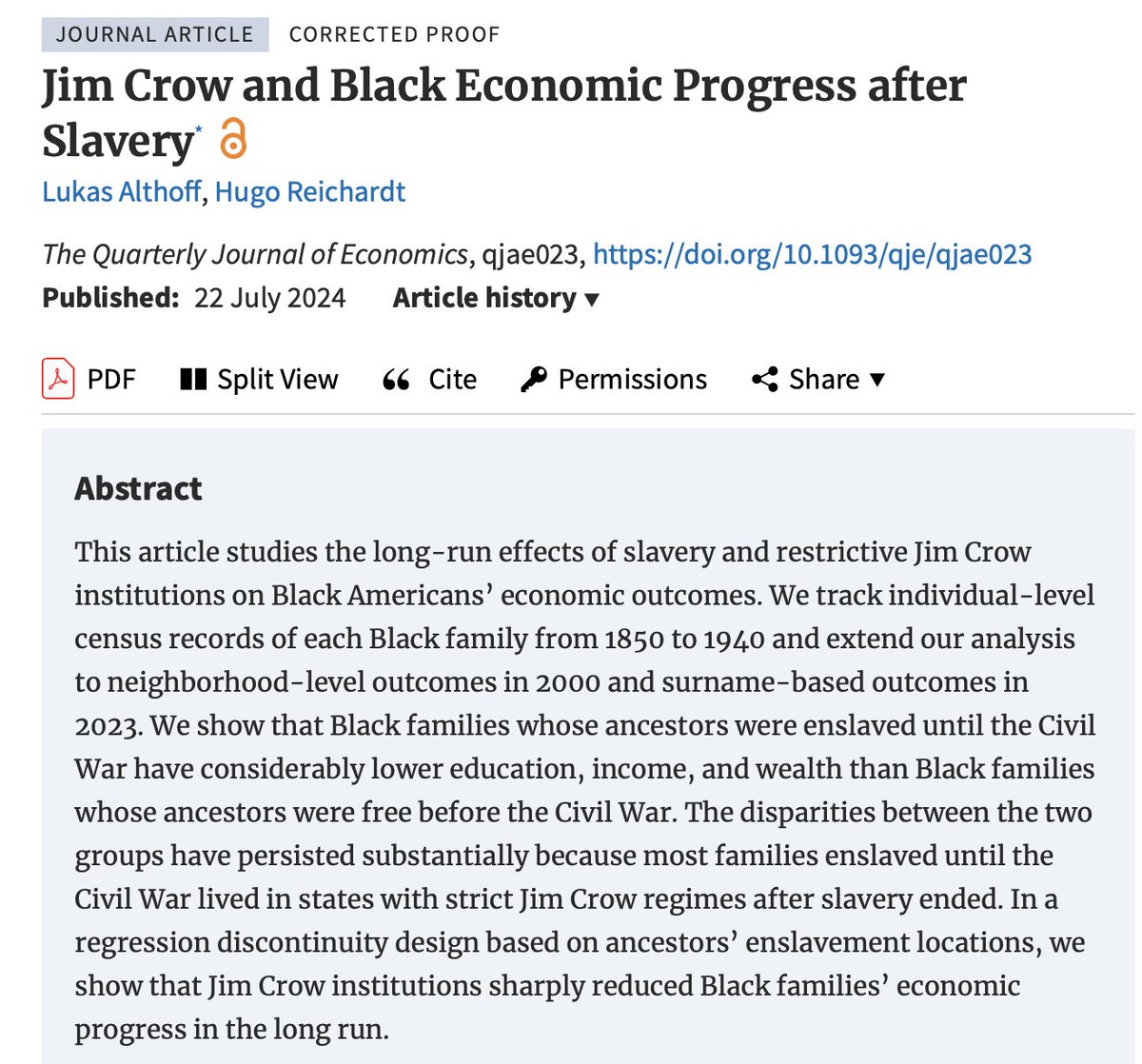
Now Althoff and Reichardt do cite Sacerdote twice - in Sections IV.B and V.A, rather en passant alluding to what they see as conceptual shortcomings in his approach. They never cite Sacerdote in their review of the existing evidence though. Despite the Sacerdote paper having asked a very similar question, A&R never tell what his conclusions were and how they may contrast with their findings and why.


Clearly, both data and empirical strategy of Sacerdote (2005) may seem outdated in the 2020s. On the other hand, the @IPUMS U.S. census extracts used by Sacerdote laid the groundwork for the complex census linkages of today. Sacerdote is also well-aware of the limits to identification in his approach but nevertheless realizes he can put bounds on the true effects - which I personally find pretty clever.


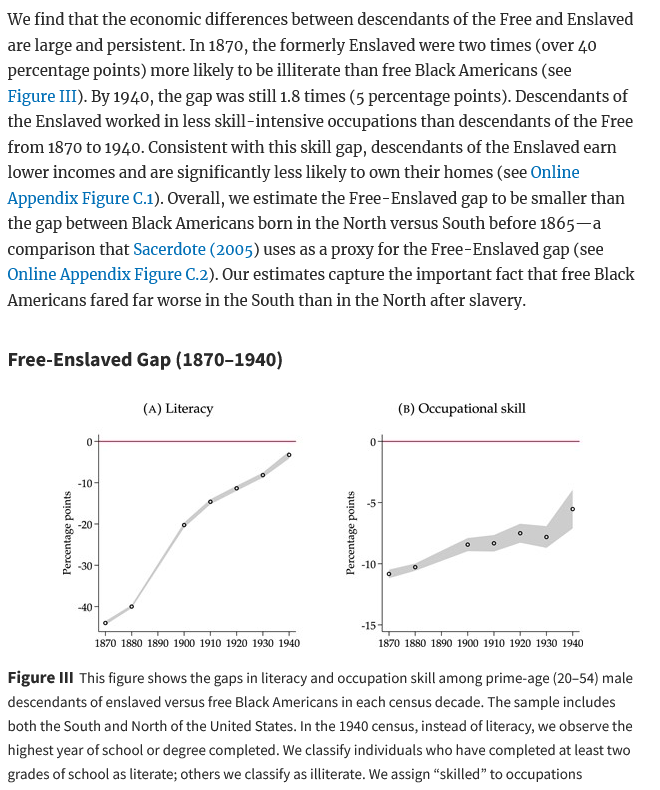
Now we should be asking - are the better data and identification strategies of today revealing something new and substantial, or are they rather adding just more bells and whistles? I find the literacy trends between descendants of free vs. descendants of enslaved Blacks to be quite similar in both papers. The main difference seems to me that Sacerdote interprets this as convergence while A&R suggest "We find that the economic differences between descendants of the Free and Enslaved are large and persistent. In 1870, the formerly Enslaved were two times (over 40 percentage points) more likely to be illiterate than free Black Americans (see Figure III). By 1940, the gap was still 1.8 times (5 percentage points)." Which makes me wonder whether a decline from 40 to 5 percentage points really indicates large persistence.

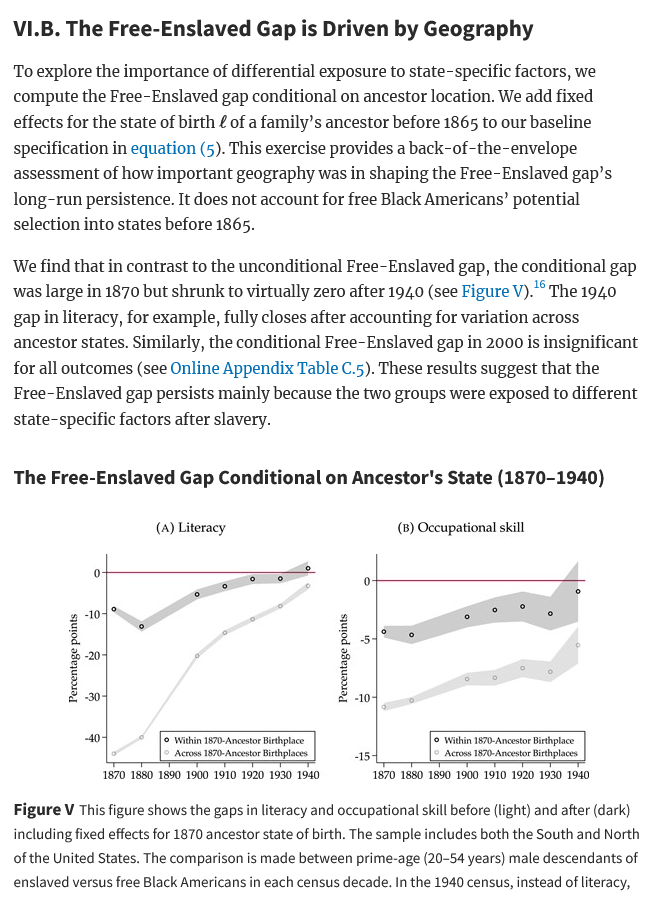
The importance of geography is also noted in Sacerdote (2005).


The gap in years of schooling between descendants of free and descendants of enslaved Blacks reported by A&R precisely replicates the result of Sacerdote (2005). At least that's my conclusion after having read both papers.


A&R then spend a large deal of their paper on applying a regression discontinuity design on the question how the Jim Crow laws contributed to the free-enslaved gap's persistence. That's arguably something that Sacerdote didn't and couldn't do back then (same as the extension of the data to the 2000s). Maybe I'm oversimplifying too much but it seems a lot of effort invested for showing that laws that were intended to be very bad for Blacks were indeed very bad for Blacks and that this institution had persistent effects.
Finally, A&R discuss the importance of Jim Crow in the context of schooling. I just noticed that most if not all of their pre-2000s sources have also been cited by Sacerdote (I'm not screenshotting all of his references, but they are there), while there is no engagement with the discussion that Sacerdote built on them (nor any mention of it).


Now this treatment of the existing literature is probably very common within the Top5 circle, more common than in lower-ranked journals, and this is just one case I accidentally happened to recognize. Still I continue to be surprised that this is apparently the way they roll at the top of our profession.
@Thread Reader App Unroll.

Missing some tweets in this thread? Or failed to load images or videos? You can try to .