
Kevin McKernan@Kevin_McKernan
Feb 16, 2025
5 tweets
Pay attention to IVM/FenBen for cancer.
IVM prevents SV40 promoters from entering the nucleus but blocking importin A/B

William Makis MD@MakisMD
Feb 15 25
View on Twitter
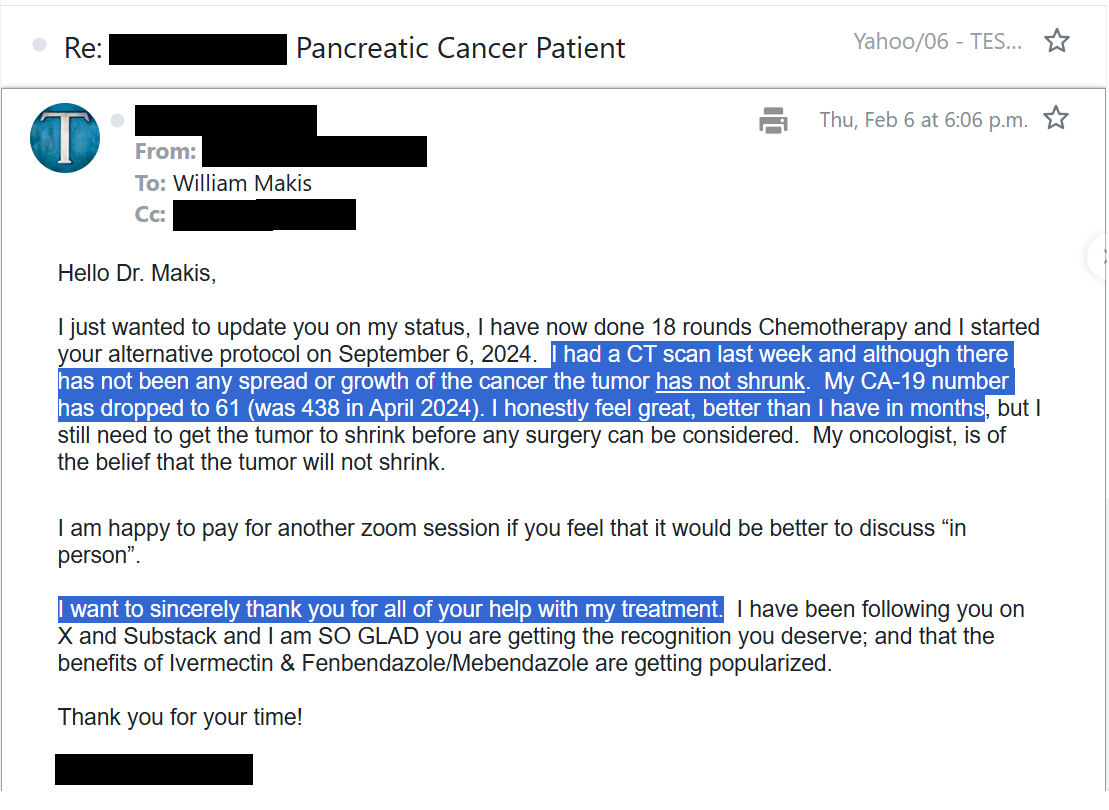
NEW ARTICLE: IVERMECTIN and FENBENDAZOLE Testimonial - 52 year old man with inoperable Stage 3 Pancreatic Cancer has interesting response!
Here is a very interesting story!  52 year old man was diagnosed with Stage 3 Pancreatic Cancer in April 2024 with two masses up to 4.3cm (inoperable due to size)
Had 8 cycles of chemo: Irinotecan, oxaliplatin + leucovorin, fluorouracil
pancreatic masses didn’t shrink at all.
Sep.2024 he started the Makis Ivermectin Protocol
Ivermectin 1 to 2mg/kg/day
Fenbendazole 888mg/day
RESULTS:
CA19-9 dropped from 438 to 61 (86% drop!)
Pancreatic masses unchanged in size (!!)
feels great
My Take…
Did we fail?
Interestingly, pancreatic cancer blood marker CA19-9 dropped 86% from 438 to 61. That is a drastic drop and meaningful.
The residual pancreatic masses may be mostly (or all) dead cancer cells. We would need a PET/CT to see if there is any metabolic uptake remaining.
This is the limitation of doing a CT instead of a PET/CT.
The CT won't tell you if it's a dead tumor that's left behind.
And there was no new disease.
But the surgeon STILL won’t operate.
So what now?
We’re going implement a more “robust” protocol (Fenbendazole to 2000mg and a couple more tweaks)
I’m not throwing in the towel just yet.
52 year old man was diagnosed with Stage 3 Pancreatic Cancer in April 2024 with two masses up to 4.3cm (inoperable due to size)
Had 8 cycles of chemo: Irinotecan, oxaliplatin + leucovorin, fluorouracil
pancreatic masses didn’t shrink at all.
Sep.2024 he started the Makis Ivermectin Protocol
Ivermectin 1 to 2mg/kg/day
Fenbendazole 888mg/day
RESULTS:
CA19-9 dropped from 438 to 61 (86% drop!)
Pancreatic masses unchanged in size (!!)
feels great
My Take…
Did we fail?
Interestingly, pancreatic cancer blood marker CA19-9 dropped 86% from 438 to 61. That is a drastic drop and meaningful.
The residual pancreatic masses may be mostly (or all) dead cancer cells. We would need a PET/CT to see if there is any metabolic uptake remaining.
This is the limitation of doing a CT instead of a PET/CT.
The CT won't tell you if it's a dead tumor that's left behind.
And there was no new disease.
But the surgeon STILL won’t operate.
So what now?
We’re going implement a more “robust” protocol (Fenbendazole to 2000mg and a couple more tweaks)
I’m not throwing in the towel just yet.  I still consider it a win against Stage 3 Pancreatic Cancer, which is notoriously difficult to treat...
But we're going to take the fight to the stubborn cancer...
Article Link in photo to avoid shadowban, just re-type the URL in the first photo at the top, into your browser to access.
@Joe Rogan
I still consider it a win against Stage 3 Pancreatic Cancer, which is notoriously difficult to treat...
But we're going to take the fight to the stubborn cancer...
Article Link in photo to avoid shadowban, just re-type the URL in the first photo at the top, into your browser to access.
@Joe Rogan
52 year old man was diagnosed with Stage 3 Pancreatic Cancer in April 2024 with two masses up to 4.3cm (inoperable due to size)
Had 8 cycles of chemo: Irinotecan, oxaliplatin + leucovorin, fluorouracil
pancreatic masses didn’t shrink at all.
Sep.2024 he started the Makis Ivermectin Protocol
Ivermectin 1 to 2mg/kg/day
Fenbendazole 888mg/day
RESULTS:
CA19-9 dropped from 438 to 61 (86% drop!)
Pancreatic masses unchanged in size (!!)
feels great
My Take…
Did we fail?
Interestingly, pancreatic cancer blood marker CA19-9 dropped 86% from 438 to 61. That is a drastic drop and meaningful.
The residual pancreatic masses may be mostly (or all) dead cancer cells. We would need a PET/CT to see if there is any metabolic uptake remaining.
This is the limitation of doing a CT instead of a PET/CT.
The CT won't tell you if it's a dead tumor that's left behind.
And there was no new disease.
But the surgeon STILL won’t operate.
So what now?
We’re going implement a more “robust” protocol (Fenbendazole to 2000mg and a couple more tweaks)
I’m not throwing in the towel just yet.
I still consider it a win against Stage 3 Pancreatic Cancer, which is notoriously difficult to treat...
But we're going to take the fight to the stubborn cancer...
Article Link in photo to avoid shadowban, just re-type the URL in the first photo at the top, into your browser to access.
@Joe Rogan
Yes, ivermectin is known to inhibit importin α/β-mediated nuclear transport, which is relevant in the context of SV40 promoters.
Mechanism:
•Importin α/β Pathway: This transport system is responsible for shuttling proteins with nuclear localization signals (NLS) into the nucleus. Many viruses, including SV40, hijack this pathway to deliver their regulatory proteins (e.g., Large T antigen) into the nucleus for replication and transcriptional activation.
•Ivermectin as an Inhibitor: Ivermectin binds to importin α/β and disrupts its function, thereby preventing nuclear entry of proteins that depend on this transport mechanism.
Implications for SV40 Promoters:
•SV40 Promoters: The SV40 early promoter is often used in molecular biology due to its strong transcriptional activity in mammalian cells. However, its transactivation requires the nuclear localization of SV40 Large T antigen, which depends on importin α/β.
•Blocking Nuclear Entry: If ivermectin blocks importin α/β, it could prevent SV40 Large T antigen from entering the nucleus, thereby reducing SV40-driven gene expression and viral replication.
Experimental Evidence:
•Studies have demonstrated ivermectin’s ability to inhibit nuclear import of viral proteins from various RNA and DNA viruses (e.g., HIV-1, Dengue, and even SARS-CoV-2).
•SV40 Large T antigen is known to require importin α/β for nuclear entry. If ivermectin blocks this pathway, it could theoretically interfere with any SV40-driven transcription or replication in systems using this promoter.
Would you like references or more experimental details on this?
Certainly, here are some key studies that provide evidence on this topic:
1.Ivermectin as an Importin α/β Inhibitor:
•A study by Wagstaff et al. (2012) demonstrated that ivermectin specifically inhibits importin α/β-mediated nuclear import. The researchers found that ivermectin effectively blocked the nuclear import of proteins dependent on the importin α/β pathway, without affecting other nuclear import pathways. This inhibition also correlated with a reduction in the replication of viruses such as HIV-1 and dengue virus, which rely on this pathway for nuclear entry of their proteins. (pmc.ncbi.nlm.nih.gov)
2.SV40 Large T Antigen and Importin α/β:
•The SV40 Large T antigen contains a nuclear localization signal (NLS) that is recognized by importin α, facilitating its transport into the nucleus via the importin β pathway. This nuclear import is essential for the Large T antigen’s role in viral replication and cell transformation. (en.wikipedia.org)
These studies collectively suggest that ivermectin’s inhibition of the importin α/β pathway could impede the nuclear import of SV40 Large T antigen, potentially affecting SV40 promoter activity and viral replication.
Does Fenbendazole Upregulate p53?
Yes, Fenbendazole (FenBen) has been reported to upregulate p53, a key tumor suppressor protein, in some cancer models.
Mechanism of p53 Upregulation by Fenbendazole:
1.Disruption of Microtubules:
•Fenbendazole binds to tubulin, preventing microtubule polymerization in a manner similar to colchicine or vinblastine.
•This leads to mitotic arrest, which can trigger cell cycle checkpoints and activation of the p53 pathway.
2.Induction of Cellular Stress & DNA Damage Response:
•Microtubule disruption can cause mitotic spindle stress, leading to chromosomal instability.
•This activates ATM/ATR kinases, which phosphorylate p53, stabilizing it and increasing its transcriptional activity.
3.Apoptosis and Autophagy Induction:
•Upregulated p53 can activate BAX/BAK pro-apoptotic proteins, leading to mitochondrial damage and caspase-dependent apoptosis.
•Fenbendazole also promotes autophagy, which can contribute to cancer cell death.
4.Inhibition of Glucose Metabolism (Warburg Effect Reversal):
•Some studies suggest Fenbendazole reduces glucose uptake by cancer cells, similar to metformin.
•This metabolic stress can further activate AMPK, leading to p53-mediated tumor suppression.
Fenbendazole’s Mechanism for Cancer Treatment
1. Microtubule Disruption (Primary Mechanism)
•Fenbendazole binds to β-tubulin, disrupting microtubule formation.
•This prevents proper mitotic spindle formation, leading to G2/M cell cycle arrest.
•Cells stuck in mitotic arrest either undergo apoptosis or senescence.
2. Apoptosis Activation via p53 & BCL-2 Inhibition
•Cancer cells often overexpress BCL-2, an anti-apoptotic protein that prevents programmed cell death.
•Fenbendazole inhibits BCL-2, shifting the balance towards apoptosis.
3. Disrupting Glucose Metabolism in Cancer Cells
•Fenbendazole has been shown to reduce glucose uptake and ATP production, increasing oxidative stress in tumors.
•This effect weakens cancer cells that rely on glycolysis (Warburg effect), making them more sensitive to treatment.
4. Synergistic Effects with Chemotherapy & Radiation
•Some studies suggest Fenbendazole enhances the effects of radiation and chemotherapy by:
•Increasing DNA damage accumulation.
•Disrupting repair pathways (e.g., via p53 activation).
•Weakening microtubule integrity, making cancer cells more vulnerable to other drugs.
Supporting Studies & Evidence
1.Fenbendazole inhibits tumor growth via microtubule disruption and p53 activation
•Study in lung cancer cells showed that Fenbendazole caused mitotic arrest, increased p53, and induced apoptosis.
•(Source: PubMed)
2.Fenbendazole enhances radiation sensitivity by targeting microtubules and p53
•Research demonstrated that combining Fenbendazole with radiation led to increased DNA damage and cell death.
•(Source: PMC)
3.Mechanism of Fenbendazole in disrupting glucose metabolism
•Study found Fenbendazole downregulates GLUT1, reducing glucose uptake in cancer cells.
•(Source: PubMed)
Conclusion
Fenbendazole upregulates p53 by causing mitotic stress, DNA damage, and metabolic inhibition, leading to cancer cell apoptosis. Its primary mechanism is microtubule disruption, similar to drugs like Vinblastine or Colchicine, but with lower toxicity.
Would you like more detailed references or mechanistic diagrams?
Also microtuble arrest and ATP synthase suppression /Warburg effect

Kevin McKernan
@Kevin_McKernan
Cannabis Genome Project,2011. SOLiD sequencer. R&D lead Human Genome Project at MIT/WIBR. Founder- Medicinal Genomics.
Missing some tweets in this thread? Or failed to load images or videos? You can try to .