


 Dave Burton@ncdave4life
Dave BurtonMar 24, 2025
12 tweets
1/12〕Ian James @Ian James, you reported that, "Research has shown that human-caused climate change is driving worsening droughts in the western United States."
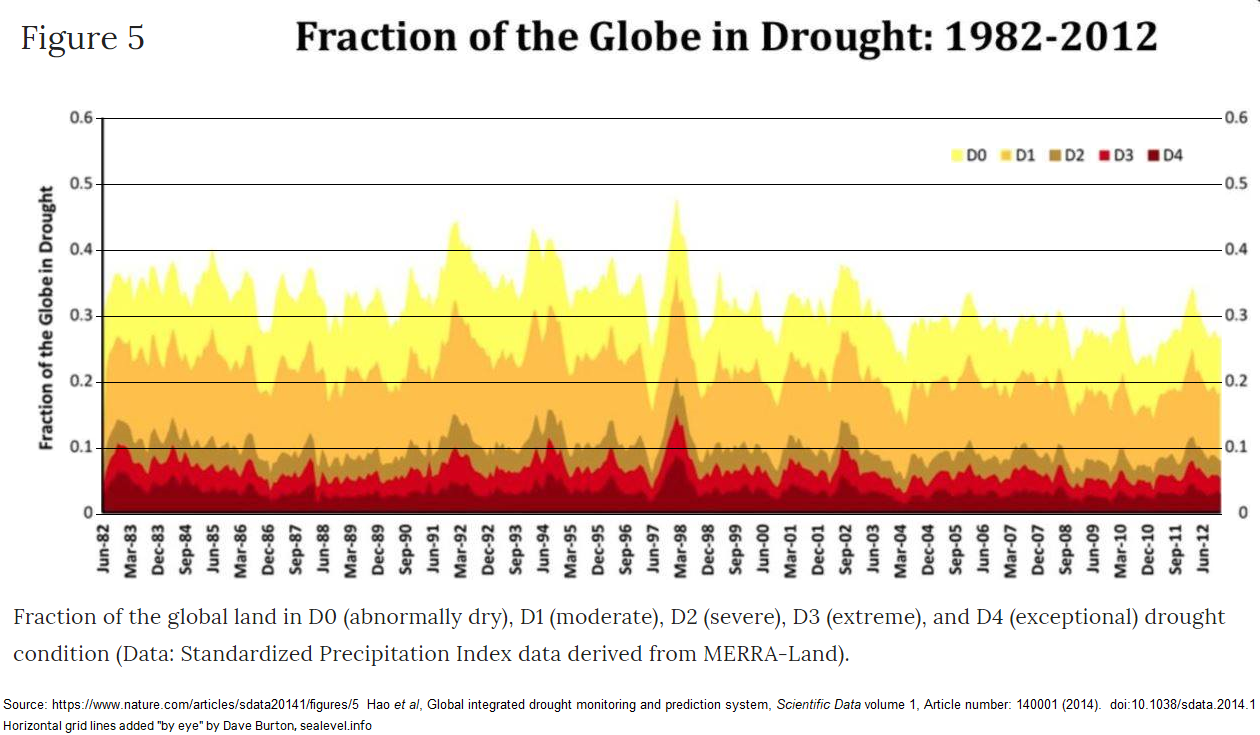
That is false. Droughts have not worsened, either in the United States, or globally:
sealevel.info/learnmore.html
sealevel.info/Fraction_of_th


Sammy Roth@Sammy_Roth
Mar 22 25
View on Twitter
A new seawater desalination being tested at Southern California's Las Virgenes Reservoir could reduce energy costs and limit harm to marine life -- if it works as hoped. Story from @Ian James: latimes.com/environment/st

2/12〕U.S. droughts are not worsening. Here's NOAA NCDC's U.S. percentage very wet or very dry:
ncdc.noaa.gov/temp-and-preci
sealevel.info/US_percentage_

3/12〕In fact, CO2 emissions mitigate drought impacts. Elevated CO2 helps plants use water more efficiently, by reducing stomatal conductance and transpiration. That's especially helpful in arid regions & during droughts. Here's a paper about corn: sciencedirect.com/science/articl
4/12〕Here's a paper about wheat:
onlinelibrary.wiley.com/doi/10.1111/gc
![Wheat production will be impacted by increasing concentration of atmospheric CO2 [CO2], which is expected to rise from about 400 μmol mol−1 in 2015 to 550 μmol mol−1 by 2050. Changes to plant...](https://pbs.twimg.com/card_img/1902387379140272129/TGfnJO7v?format=jpg&name=420x420_2)

5/12〕Here's a NASA video about how rising CO2 levels are greening the Earth and causing deserts to retreat:
youtube.com/watch?v=zOwHT8
6/12〕Mitigation of drought damage is a very important benefit of rising CO2 levels, and it is one of the reasons that catastrophic drought-induced famines are fading from living memory, for the first time in human history.
● sealevel.info/learnmore.html
● journals.ametsoc.org/view/journals/

7/12〕That's a very, very Big Deal. Famine used to be a scourge comparable to war and epidemic, the Third Horseman of the Apocalypse.
● sealevel.info/learnmore.html

8/12〕
sealevel.info/learnmore.html
For comparison:
● COVID-19 killed about 0.1% of the world's population
● The catastrophic 1918 flu pandemic killed about 2%
● WWII killed 2.7% of the world's population
● But the near-global drought and famine of 1876-78 killed about 3.7% of the world's population.

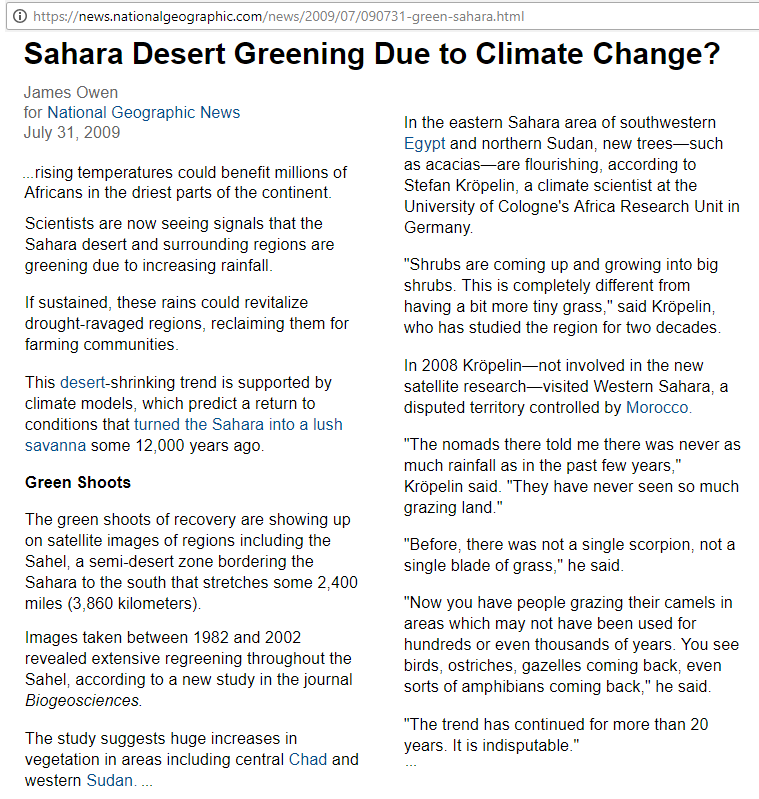
9/12〕Droughts still happen, of course, but elevated CO2 mitigates the adverse effects of vapor pressure deficit (dryness) on plants. That's why the global greening trend is most pronounced in the driest regions, like the Sahel (southern Sahara).
x.com/ncdave4life/st
Dave Burton@ncdave4life
Dave BurtonFeb 03 24
View on Twitter
15/18》 Here's what manmade climate changes is doing in Africa. This is what climate activists are campaigning against:
“’Before, there was not a single scorpion, not a single blade of grass… Now you have people grazing their camel…"
sealevel.info/Owen2009_Sahar
sealevel.info/090731-green-s

10/12〕ChatGPT did a good job of explaining how elevated CO2 improves plants' water use efficiency and mitigates drought impacts:
“In agronomy, the effects of elevated CO2 on plant water use efficiency and drought resilience are extensively studied. One of the key mechanisms through which elevated CO2 levels improve water use efficiency is by reducing stomatal conductance and, consequently, water loss through transpiration.
“Stomata are small pores on the surface of plant leaves that regulate gas exchange, including the uptake of CO2 for photosynthesis and the release of water vapor through transpiration. When CO2 levels are elevated, plants can maintain the same or higher rate of photosynthesis while reducing stomatal conductance. This reduction in stomatal conductance leads to a decrease in water loss through transpiration without significantly affecting CO2 uptake, resulting in improved water use efficiency.”
References:
1. Chun JA, et al. (2011). Effect of elevated carbon dioxide and water stress on gas exchange and water use efficiency in corn. Agricultural and Forest Meteorology, 151(3), pp 378–384. doi.org/10.1016/j.agrf.
2. O'Leary GJ, et al. (2015). Response of wheat growth, grain yield and water use to elevated CO2 under a Free-Air CO2 Enrichment (FACE) experiment and modelling in a semi-arid environment. Glob Chang Biol. 21(7):2670–2686. doi.org/10.1111/gcb.12
3. Fitzgerald GJ, et al. (2016) Elevated atmospheric [CO2] can dramatically increase wheat yields in semi-arid environments and buffer against heat waves. Glob Chang Biol. 22(6):2269-84. doi.org/10.1111/gcb.13
4. Uddin S, et al. (2018) Elevated [CO2] mitigates the effect of surface drought by stimulating root growth to access sub-soil water. PLoS One. 13(6):e0198928. doi.org/10.1371/journa
5. Taylor, C & Schlenker, W (2021). Environmental Drivers of Agricultural Productivity Growth: CO2 Fertilization of US Field Crops. National Bureau of Economic Research, no. w29320. doi.org/10.3386/w29320
6. Chen, Xin et al (2024). The global greening continues despite increased drought stress since 2000. Global Ecology and Conservation, Volume 49, 2024, e02791. doi.org/10.1016/j.gecc.
11/12〕To understand a politicized topic like #ClimateChange, you need balanced information. I'm here to help:
sealevel.info/learnmore.html
That resource list has:
● accurate introductory climatology information
● in-depth science from both skeptics & alarmists
● links to balanced debates between experts on both sides
● accurate information about impacts of CO2 & climate change, such as the effects on crop yields
● links to the best blogs on both sides of the climate debate
12/12〕So, Ian @Ian James, please correct this error in your @Los Angeles Times article:
latimes.com/environment/st

Dave Burton
Dave Burton@ncdave4life
My preferred pronoun is "harmless data drudge." https://t.co/YTkK6vaHGs Tel: +1 919-481-0098.
Missing some tweets in this thread? Or failed to load images or videos? You can try to .