
TacticzHazel - Value Investing@TacticzH
Jul 25, 2025
19 tweets
- ''A hidden gem'' - My $DLO Thesis!
DLocal shares have fallen over 85% since its IPO, but the ''new'' CEO, Pedro Arnt is turning things around. Growth is accelerating and profits are increasing.
 A big thread -Let's dive in
A big thread -Let's dive in 
1/ $DLO The company  DLocal is a fintech platform from Uruguay, it connects global merchants to emerging market consumers.
DLocal provides payment solutions for some of the world’s largest companies, like $AMZN, $GOOGL, $UBER, $NIKE, $CRM and $MSFT (and many more).
In essence you can compare them to $ADYEN, but they are definitely not the same. $DLO focuses solely on emerging markets while $ADYEN has a worldwide reach.
They help all of the above companies navigate the difficult landscape of payment processing in emerging markets.
They aim specially at: Latin America, Africa, the Middle East, and Asia and currently operate in 43 countries.
This video is a great summary of what they do
DLocal is a fintech platform from Uruguay, it connects global merchants to emerging market consumers.
DLocal provides payment solutions for some of the world’s largest companies, like $AMZN, $GOOGL, $UBER, $NIKE, $CRM and $MSFT (and many more).
In essence you can compare them to $ADYEN, but they are definitely not the same. $DLO focuses solely on emerging markets while $ADYEN has a worldwide reach.
They help all of the above companies navigate the difficult landscape of payment processing in emerging markets.
They aim specially at: Latin America, Africa, the Middle East, and Asia and currently operate in 43 countries.
This video is a great summary of what they do
DLocal is a fintech platform from Uruguay, it connects global merchants to emerging market consumers.
DLocal provides payment solutions for some of the world’s largest companies, like $AMZN, $GOOGL, $UBER, $NIKE, $CRM and $MSFT (and many more).
In essence you can compare them to $ADYEN, but they are definitely not the same. $DLO focuses solely on emerging markets while $ADYEN has a worldwide reach.
They help all of the above companies navigate the difficult landscape of payment processing in emerging markets.
They aim specially at: Latin America, Africa, the Middle East, and Asia and currently operate in 43 countries.
This video is a great summary of what they do 2/ The One-Stop-Shop-Model
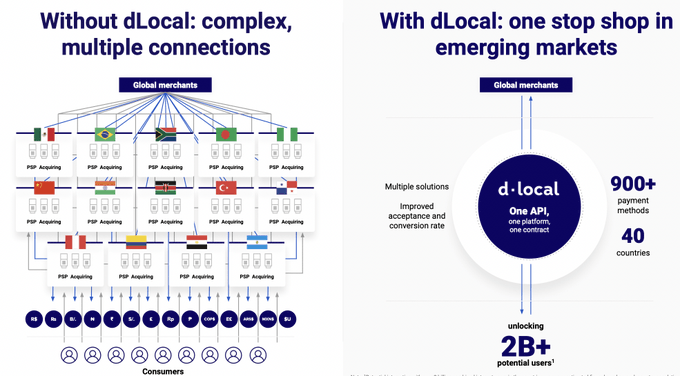
$DLO acts as a one-stop-shop. They basically connect a huge scala of payment methods through one API. They make all these different payment methods, in all of the countries they operate in, easily accessible to their clients.
This way it's easy for their customers to expand their business in these high-growth emerging market regions.
It's platform manages currencies, fraud, compliance, settlement, and reconciliation to simplify cross‑border payments in all these fragmented markets.
The picture below perfectly captures how that works.
3. How does $DLO make money?
In simple terms: $DLO makes most of its money by charging fees whenever customers make payments or when businesses send money out.
That means they generate revenue through fees on pay-in and pay-out services.
 Payins ( when customers pay a business) : They accept over 700–900 local payment methods (e-wallets, bank transfers, cards, cash, etc.) in local currencies
Payouts (when a business sends money out to people or partners): Execute mass disbursements to local partners, vendors, and gig workers in local currencies
The different types of fees are; processing fees, installment fees, foreign exchange fee and other transactional fees.
Payins ( when customers pay a business) : They accept over 700–900 local payment methods (e-wallets, bank transfers, cards, cash, etc.) in local currencies
Payouts (when a business sends money out to people or partners): Execute mass disbursements to local partners, vendors, and gig workers in local currencies
The different types of fees are; processing fees, installment fees, foreign exchange fee and other transactional fees.
Payins ( when customers pay a business) : They accept over 700–900 local payment methods (e-wallets, bank transfers, cards, cash, etc.) in local currencies
Payouts (when a business sends money out to people or partners): Execute mass disbursements to local partners, vendors, and gig workers in local currencies
The different types of fees are; processing fees, installment fees, foreign exchange fee and other transactional fees.

4/ Who is in charge of $DLO?
When investing in a company, one of the first things I do, is look at management/leadership. $DLO's CEO impressed me right of the bat.
Pedro Arnt joined $DLO in August 2023, and was appointed CO-CEO next to the co-founder Sebastián Kanovich.
He's an experienced fintech executive, and he was one of the key drivers behind $MELI's road to success. He joined Mercadolibre in 1999 and worked his way up to become CFO and Execute Vice President.
His work at $MELI makes him the perfect CEO for DLocal, as he deeply understands the operational, regulatory, and currency complexities of the markets dLocal serves.
Pedro described joining dLocal as;
''a unique chance to scale a company that’s “big enough to do amazing work, yet still innovating and building''
Investors can now see that he’s got a clear vision and knows how to get things done. His leadership is a big reason why DLO is starting to bounce back.
In Pedro we trust!

5/ The downfall
$DLO's stock price has declined almost 85% from it's all-time high. There are a couple of reasons as to why this happened, and they are important to be aware of:
Short report: DLocal was accused of fraud in a short report by Hollenden Square Research. The company and CEO addressed the issues briefly, and further stated the the allegations were ''inaccurate and misleading''. To me, the short report lacks substance and the accusation of fraud is misrepresentative of the quality of the company
Declining margins: Margins have been declining for a while. This is due to repricing and a strong focus on growth. As clients become larger, they have more negotiations power, and therefore pressure on margins becomes larger. Lower take rates = lower margins
Change in Leadership: When the founder stepped down, the market reacted very negatively. However, when Pedro Arnt joined the club, we saw the exact opposite. Leadership changes take a while to come to fruition, and I think they are in a steady position now.
Short report: DLocal was accused of fraud in a short report by Hollenden Square Research. The company and CEO addressed the issues briefly, and further stated the the allegations were ''inaccurate and misleading''. To me, the short report lacks substance and the accusation of fraud is misrepresentative of the quality of the company
Declining margins: Margins have been declining for a while. This is due to repricing and a strong focus on growth. As clients become larger, they have more negotiations power, and therefore pressure on margins becomes larger. Lower take rates = lower margins
Change in Leadership: When the founder stepped down, the market reacted very negatively. However, when Pedro Arnt joined the club, we saw the exact opposite. Leadership changes take a while to come to fruition, and I think they are in a steady position now.
6.1/ Growth potential - TAM
So what makes DLocal such a great investment? It's their huge growth potential.
First, let's check the potential of emerging markets as a whole and then dive into the numbers.
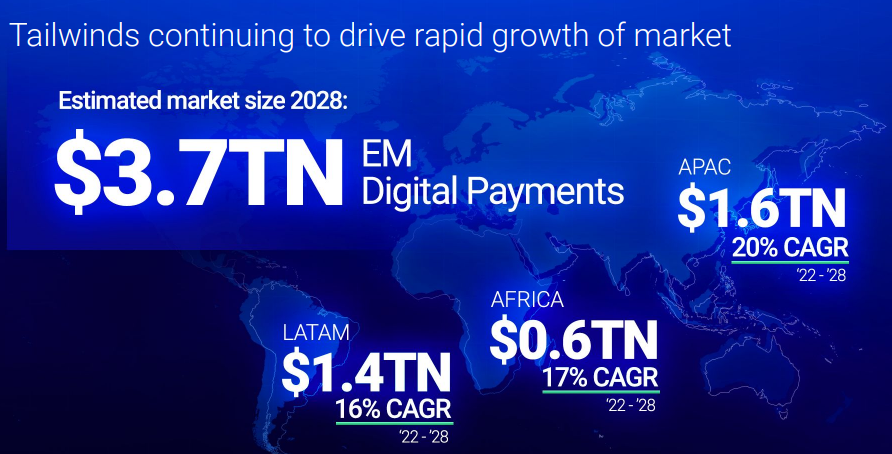
DLocal currently addresses an estimated $2T TAM in digital payments across the Global South.
This market is projected to grow at a high-teens Compound Annual Growth Rate (CAGR) through 2030 in most Latin American and Asia-Pacific markets
Currently they only take like 1% of the whole market potential.
6.2 / Growth Potential - Tailwinds
Besides the huge addressable TAM, there are several secular tailwinds in E-M to keep in mind:
Internet Usage is growing at a rapid pace
E-commerce penetration is only getting started
Consumer spending is growing almost at a double pace in EMs compared to DMs (developed markets
All of these combined make the E-M a very attractive niche to focus on. And Dlocal has no intention to deviate from this plan.
Internet Usage is growing at a rapid pace
E-commerce penetration is only getting started
Consumer spending is growing almost at a double pace in EMs compared to DMs (developed markets
All of these combined make the E-M a very attractive niche to focus on. And Dlocal has no intention to deviate from this plan.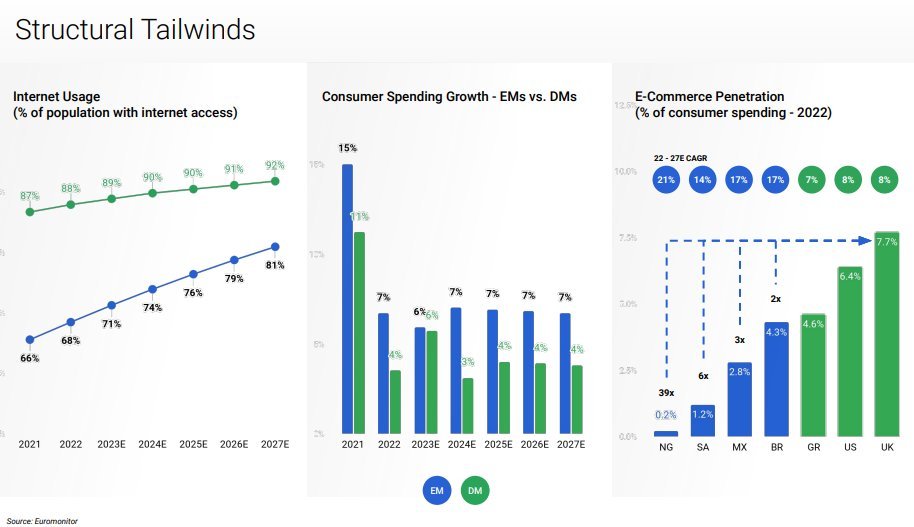
7/ $DLO's fast growth
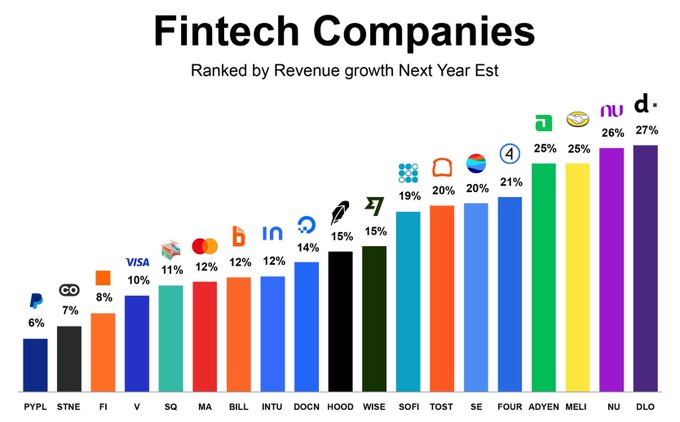
$DLO's growth has been very strong in the last 5 years.
They've grown their revenue at a CAGR of 68.3%
When looking at their peers, they are expected to be the fastest growing fintech company next year.
8/ TPV
But even more important is their TPV growth. TPV stands for total payment volume. It represents the total dollar amount of transactions processed through their platform over a specific period.
$DLO's main focus right now is increasing their TPV. Meanwhile also sustaining a decent take rate and improving their margins.
TPV indicates overall business expansion and market share. The more transactions, the more fees earned, the more profit eventually.
Their TPV grew 81.49% CAGR since 2021. From just $3.7B in Q2-21 to $28.3B in Q1-25.

9/ Take rate
Another key metric to watch is their take rate, and it's been under pressure.
DLocal had a tough time with its profit margins. That's because take rates (basically, how much they earn from each transaction) went down across the whole industry, and DLocal was also putting a lot of money into improving its tech.
Plus, there were a few one-off issues that messed with their operations temporarily.
It looks like they've stabilized their take rates and are keeping their margins solid. They're also starting to see their operations become more efficient, and that should only get better in the next few quarters.

10/ Revenue growth performance
With TPV growing so fast, so did their revenue. Revenue grew 68% CAGR in the last 5 years.
But more importantly. Revenue is expected to double in the next 3 years. From $746M to $1.5B in 2027

11/ Margins
As mentioned before, margins were declining for a long period, but are now stabilizing
Gross profit margin sits just below 40%
Net profit margin is hovering just above 20%
FCF margins are just above 2% but the CEO expects these margins to return to ''normal'' very soon. Which would imply a FCF margin of 20% or more.
Gross profit margin sits just below 40%
Net profit margin is hovering just above 20%
FCF margins are just above 2% but the CEO expects these margins to return to ''normal'' very soon. Which would imply a FCF margin of 20% or more.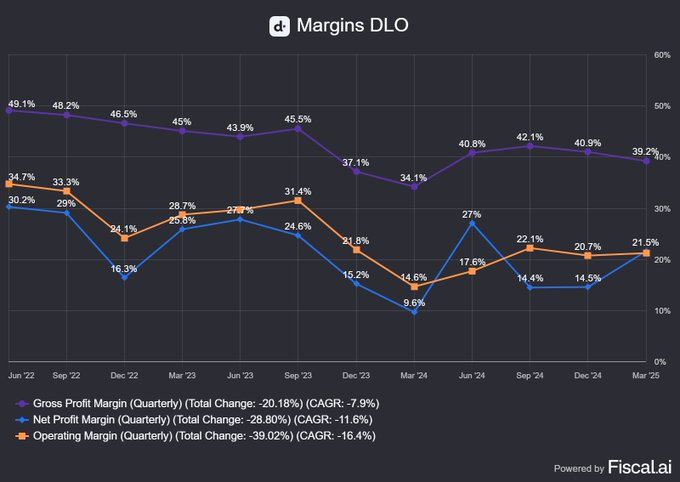
12/ Cash and Debt
Their balance sheet looks very healthy. They have a strong cash position and almost no debt.

13/ Risks
Before we get to the valuation, let's explore the risks when investing in $DLO:
So, what's $DLO up against?
They've got a high concentration in a small group of merchants
Being in emerging markets means they're constantly facing currency risks and economic instability, but that just comes with the territory.
Competition: they're battling it out with heavyweights like Adyen and Stripe. Albeit, they don't have a specific focus on Emerging Markets.
Despite all that, $DLO is actually pretty well-positioned to tackle these risks because they've really specialized and focused on all the unique details of emerging markets.
They've got a high concentration in a small group of merchants
Being in emerging markets means they're constantly facing currency risks and economic instability, but that just comes with the territory.
Competition: they're battling it out with heavyweights like Adyen and Stripe. Albeit, they don't have a specific focus on Emerging Markets.
Despite all that, $DLO is actually pretty well-positioned to tackle these risks because they've really specialized and focused on all the unique details of emerging markets.14.1/ $DLO Valuation Base Case
For all my scenario's, I think my assumptions are rather conservative. A lot will depend on the take rate. I think anything close to 2% is very justifiable
Assumptions:
TPV: 30% CAGR
Take rate: 1.85
Net margin: 20%
Multiple: 20:
No dilution
This gives a CAGR of 22.83%
TPV: 30% CAGR
Take rate: 1.85
Net margin: 20%
Multiple: 20:
No dilution
This gives a CAGR of 22.83%
14.2/ $DLO Valuation Bear Case
My bear case:
Assumptions:
TPV: 25% CAGR
Take rate: 1.75
Net margin: `19%
Multiple: 18:
No dilution
These assumptions are highly conservative and still provide us with a CAGR of 11.72%
TPV: 25% CAGR
Take rate: 1.75
Net margin: `19%
Multiple: 18:
No dilution
These assumptions are highly conservative and still provide us with a CAGR of 11.72% 
14.3/ / $DLO Valuation Bull Case
My bull case:
Assumptions:
TPV: 35% CAGR
Take rate: 2
Net margin: 23%
Multiple: 22:
No dilution
The bull case scenario gives a CAGR of 36.23%
Summary:
Bear case: 11.72% CAGR
Base case: 22.83% CAGR
Bull case: 36.23% CAGR
TPV: 35% CAGR
Take rate: 2
Net margin: 23%
Multiple: 22:
No dilution
The bull case scenario gives a CAGR of 36.23%
Summary:
Bear case: 11.72% CAGR
Base case: 22.83% CAGR
Bull case: 36.23% CAGR
15/ Conclusion
Just like any other company, $DLO does not come without risk. But, the opportunity is very clear. Grow TPV, maintain a decent take rate and ride the E-M secular trends.
It's great management, fast-growing metrics, high margins and geographical tailwinds provide an excellent risk/reward play right now.
That's why I recently opened a position in $DLO and will continue to scale it to a full position in the upcoming months.
Note: this analysis is purely my reflection of how I personally view the company. I'm not a financial expert, nor do I claim to be. I just do my best.
So, do your own research!
If there's anything I missed or got wrong, let me know!
Thanks for reading. Leave a like, make a repost or follow me! It really helps me out.
Have a great day!


TacticzHazel - Value Investing
@TacticzH
Long-Term Investor with a Value Mindset 📈 |
Market Analyst and Commodity Trader |
15% off https://t.co/tcYsRwuSqG : https://t.co/vmheAb5XgC
Missing some tweets in this thread? Or failed to load images or videos? You can try to .