
Ammaar Muslim@ammaar_muslim
Aug 1, 2025
21 tweets
The ʿUthmānī Position on ʿAlī b. Abī Ṭālib  The majority of proto-Sunnis throughout the second-century were ʿUthmānīs.
Who were ʿUthmānīs?
The majority of proto-Sunnis throughout the second-century were ʿUthmānīs.
Who were ʿUthmānīs?
The majority of proto-Sunnis throughout the second-century were ʿUthmānīs.
Who were ʿUthmānīs?Some mistakenly believe the ʿUthmānīs to have merely preferred ʿUthmān over ʿAlī, as though the ʿUthmānīs still considered ʿAlī the fourth-best in merit or acknowledged his Caliphate, but this is not historically accurate.
In actual fact, the ʿUthmānīs of the second-century are known to have considered Abū Bakr, ʿUmar, and ʿUthmān to be the three best men after the Prophet and the *only* legitimate Caliphs, with their attitude towards ʿAlī ranging from indifference to varying degrees of animosity.
As the well-informed litterateur al-Jāḥiẓ (d. 255), no friend of the Shia, puts it:
“You know for a fact that there wasn’t a single ʿUthmānī on earth except that he rejected his (i.e. ʿAlī’s) imamate, and they (i.e. the ʿUthmānīs) were more in number (among the masses) and boasted a greater number of jurists and narrators”

This is how Aḥmad b. Saʿīd al-Dārimī (d. 253) defines ʿUthmānīs:
“There was a group called the ʿUthmāniyya who asserted: Abū Bakr, (then) ʿUmar, (then) ʿUthmān, (then) they remain silent”

A number of those who are considered pillars of Sunnism today and highly lauded in classical books of rijāl were ʿUthmānīs, especially those residing in Basra.
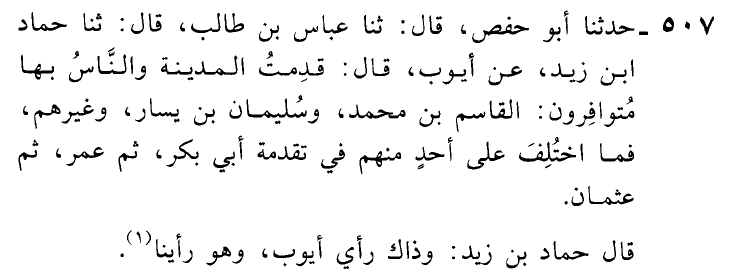
The Basran Ayyūb al-Sakhtiyānī (d. 131) was an ʿUthmānī. He claimed to have received this doctrine from Medina as reported by Ayyūb’s student, the ʿUthmānī Ḥammād b. Zayd (d. 177).
The highly respected Basran colleague of Ayyūb, Ibn ʿAwn (d. 151), was an ʿUthmānī as Ibn Saʿd (d. 230) informs us.

The Basran Yazīd b. Zurayʿ (d. 183), a known ʿUthmānī himself, and a student of both Ayyūb and Ibn ʿAwn, states:
“The best of this umma after the Messenger of Allah are Abū Bakr, then ʿUmar, then ʿUthmān, then we stop”

When the Basran ʿAbd al-Raḥmān b. al-Mahdī (d. 198) heard that his colleague, the Basran Yaḥyā b. Saʿīd al-Qaṭṭān (d. 198) considered Abū Bakr first, ʿUmar second, and then chose to suspend judgment instead of affirming ʿUthmān, he grew angry at him and criticized him saying:
“Whose lead are you following in this? When this is not the position of the Basrans!”

The Basran judge, ʿAbdallāh b. Sawwār al-ʿAnbarī (d. 228), states:
“The sunna with us, and what we found Ḥammād (b. Salama), Ḥammād (b. Zayd), and those men who should be followed upholding (is) giving precedence to Abū Bakr, then ʿUmar, then ʿUthmān”

The Basran Sulaymān b. Ḥarb (d. ca. 224) who later moved to Baghdad is quoted as saying:
“The Messenger passed away and the best of of the people after him was Abū Bakr. Abū Bakr passed away and the best of people after him was ʿUmar. ʿUmar passed away and the best of people after him was ʿUthmān.
Abū Bakr, (then) ʿUmar, (then) ʿUthmān, (then) we keep silent”

Perhaps the best summary of how entrenched this position was in Basra is provided by Mūsa b. Ismāʿīl al-Tabūdhkī (d. 223 or 226) who states:
“This is what we were instructed, what nourished our flesh (since childhood), and what we found the people (united) upon: Giving precedence to Abū Bakr, ʿUmar, ʿUthmān, then remaining silent”

And we know that the Baghdadi circle around Aḥmad b. Ḥanbal (d. 241), who were decisive in defining the contours of what Sunnism came to be, shared the same ʿUthmānī position as their Basran teachers.
We find in the early treatise Masāʾil al-Imāma, likely authored by the Baghdadi Muʿtazilī theologian Jaʿfar b. Ḥarb (d. 236):
“As for the Baghdadi authorities among the Aṣḥāb al-Ḥadīth then they do not affirm the imamate of ʿAlī. These include Ibn Maʿīn, Abū Khaythama, and Aḥmad b. Ḥanbal. They used to efface the name of ʿAlī from the list of Caliphs and consider his rule as a period of fitna …”

The reality is that if Aḥmad b. Ḥanbal had not changed tack at some later point and began rehabilitating ʿAlī within Aṣḥāb al-Ḥadīth circles, Sunnism would have looked very different today …

Missing some tweets in this thread? Or failed to load images or videos? You can try to .