Salim سليم@_AbuHadi_
Aug 5, 2025
12 tweets
An excellent thread. To add: Syriac chronicles from the 7th–8th centuries further corroborate the ʿUthmānī erasure of ʿAlī from the caliphal record.

Ammaar Muslim@ammaar_muslim
Aug 01 25
View on Twitter
The ʿUthmānī Position on ʿAlī b. Abī Ṭālib  The majority of proto-Sunnis throughout the second-century were ʿUthmānīs.
Who were ʿUthmānīs?
The majority of proto-Sunnis throughout the second-century were ʿUthmānīs.
Who were ʿUthmānīs?
The majority of proto-Sunnis throughout the second-century were ʿUthmānīs.
Who were ʿUthmānīs?The Maronite Chronicle, likely written in the mid‑7th Century, portrays ʿAlī as a rebel.
It says that after his killing, Muʿāwiya went to Ḥīra, received the allegiance of the entire Arab army, then returned to Damascus.
This frames ʿAlī not as a Caliph, but as a usurper.

This fits with the ʿUthmānī doctrine described in the original thread: affirming only Abū Bakr, ʿUmar, and ʿUthmān as legitimate Caliphs, treating ʿAlī with silence, if not outright contempt, since he is merely a suppressed rebel.
The Syriac Life of Maximus the Confessor goes further.
It reports that Muʿāwiya made a truce with Emperor Constans while waging war against “Abū Turāb” at Ṣiffīn, and defeated him.
No arbitration. Nor any caliphal recognition for ʿAlī.

Most striking are the lists in two other Syriac texts, both of which completely omit ʿAlī:
• Chronicle ad 705: “They were without a leader in the war of Ṣiffīn: five and a half years. After this, Muʿāwiya reigned: twenty years.”

• Chronicle ad 724: “After ʿUthmān, dissension: five years and four months. Muʿāwiya … nineteen years and two months.”

These omissions are not accidents.
They align with the prevailing ʿUthmānī position: ʿAlī’s rule was not considered a legitimate caliphate, but rather, a period of turmoil.
And crucially: These Syriac chroniclers likely drew their information from the Muslim milieu.
They had no motive to erase ʿAlī on their own, while this silence mirrors the mainstream Muslim narrative of the time, namely, that of the ʿUthmāniyya.
In the words of Penn:

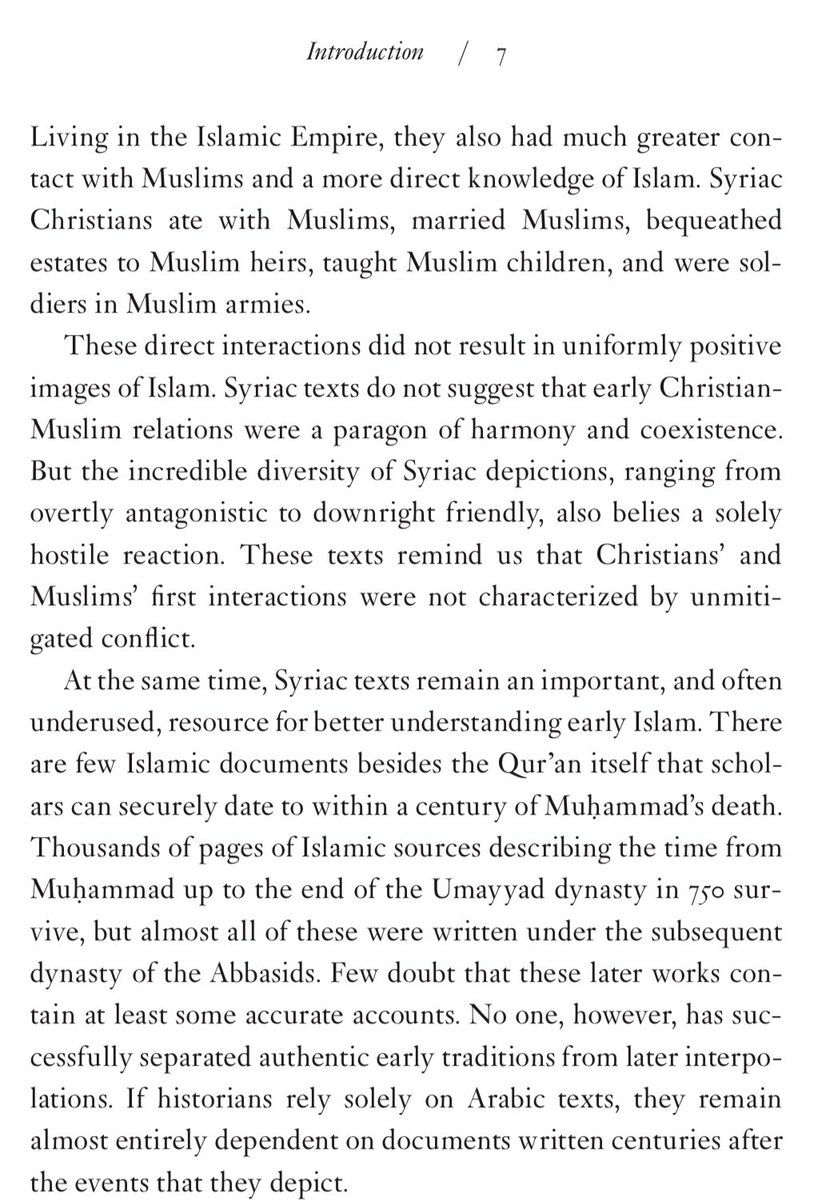
So while Muslim sources may provide us glimpses of the “silence” over ʿAlī, Syriac sources make that silence visible; by erasing him entirely from the succession.
Taken together, the Muslim and Syriac records show just how deeply embedded the ʿUthmānī narrative was in the 1st/2nd Hijri century. Its echoes are forgotten in contemporary Muslim memory, while they remain loud and clear in non‑Muslim historiography.
In short: Syriac chronicles, written by individuals embedded in the Muslim milieu, echo the ʿUthmānī stance that erased ʿAlī from the caliphal record. This reflects how mainstream proto‑Sunnism treated his rule.
The information on these chronicles, their provenance, and their contents, can be found in Michael Philip Penn’s eye-opening work: “When Christians First Met Muslims”.
References (in order of the thread): Pgs. 54-57, 62-68, 156-159, 196-199, 6-7.


Missing some tweets in this thread? Or failed to load images or videos? You can try to .