Kevin Weil  @kevinweil
Sep 2, 2025
12 tweets
 I’m starting something new inside OpenAI! It’s called OpenAI for Science, and the goal is to build the next great scientific instrument: an AI-powered platform that accelerates scientific discovery.
I’m starting something new inside OpenAI! It’s called OpenAI for Science, and the goal is to build the next great scientific instrument: an AI-powered platform that accelerates scientific discovery.We’ll look to hire a small team of academics that are (i) world-class in their field; (ii) completely AI-pilled; and (iii) great science communicators. Paired with a small team of researchers, we want to prove that AI models are ready to accelerate fundamental science—and accelerate research all over the world.
Scientific discovery improves everything from the quality of our daily lives to national security to global GDP. Innovation is the reason the US leads the world. Few domains hold as much promise for improving lives as science.
GPT-5 is clearly a new threshold; below are four recent examples. There are many more, not to mention things like AlphaFold from our friends at GDM.
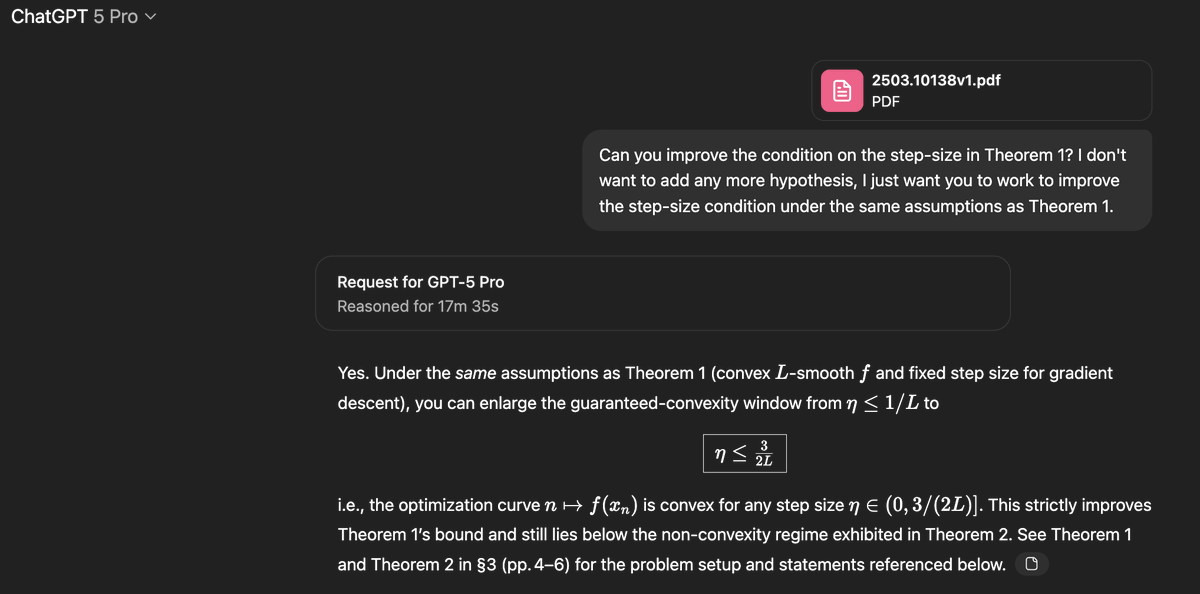
1. GPT-5 Pro was able to improve a bound in one of @Sebastien Bubeck's papers on convex optimization—by 50%, with 17 minutes of thinking. x.com/SebastienBubec
Sebastien Bubeck@SebastienBubeck
Aug 20 25
View on Twitter
Claim: gpt-5-pro can prove new interesting mathematics.
Proof: I took a convex optimization paper with a clean open problem in it and asked gpt-5-pro to work on it. It proved a better bound than what is in the paper, and I checked the proof it's correct.
Details below.
2. GPT-5 outlining proofs and suggesting related extensions, from a recent hep-th paper on quantum field theory [arxiv.org/pdf/2508.21276]

3. Our recent work with @Retro Biosciences , where a custom model designed much-improved variants of Nobel-prize winning proteins related to stem cells. x.com/polynoamial/st
Noam Brown@polynoamial
Aug 22 25
View on Twitter
This result was achieved several months ago, with a non-reasoning mini model. Our latest models are much more capable and general. I suspect we'll see many more results like this over the next year or so.
4. @Derya Unutmaz, MD has been a non-stop source of examples of AI accelerating his biological research, such as x.com/DeryaTR_/statu
Derya Unutmaz, MD@DeryaTR_
Aug 17 25
View on Twitter
I’m excited to share the first part of an absolutely stunning analysis from the GPT-5 thinking model! I uploaded a huge spreadsheet, nearly 1,300 metabolites (lipids, carbohydrates, microbiome-derived compounds, and much more) measured in 150 ME/CFS patients and 100 healthy controls.
In the first run, I didn’t even tell GPT-5 these samples were from ME/CFS patients, I wanted to see what it could find blind, purely from the metabolomics data. Next, I’ll share the version where I revealed these were from our patient cohort, tied to our recently published paper and what GPT-5 uncovered there is yet on another level!
We had analyzed this same dataset over two years ago, and it took us more than a month to fully work through it.
 GPT-5 did a better job in under five minutes.
It not only replicated almost everything we had concluded back then, including finding all the significant differences, creating multiple spreadsheets on different pathways and so on, but also uncovered several discoveries we completely missed.
GPT-5 even highlighted actionable targets and potential treatments for patients (which I’ll share soon).
This isn’t an “incremental improvement.” This is a revolution!
What once took months now takes hours. As I mentioned before the rules of scientific research aren’t just shifting, they’re being rewritten!
Sharing a portion of output from GPT-5 as an example, and executive summary is also included as a screenshot.
Unified mechanistic theory with causal diagram
Observed pattern
•Lipid remodeling with increased DAG, PC, SM, and specific ceramides in patients.
•Cofactor pattern with decreased carotenoids and increased alpha-tocopherol.
Mechanistic links
•De novo ceramide synthesis via serine palmitoyltransferase and ceramide synthases increases ceramide pools that influence stress and signaling.
•The Kennedy (CDP-choline) pathway couples DAG and PC metabolism; CHKA → PCYT1A → CHPT1 convert choline to PC using DAG as the acceptor.
•DAG activates PKCε and related isoforms, which can shift receptor signaling fidelity.
•Alpha-tocopherol is a lipid-phase peroxyl radical scavenger and is regenerated by ascorbate; reduced carotenoids are consistent with antioxidant consumption.
Ranked, actionable targets
1.SPTLC1/2 or CERS (enzymes) - decrease de novo ceramide synthesis. Low feasibility at present but highly causal if lipid drivers are primary. Risks include effects on myelin.
2.DGAT1/2 modulation - reduce toxic DAG signaling by shunting to neutral storage or titrating flux. Medium feasibility, GI tolerability is the key risk.
3.PKCε inhibition - block DAG-to-signaling step. Currently low feasibility, but mechanistically precise.
4.Dietary carotenoids and vitamin C support - replete antioxidant capacity and aid tocopherol recycling. High feasibility, monitor F2-isoprostanes and carotenoid panel.
5.Trial L-carnitine only if deficiency is confirmed - small signal in carnitine pathway; low-confidence, pilot dosing with monitoring.
Proposed validation experiments and minimal clinical biomarker panel
Validation experiments
•Targeted lipidomics focusing on DAG species, ceramides (chain-length resolved), sphingomyelins, PCs.
•PKCε activity proxies in accessible cells if feasible.
•Antioxidant panel: alpha-tocopherol, carotenoids, vitamin C, plus F2-isoprostanes for lipid peroxidation readout.
•If pilot L-carnitine is considered, measure free and acyl-carnitines and the acyl/free ratio pre-post.
Minimal monitoring panel
•Ceramides: d18:1/16:0, d18:1/18:0, and dihydroceramides.
•DAG class panel with positional isomers if available; report as molar % of total lipids.
•PC class and LPC/PC ratio; choline and phosphocholine to infer Kennedy pathway flux.
•Alpha-tocopherol, beta-cryptoxanthin, carotene diols, vitamin C, and F2-isoprostanes.
GPT-5 did a better job in under five minutes.
It not only replicated almost everything we had concluded back then, including finding all the significant differences, creating multiple spreadsheets on different pathways and so on, but also uncovered several discoveries we completely missed.
GPT-5 even highlighted actionable targets and potential treatments for patients (which I’ll share soon).
This isn’t an “incremental improvement.” This is a revolution!
What once took months now takes hours. As I mentioned before the rules of scientific research aren’t just shifting, they’re being rewritten!
Sharing a portion of output from GPT-5 as an example, and executive summary is also included as a screenshot.
Unified mechanistic theory with causal diagram
Observed pattern
•Lipid remodeling with increased DAG, PC, SM, and specific ceramides in patients.
•Cofactor pattern with decreased carotenoids and increased alpha-tocopherol.
Mechanistic links
•De novo ceramide synthesis via serine palmitoyltransferase and ceramide synthases increases ceramide pools that influence stress and signaling.
•The Kennedy (CDP-choline) pathway couples DAG and PC metabolism; CHKA → PCYT1A → CHPT1 convert choline to PC using DAG as the acceptor.
•DAG activates PKCε and related isoforms, which can shift receptor signaling fidelity.
•Alpha-tocopherol is a lipid-phase peroxyl radical scavenger and is regenerated by ascorbate; reduced carotenoids are consistent with antioxidant consumption.
Ranked, actionable targets
1.SPTLC1/2 or CERS (enzymes) - decrease de novo ceramide synthesis. Low feasibility at present but highly causal if lipid drivers are primary. Risks include effects on myelin.
2.DGAT1/2 modulation - reduce toxic DAG signaling by shunting to neutral storage or titrating flux. Medium feasibility, GI tolerability is the key risk.
3.PKCε inhibition - block DAG-to-signaling step. Currently low feasibility, but mechanistically precise.
4.Dietary carotenoids and vitamin C support - replete antioxidant capacity and aid tocopherol recycling. High feasibility, monitor F2-isoprostanes and carotenoid panel.
5.Trial L-carnitine only if deficiency is confirmed - small signal in carnitine pathway; low-confidence, pilot dosing with monitoring.
Proposed validation experiments and minimal clinical biomarker panel
Validation experiments
•Targeted lipidomics focusing on DAG species, ceramides (chain-length resolved), sphingomyelins, PCs.
•PKCε activity proxies in accessible cells if feasible.
•Antioxidant panel: alpha-tocopherol, carotenoids, vitamin C, plus F2-isoprostanes for lipid peroxidation readout.
•If pilot L-carnitine is considered, measure free and acyl-carnitines and the acyl/free ratio pre-post.
Minimal monitoring panel
•Ceramides: d18:1/16:0, d18:1/18:0, and dihydroceramides.
•DAG class panel with positional isomers if available; report as molar % of total lipids.
•PC class and LPC/PC ratio; choline and phosphocholine to infer Kennedy pathway flux.
•Alpha-tocopherol, beta-cryptoxanthin, carotene diols, vitamin C, and F2-isoprostanes.
GPT-5 did a better job in under five minutes.
It not only replicated almost everything we had concluded back then, including finding all the significant differences, creating multiple spreadsheets on different pathways and so on, but also uncovered several discoveries we completely missed.
GPT-5 even highlighted actionable targets and potential treatments for patients (which I’ll share soon).
This isn’t an “incremental improvement.” This is a revolution!
What once took months now takes hours. As I mentioned before the rules of scientific research aren’t just shifting, they’re being rewritten!
Sharing a portion of output from GPT-5 as an example, and executive summary is also included as a screenshot.
Unified mechanistic theory with causal diagram
Observed pattern
•Lipid remodeling with increased DAG, PC, SM, and specific ceramides in patients.
•Cofactor pattern with decreased carotenoids and increased alpha-tocopherol.
Mechanistic links
•De novo ceramide synthesis via serine palmitoyltransferase and ceramide synthases increases ceramide pools that influence stress and signaling.
•The Kennedy (CDP-choline) pathway couples DAG and PC metabolism; CHKA → PCYT1A → CHPT1 convert choline to PC using DAG as the acceptor.
•DAG activates PKCε and related isoforms, which can shift receptor signaling fidelity.
•Alpha-tocopherol is a lipid-phase peroxyl radical scavenger and is regenerated by ascorbate; reduced carotenoids are consistent with antioxidant consumption.
Ranked, actionable targets
1.SPTLC1/2 or CERS (enzymes) - decrease de novo ceramide synthesis. Low feasibility at present but highly causal if lipid drivers are primary. Risks include effects on myelin.
2.DGAT1/2 modulation - reduce toxic DAG signaling by shunting to neutral storage or titrating flux. Medium feasibility, GI tolerability is the key risk.
3.PKCε inhibition - block DAG-to-signaling step. Currently low feasibility, but mechanistically precise.
4.Dietary carotenoids and vitamin C support - replete antioxidant capacity and aid tocopherol recycling. High feasibility, monitor F2-isoprostanes and carotenoid panel.
5.Trial L-carnitine only if deficiency is confirmed - small signal in carnitine pathway; low-confidence, pilot dosing with monitoring.
Proposed validation experiments and minimal clinical biomarker panel
Validation experiments
•Targeted lipidomics focusing on DAG species, ceramides (chain-length resolved), sphingomyelins, PCs.
•PKCε activity proxies in accessible cells if feasible.
•Antioxidant panel: alpha-tocopherol, carotenoids, vitamin C, plus F2-isoprostanes for lipid peroxidation readout.
•If pilot L-carnitine is considered, measure free and acyl-carnitines and the acyl/free ratio pre-post.
Minimal monitoring panel
•Ceramides: d18:1/16:0, d18:1/18:0, and dihydroceramides.
•DAG class panel with positional isomers if available; report as molar % of total lipids.
•PC class and LPC/PC ratio; choline and phosphocholine to infer Kennedy pathway flux.
•Alpha-tocopherol, beta-cryptoxanthin, carotene diols, vitamin C, and F2-isoprostanes.
I went to grad school to become a researcher in high energy physics, only to get nerdsniped into startups like so many others. I feel super fortunate now to get to combine both.
I’ll simultaneously begin working with @Sebastien Bubeck and the synthetic data team at OpenAI as an AI researcher to learn the craft. I’m grateful to him and his team for being willing to mentor me, and I’m eager to prove worth their time and effort!
I’m able to do this because the product and design leaders at OpenAI are amazing, and now are complemented by @Fidji Simo beginning her role as CEO of Applications. OpenAI’s products have been my life since I joined, and they’re in great hands.
We’ll share more about OpenAI for Science in the coming months. In the meantime, if you’re an AI or academic researcher interested in joining us, my DMs are open.
Kevin Weil
@kevinweil
CPO @OpenAI, BoD @Cisco @nature_org, LTC @USArmyReserve
Prev: President @Planet, Head of Product @Instagram @Twitter
❤️ @elizabeth ultramarathons kids cats math
Missing some tweets in this thread? Or failed to load images or videos? You can try to .