
Daniel Kodsi@dfkodsi
Sep 19, 2025
4 tweets
In the coming term, the Supreme Court will be considering a pair of cases about state laws which exclude male athletes from female sports. Such laws, which have now been enacted by 27 states, are conceived by their proponents as protecting the integrity of female sports and by their opponents as engaging in invidious discrimination. The cases are to be argued together and are among the highest profile of this SCOTUS term—unsurprisingly, since they concern the constitutionality of central provisions of Title IX, a landmark civil rights law.
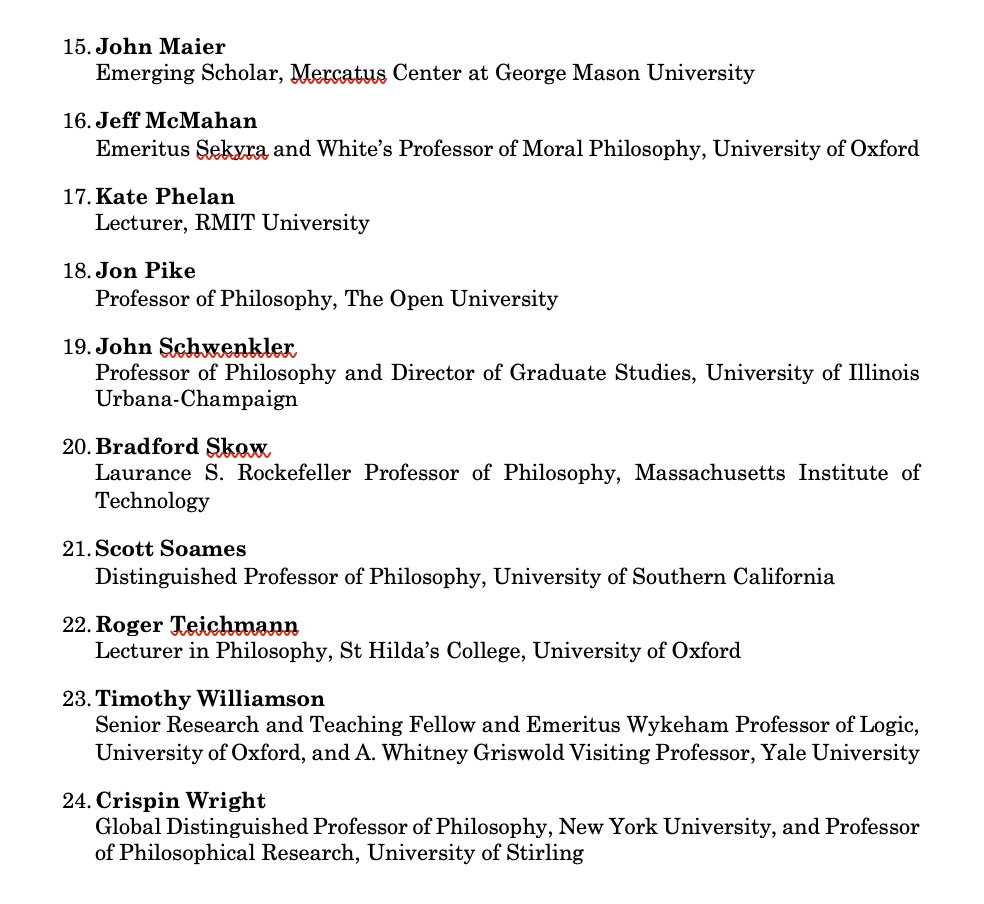
@John Maier and I have authored an amicus brief on behalf of the petitioners in these cases, with the leading legal scholar and political philosopher @Robert P. George of Princeton as a co-signatory. The brief was also joined by 21 other philosophers, including distinguished professors at Maryland, Virginia, Rutgers, Notre Dame, MIT, USC, NYU, Yale, and Oxford. (Signatories on Twitter: @Tomas Bogardus, @Rona Dinur, @Prof. Gary Francione, @Joel David Hamkins, @Holly Lawford-Smith, @Mary Leng, @Jon Pike, @John Schwenkler, @Brad Skow, @Page about Timothy Williamson, philosopher..)
To our knowledge, the brief represents the first time that such a senior group of academics has publicly and explicitly committed to a conclusion on the sex realist side of recent culture wars. According to sex realism, facts about sex play an important role in human thought and action, as they do in the thought and action of other species. Of course, it is not to be assumed that in joining the brief, any signatory’s agreement with sex realism goes beyond its application to the special case of sports, where the approach of separating teams, leagues, events and competitions along the line of sex, as advocated by athletes like @Sharron Davies MBE, @Martina Navratilova and @Riley Gaines, has long enjoyed super-majority support among the broader public.
The brief is philosophically substantive. It explains how a general philosophical distinction is relevant to the challenge of how to organize sports. The simplest way to introduce this distinction is by means of examples, like those in the table below. Contemporary philosophers use the vocabulary of “naturalness” to capture the difference between the categories on the left-hand-side of the table—like Gold—and those on the right-hand-side—like Gold or iron pyrite. The former are relatively natural, the latter unnatural. For evocativeness, unnatural categories are often called “gerrymandered,” because their boundaries look weird, jagged, arbitrarily delineated, drawn ad hoc.
The brief argues that the vocabulary of naturalness enables a simple explanation of why it is better to organize sports around the line of sex than any other relevant line. The gist is that the sex categories Female (person) and Male (person) are highly natural. Even worse, the opponents of organizing sports around the biological line of sex fail to identify any remotely natural alternative categories to use in their place.
Finally, the brief critiques the uncharitable interpretation of the Idaho and West Virginia statutes on which the respondents insist at some length, arguing that if the justice system were required to take challenges of the kind mounted by the respondents seriously in general, its operation would grind to a halt.

“INTERESTS OF THE AMICI CURIAE Amici are Daniel Kodsi (B.A., B.Phil., and D.Phil., University of Oxford); John Maier (B.A., University of Oxford; M.Sc., London School of Economics); Robert P. George (B.A., Swarthmore College; J.D., M.T.S., Harvard University; D.Phil., B.C.L., D.C.L., and D.Litt., University of Oxford); and 21 other philosophers listed in Appendix A.
“Amici share with the public at large an interest in seeing the law be formulated using clear, precise and principled distinctions, rather than unclear, vague and invidious ones. Consequently, they have an interest in seeing that the laws ensuring fairness in sports be formulated in sex-based terms, which are much clearer, more precise and more principled than any relevant alternatives.
“Amici have a further interest in familiarizing the Court with a general philosophical distinction, between more and less 'natural' categories, which in their professional judgement is highly relevant to problems of categorization in general, including in the natural sciences and mathematics. Recognizing this distinction enables a perspicuous explanation of why it is so costly to abandon sex categories in sports in favor of alternative categories to which ad hoc exceptions have been built in.”
“SUMMARY OF ARGUMENT On their face-value interpretation, the Idaho and West Virginia statutes enable female persons, and only female persons, to participate in certain spaces— namely, in certain sports teams, leagues, events and competitions. To achieve this aim, the Idaho and West Virginia statutes preclude male persons, and only male persons, from participating in those sports teams, leagues, events and competitions. On this facevalue interpretation, the statutes propose to organize sports in part around the sex categories: female (person) and male (person).
“This brief contends that organizing sports around the sex categories is fully justified, given the officially uncontested fact that it is justified to organize sports approximately around the sex categories. Its argument leverages a general philosophical distinction between more and less natural categories. This distinction will be applied to reinforce the case for organizing sports around the sex categories, as well as against reorganizing sports around alternative categories to which vividly ad hoc exceptions have been built in. Finally, the argument will be extended to the disputed question of the intended function of the Idaho and West Virginia statutes, which it is concluded is, indeed, the face-value one: to enable female participation in sports by means of excluding male would-be competitors.”
Link and list of signatories: supremecourt.gov/DocketPDF/24/2


Daniel Kodsi
@dfkodsi
Editor @philosophersmag | PhD Philosophy ’24 @TrinityOxford | Contact me (in professional or personal capacity) at editor@philosophersmag.com
Missing some tweets in this thread? Or failed to load images or videos? You can try to .