Shopify's Growth Accelerating — But are Valuation Too High?
$SHOP is up almost 89.1% past year, while S&P500 up +17.5%.
Is it overvalued? Let’s examine the valuation, revenue growth rate by segments, key metrics, profitability, and expenses. A short 


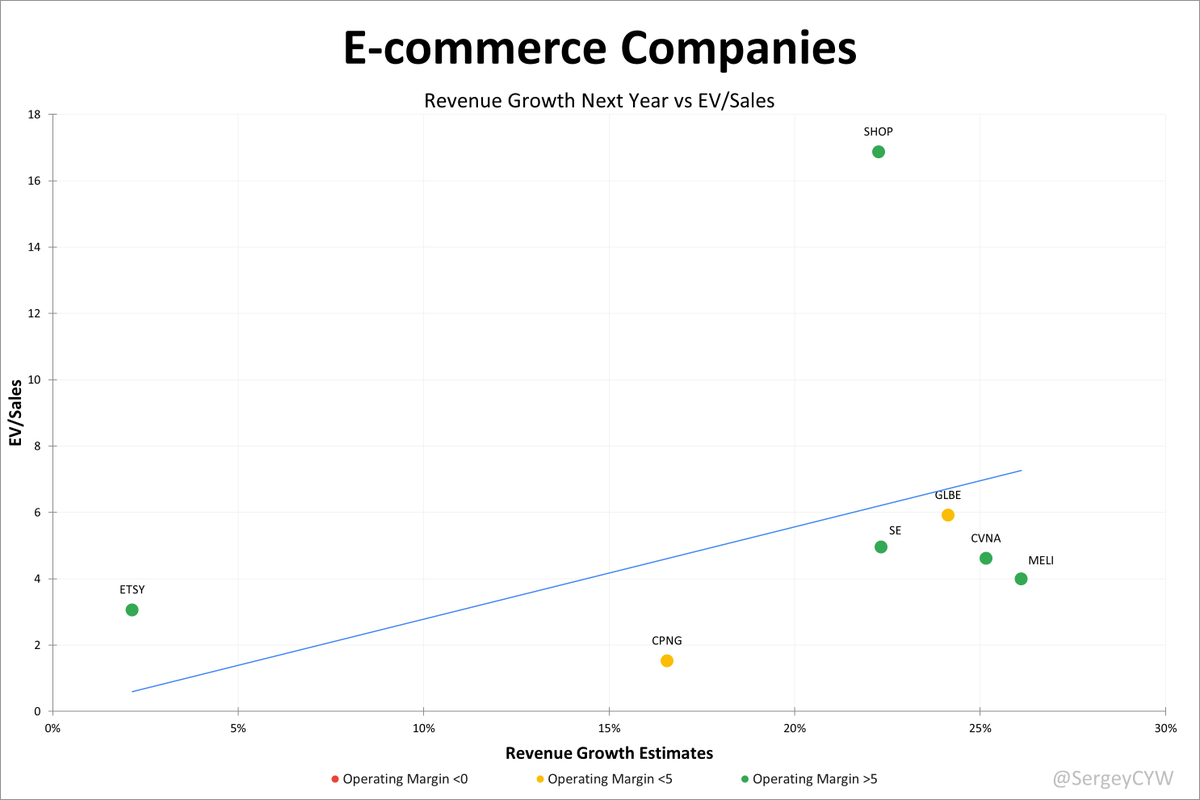
$SHOP Shopify is trading at a Forward EV/Sales multiple of 15.16, which is above the median of 11.33 and close to valuation levels based on multiples from 2018-2019.

$SHOP Shopify is trading at a Forward P/E multiple of 95.7, with revenue growth of +31.1% YoY in the most recent quarter. This forward P/E ratio is 3.1 times the anticipated revenue growth rate.
The EPS growth forecast for 2026 is 27%, with a P/E of 102.8, resulting in a 2026 PEG ratio of 3.8.
According to PEG ratio valuation is high.

Analysts forecast $SHOP revenue growth of +29.3% in 2025 and +22.3% in 2026. Based on this outlook, the valuation using the EV/Sales multiple appears to be trading at a premium compared to other companies in the e-commerce sector.
Shopify has established itself as a dominant force in the e-commerce platform space, with Morningstar analysts recognizing the company as having a wide economic moat. This comprehensive analysis examines the five key components of Shopify's competitive advantages and their respective strengths in creating sustainable barriers to competition.
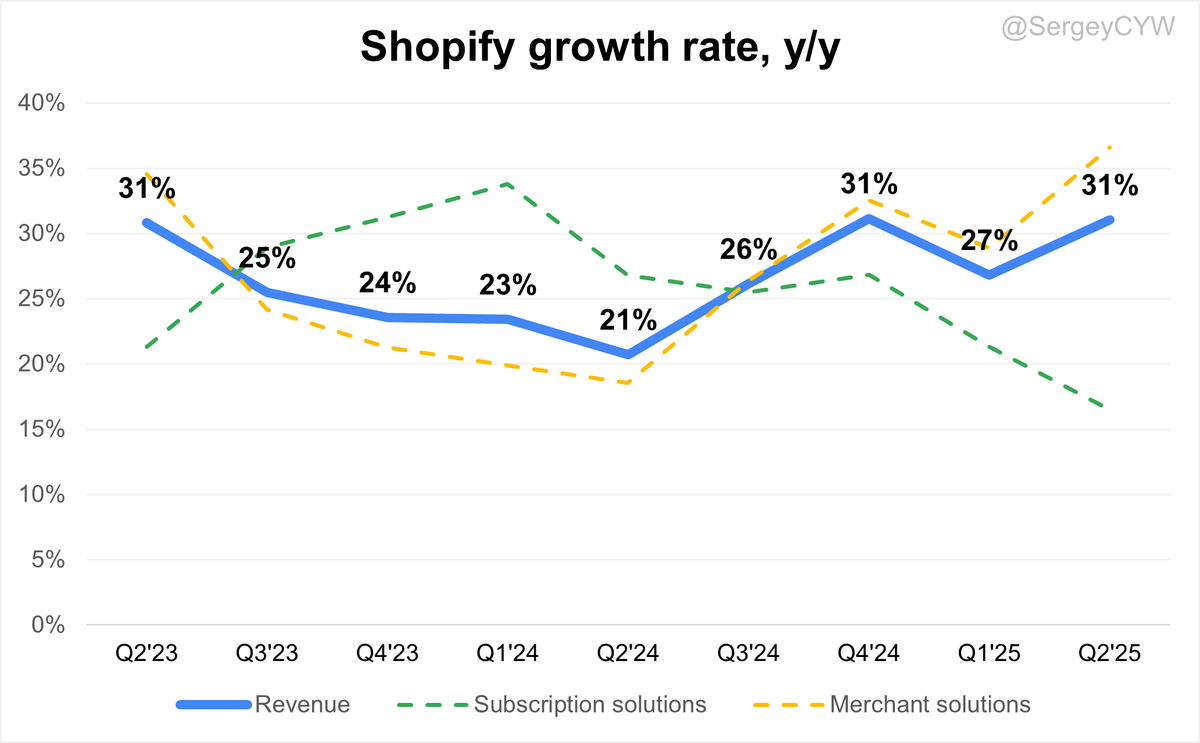
Revenue growth for $SHOP accelerated to +31.1% YoY in Q2. Based on guidance for the next quarter, if the company beats by 5.5% again, as it did in Q2, Q3 growth would reach 34.2%, signaling further acceleration in revenue growth.
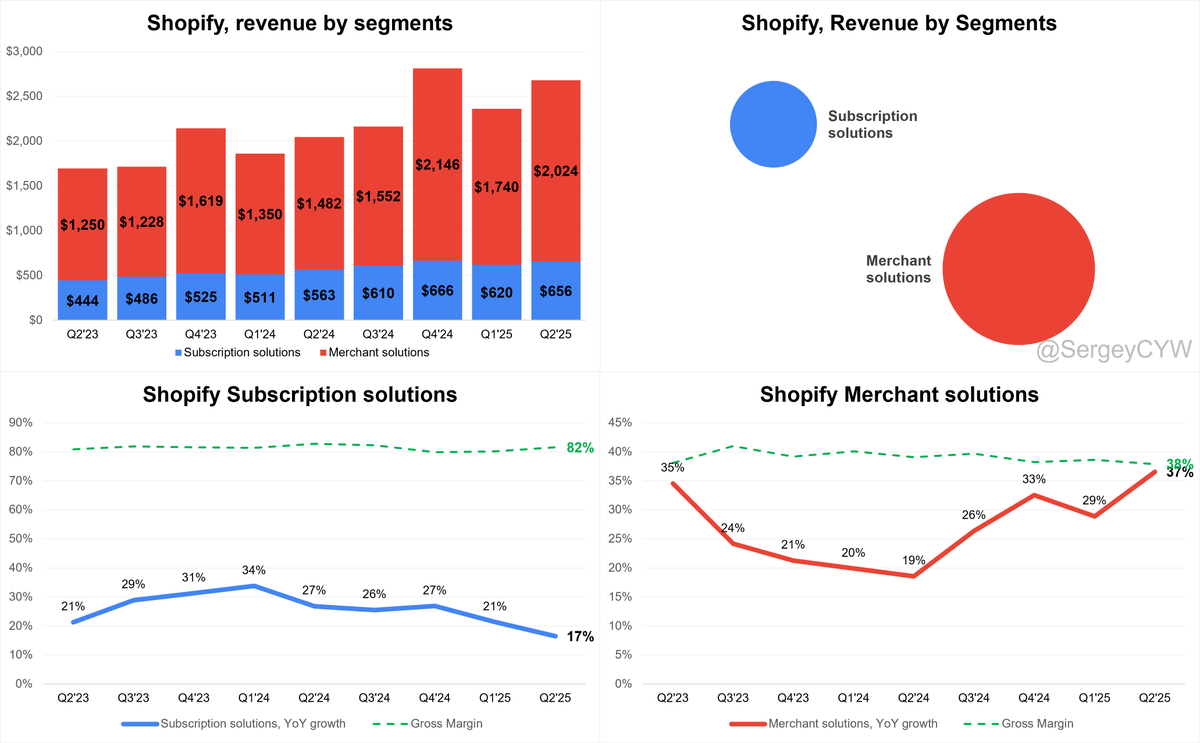
$SHOP Shopify revenue breakdown by segment: Merchant Solutions accounts for 75.5% of total revenue, while Subscription Solutions makes up 24.5%.
Merchant Solutions revenue growth rate accelerates to +26.6% YoY. The gross margin for this segment was 37.9%, down from 39.1% a year earlier.
Subscription Solutions revenue grew +16.5% YoY, slower than overall revenue growth. However, this segment is highly profitable, with a gross margin of 81.6%, slightly down from 82.8% in the same quarter last year.
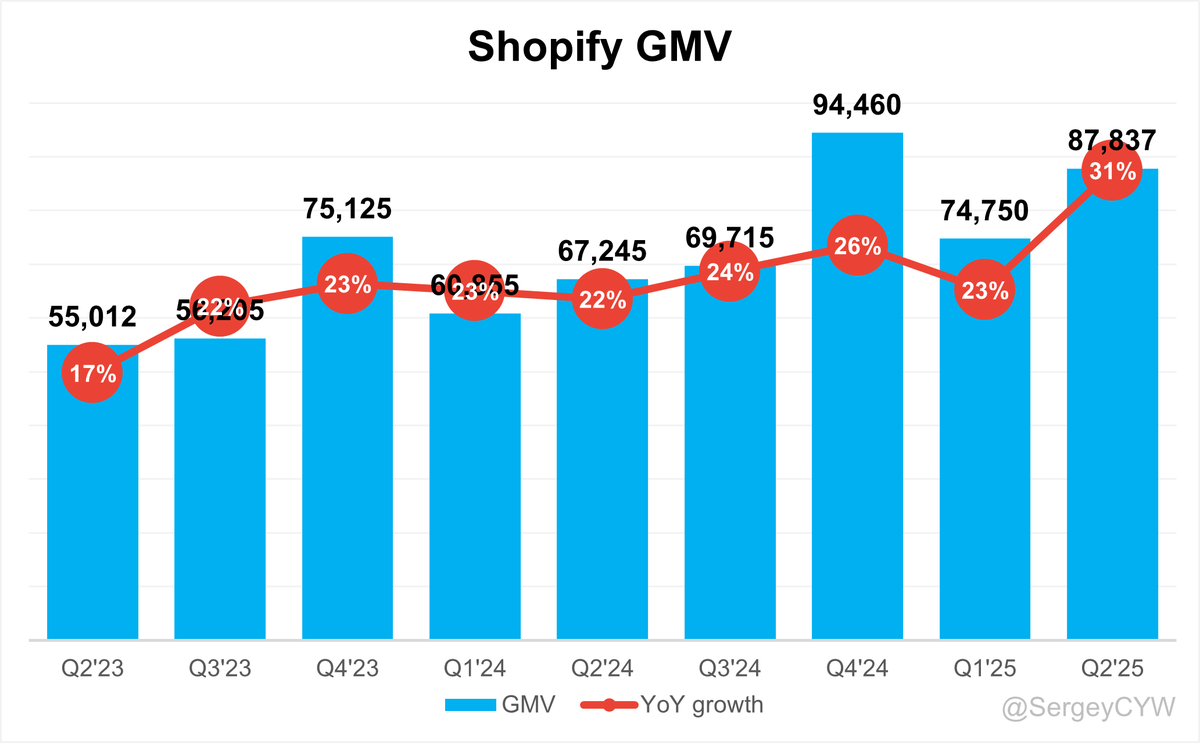
$SHOP GMV growth accelerated from +23% YoY in Q1 2025 to +31% in Q2 2025.
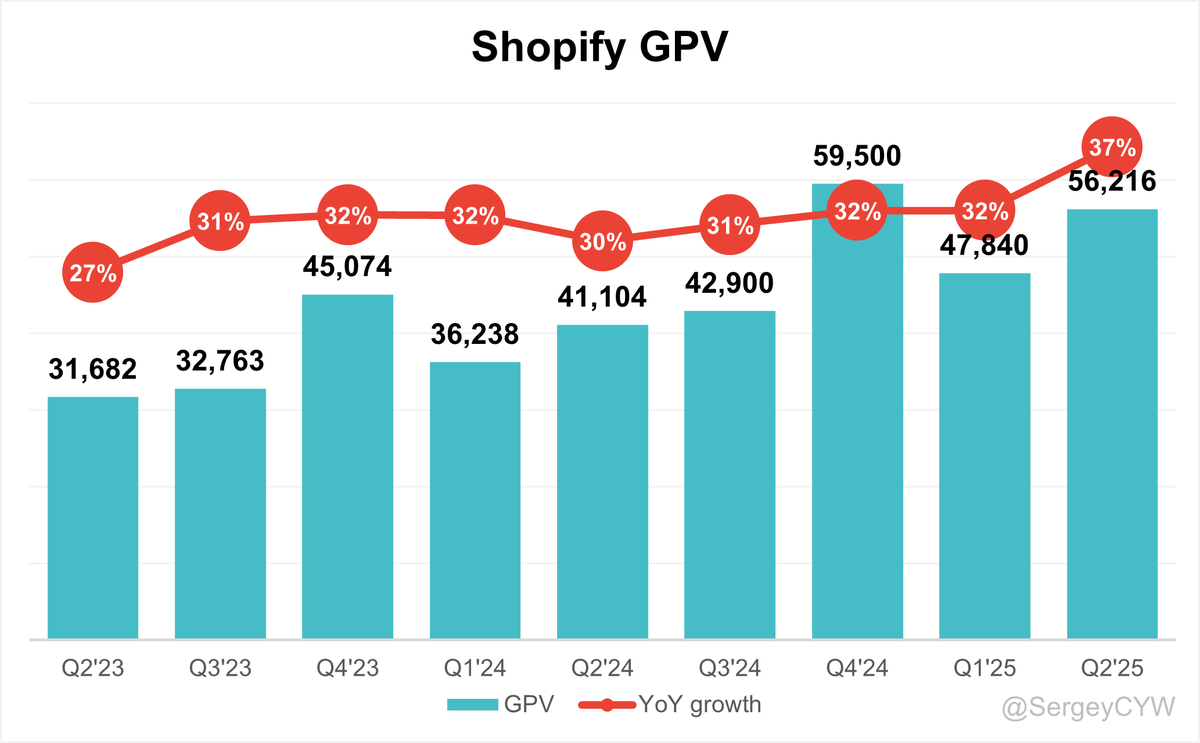
$SHOP GPV growth accelerated from +30% YoY in Q2 2024 to +37% in Q2 2025.
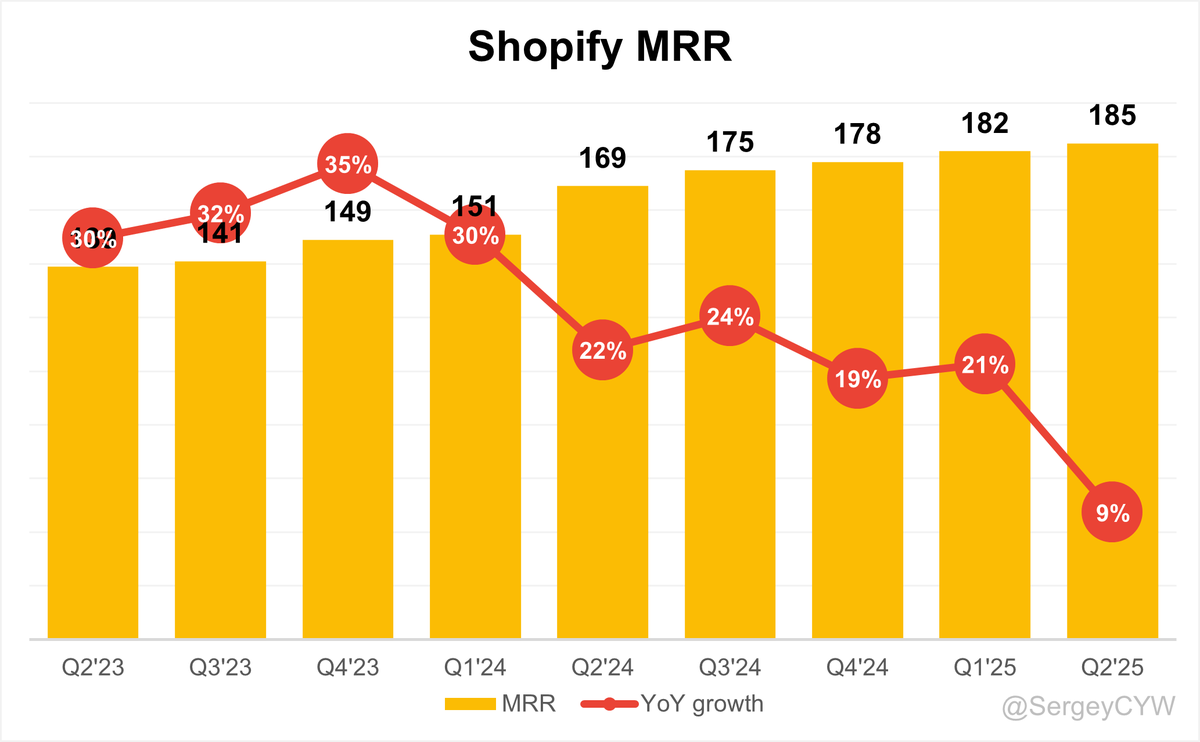
$SHOP MRR growth decelerated from +35% YoY in Q4 2023, and slowed to +9% YoY in Q2 2025.
$SHOP attach rate is currently at a strong level of 3.10%, up from 3.04% in Q2 2024.

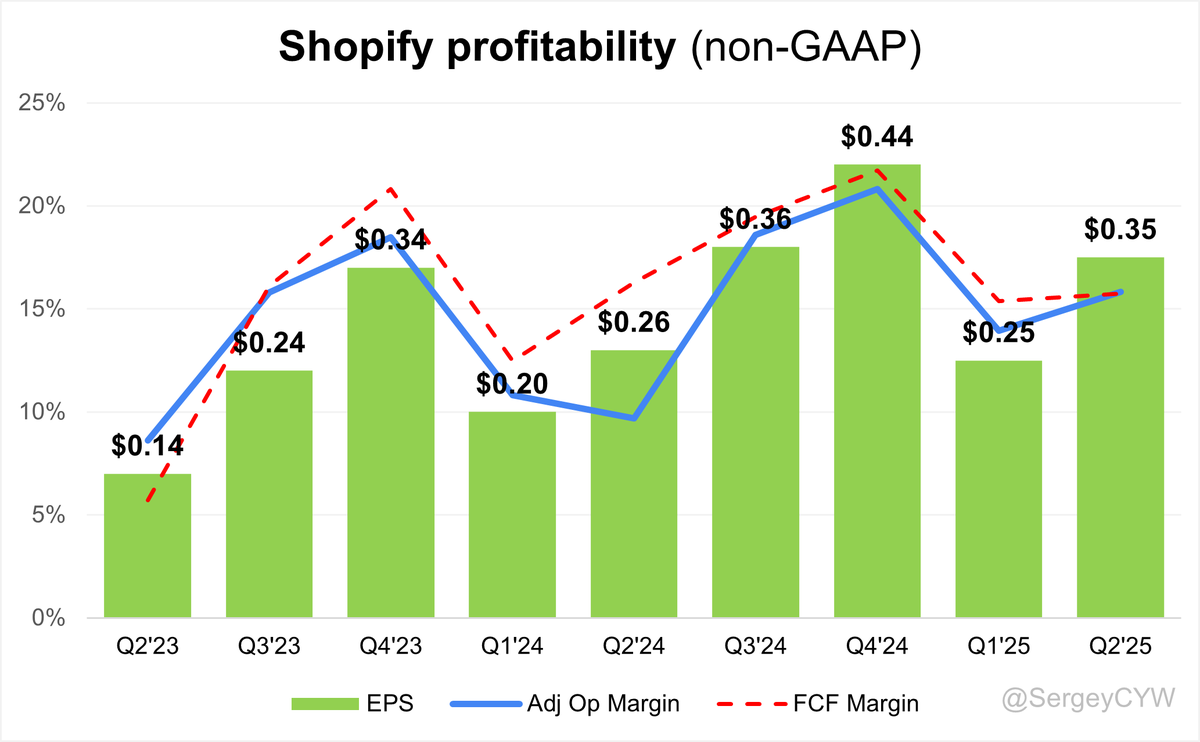
Over the past year, $SHOP Shopify's margins have shifted:
•Gross Margin decreased from 51.4% to 48.6%.
•Operating Margin increased from 14.6% to 15.8%.
•Free Cash Flow (FCF) Margin slightly decreased from 16.3% to 17.7%.
The company also achieved GAAP profitability in Q2 2024.
Gross margin declined primary causes included Merchant Solutions margin pressure from PayPal expansion and international mix, and Subscription Solutions margin decline due to hosting costs and trial revenue deferral.
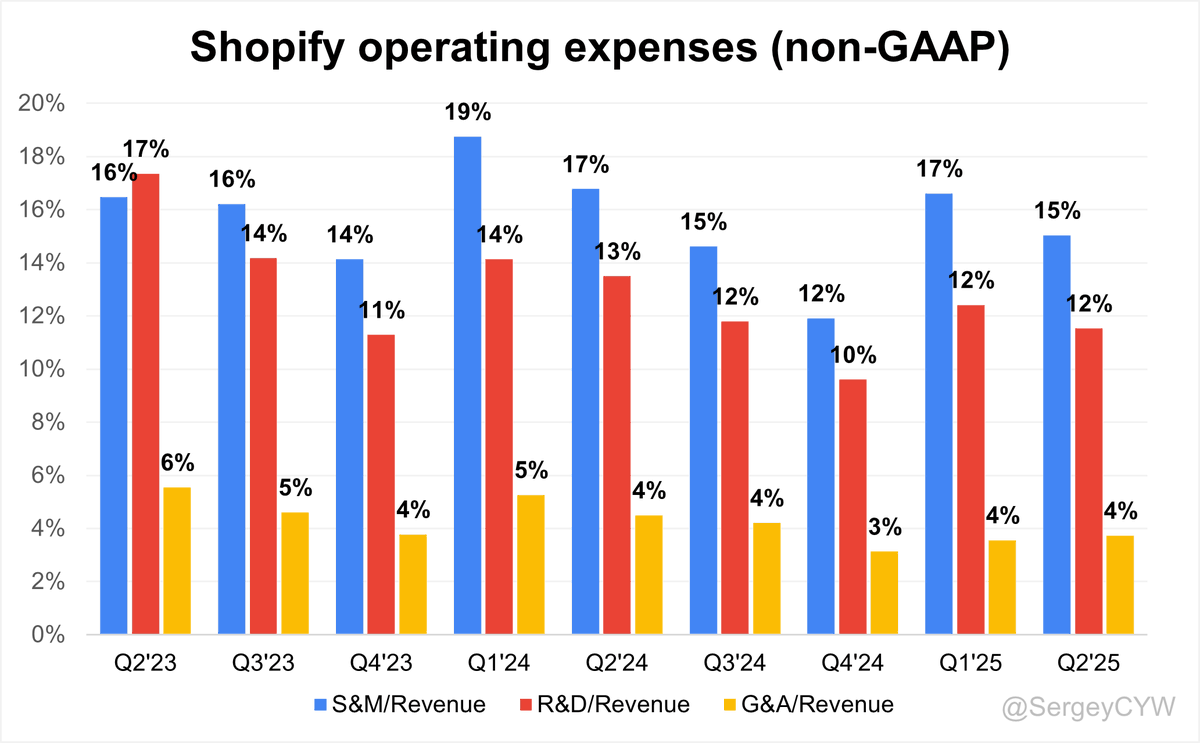
$SHOP non-GAAP operating expenses have gradually decreased, driven by reductions in S&M, R&D, and G&A spending.
Sales & Marketing (S&M) expenses declined from 16% two years ago to 15%.
R&D expenses also dropped from 17% to 12% over the same period, but remain at a relatively high level, enabling continuous product innovation.
General & Administrative (G&A) expenses have decreased to 4%.
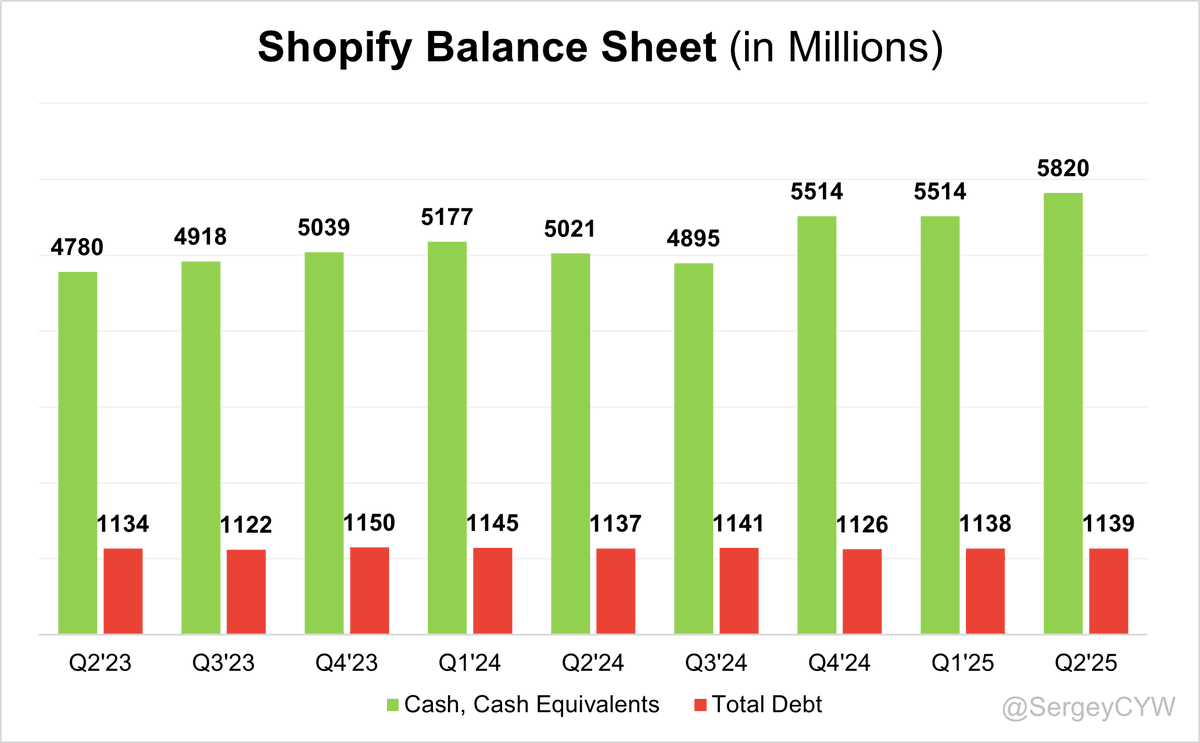
$SHOP Balance Sheet: Total debt stands at $1,139 million, while Shopify holds $5,820 million in cash and cash equivalents, far exceeding its liabilities and reflecting a healthy balance sheet.
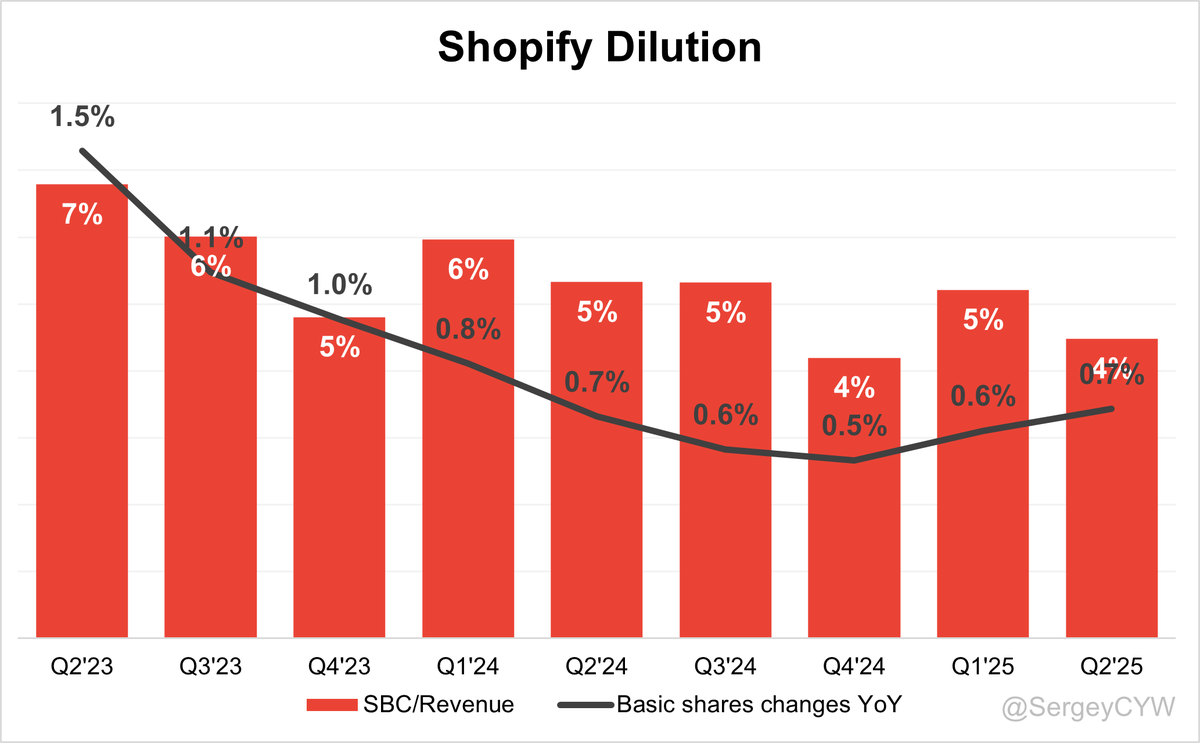
$SHOP Shareholder Dilution: Shopify’s stock-based compensation (SBC) expenses have declined to 4% of revenue, which is still low compared to average SaaS companies.
However, shareholder dilution remains well-controlled, with the weighted-average number of basic common shares outstanding increasing by just 0.7% YoY.
Shopify’s $920 million convertible note matures on November 1, 2025, and the company stated it will settle the full principal in cash, along with any excess value above par also in cash.
Conclusion
$SHOP has been highly innovative and is strengthening its position through a high level of investment in R&D.
Shopify’s wide economic moat is supported by strong switching costs, economies of scale, and a powerful brand, with moderate contributions from network effects and intellectual property.
The company operates in a massive Total Addressable Market (TAM) of $849 billion. Yet, it holds just 2% penetration in its $404 billion core SAM, highlighting significant growth potential. Global e-commerce is projected to reach $76.4 trillion by 2030, growing at a CAGR of 18%, providing long-term tailwinds for Shopify.
Margins—operating, and net—are improving compared to last year, free cash flow roughly at same level.
Key performance indicators (KPIs):
•GMV and GPV continue to grow at strong, stable rates
•MRR growth slowing to +9% YoY
•Attach Rate is at strong level, signaling Shopify’s growing competitive edge
The revenue growth forecast for next quarter suggests acceleration to +34.2% YoY, supported by strong key performance indicators.
$SHOP trades at premium valuation multiples, but given its competitive advantage, strong execution, and accelerating revenue growth, the premium appears justified.
The company has exited low-margin logistics operations and is now focused on high-margin subscription solutions, with gross margin rising to 81.6% and remaining at a very high level.
In August 2025, after valuation multiples rose significantly, I slightly trimmed my position. $SHOP now represents 8.9% of my portfolio.
If you found this insightful:
- Follow me @Sergey
- Like and share first post below
- For the full review, subscribe to my email newsletter SergeyCYW.substack.com

Sergey@SergeyCYW
Oct 02 25
View on Twitter
Shopify's Growth Accelerating — But are Valuation Too High?
$SHOP is up almost 89.1% past year, while S&P500 up +17.5%.
Is it overvalued? Let’s examine the valuation, revenue growth rate by segments, key metrics, profitability, and expenses. A short

Sergey
@SergeyCYW
I talk about growth stock investing, fundamental analysis with a long-term mindset. I provide earnings reviews and key news updates. https://t.co/7Viimrqjr9
Missing some tweets in this thread? Or failed to load images or videos? You can try to .