
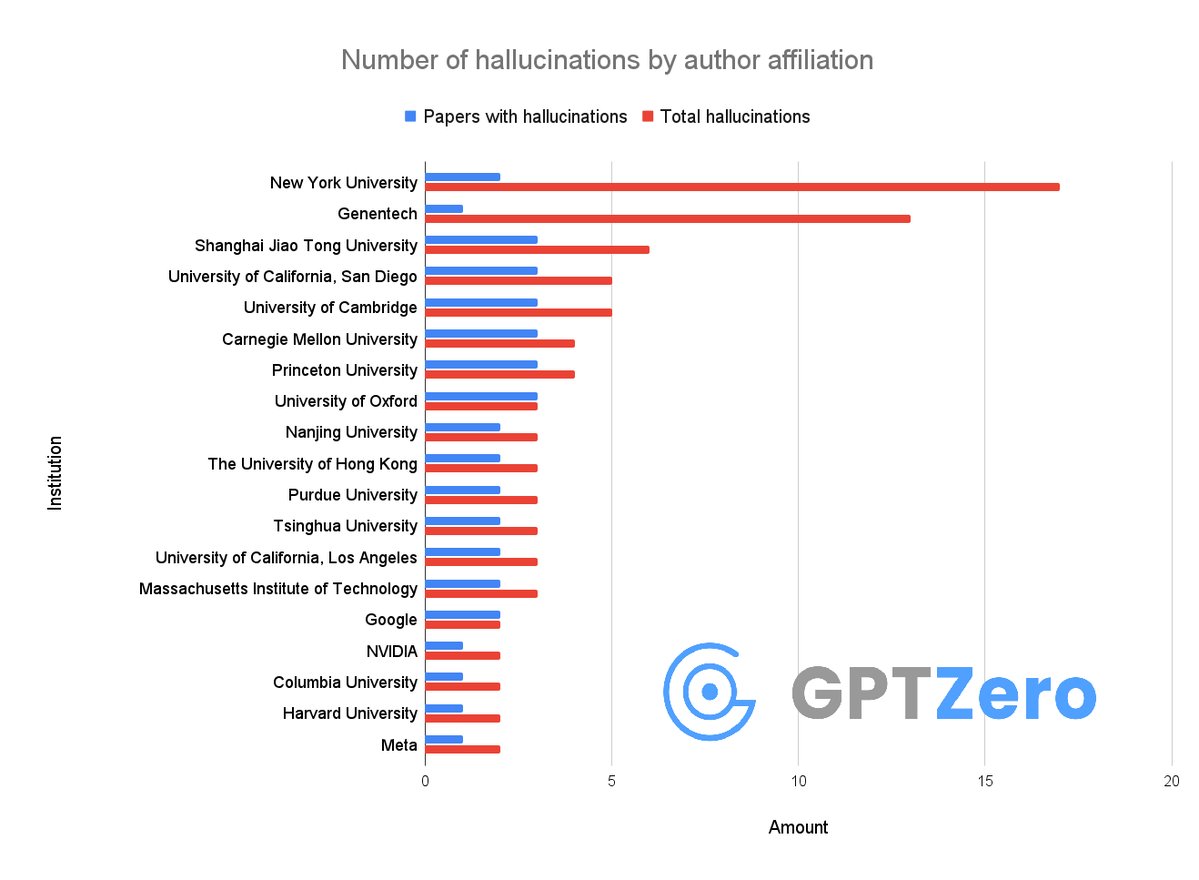
Okay so, we just found that over 50 papers published at @Neurips 2025 have AI hallucinations
I don't think people realize how bad the slop is right now
It's not just that researchers from @Google DeepMind, @Meta, @Massachusetts Institute of Technology (MIT), @Cambridge University are using AI - they allowed LLMs to generate hallucinations in their papers and didn't notice at all.
It's insane that these made it through peer review
This paper had the record 13 hallucinations in its citations, including several other papers that are totally made up, and [4], which it builds on extensively in its method
If you can see our hallucination scan here: app.gptzero.me/documents/53b0
If authors aren't checking what AI writing into their paper, how do you trust that their experimental results or data isn't fabricated by AI as well?


We found that John Smith and Jane Doe are getting a lot of citations, here, they were cited by 2 totally different teams at @UC San Diego / @NVIDIA
You can find the full list of hallucinations at gptzero.me/news/neurips


Another example of "vibe citing".
Authors non-existent and publication dates are off by years.
These papers had to beat out 15,000 others, which got rejected. How does this happen??

We've seen a huge increase in "ai scientists" on github with big spikes in their usage corresponding to the April (NeurIPS) and September (ICLR) conference deadlines in 2025
No surprise from the AI-maxxing posts you've been seeing everywhere

Unfortunately, it's too late to fix these papers - they were already published and presented to 20,000 people in December 2025.
Human peer review isn't going to scale up to catch AI slop, but it doesn't mean we're screwed.
@GPTZero is working with the excellent @ICLR 2026 2026 team (and several others) to ensure there are zero hallucinations that make it to publication
x.com/alexcdot/statu
When we looked around, a lot of people noticed the rise in hallucinations but nobody was building a solution
So we grinded over the past year to build gptzero.me/hallucination-.
We used it to find these hallucinations by scanning every single NeurIPS 2025 paper through our hallucination detector.

If you're a conference organizer, shoot me a note! We'd love to help you and your reviewers
You can see the other 97 hallucinations we found at gptzero.me/news/neurips
Kudos to the brilliant Nazar, Alex, Paul, Olivia, Nigel, Midhun, and @Edward Tian for making it possible.


Alex Cui
@alexcdot
Building @GPTZeroAI | Previously @Waabi_ai, @UofTCompSci @Caltech, @Facebook | Staying curious
Missing some tweets in this thread? Or failed to load images or videos? You can try to .