
Finbar Curtin@FinbarCurtin
Apr 20
22 tweets
1/n) New working paper: “The empirically inscrutable climate-economy relationship”, with @Matt Burgess.
We argue that it is not possible to reliably estimate economic climate damages from historical data.
Link below.
2/n) PAPER: osf.io/preprints/soca
Climate-econometric studies like Burke et al. (2015), Kahn et al. (2021), and Bilal and Känzig (2026) use historical data to identify the effect of climate on GDP.

3/n) They pass projections of future climate change through this effect to generate an estimate of economic damages. However, these projections vary WILDLY, which suggests identification challenges.

4/n) We show that several factors create fundamental identification challenges:
- Spatial heterogeneity
- Affluence-driven adaptation
- Influential outliers
- Low signal-to-noise ratio
- Locally optimal environment
- Irreducibility of high-dimensional climate
5/n) We show how these identification challenges manifest by replicating and stress testing three famous and diverse studies: Burke et al. (2015), Kahn et al. (2021), and Bilal and Känzig (2026).
6/n) Importantly, we don’t think these particular papers are uniquely flawed; our point is that they are attempting an impossible feat, and we commend the authors for their contributions. @Marshall Burke, @Diego Känzig, @Adrien Bilal, @Matthew E. Kahn
7/n) We also thank the authors for making their replication packages available, and we thank several of them for providing comments on earlier drafts (we sent our paper to each before releasing).
8/n) Principally, the climate–economy relationship varies strongly across space AND time.
A function that varies along both dimensions cannot be estimated without imposing strong (and potentially wrong) assumptions (often, one global relationship from 1960–present).
9/n) This figure shows within-country GDP-temperature relationships. El Salvador (tropical, service-based economy) and Iraq (desert, petrostate) have the same average temperature, but different within-country slopes. Pooling them in one regression assumes one global function.
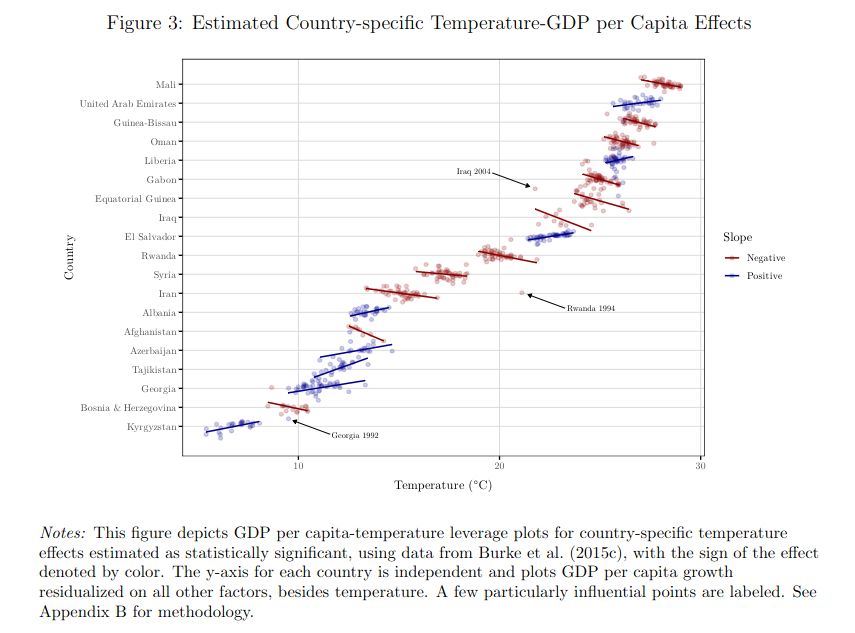
10/n) One of the consequences of pooling across heterogeneous countries is that idiosyncrasies in one can be estimated to have global implications.
11/n) For example, we find that a handful of influential data points drive a large amount of the estimated effects.
Removing 6 observations from Burke et al. (2015) (out of over 6,000) attenuates the estimated effect by ~25%. We find a similar pattern in Kahn et al. (2021).
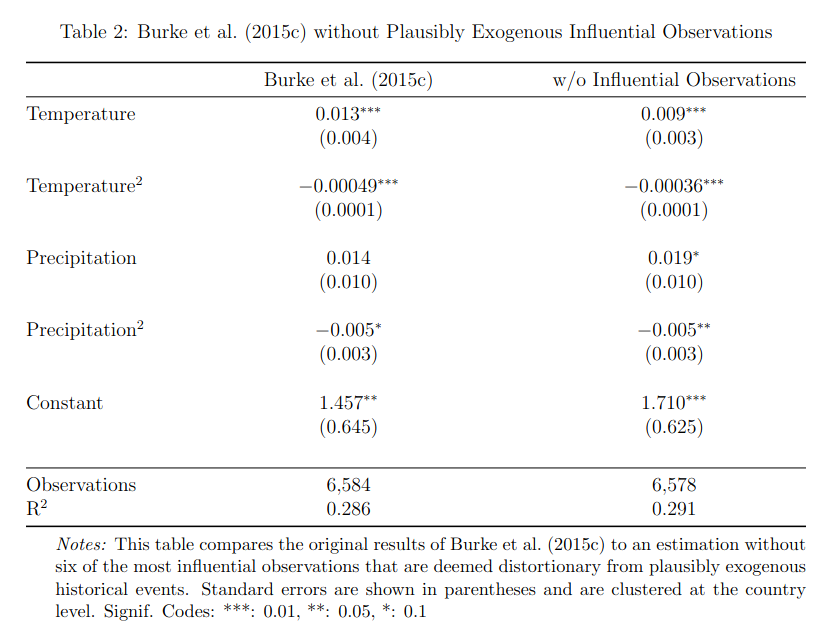
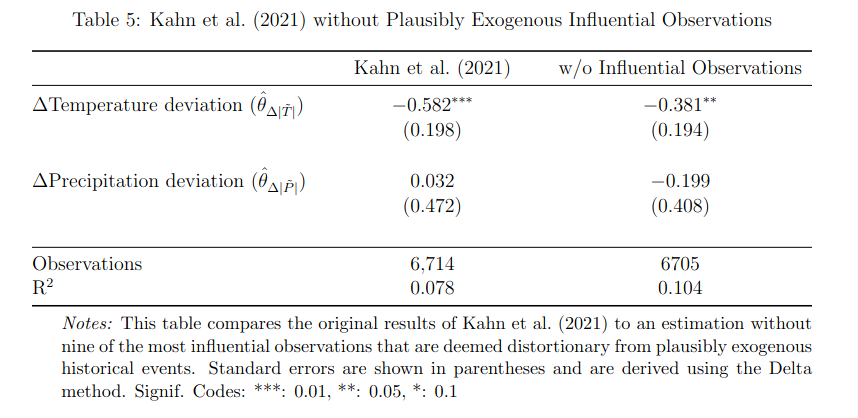
12/n) These are growth miracles and disasters, plausibly exogenous to climate, which happened to occur in particularly hot or cold years.
Pooling countries in one regression means that heterogeneous relationships are averaged together according to some weighting scheme.
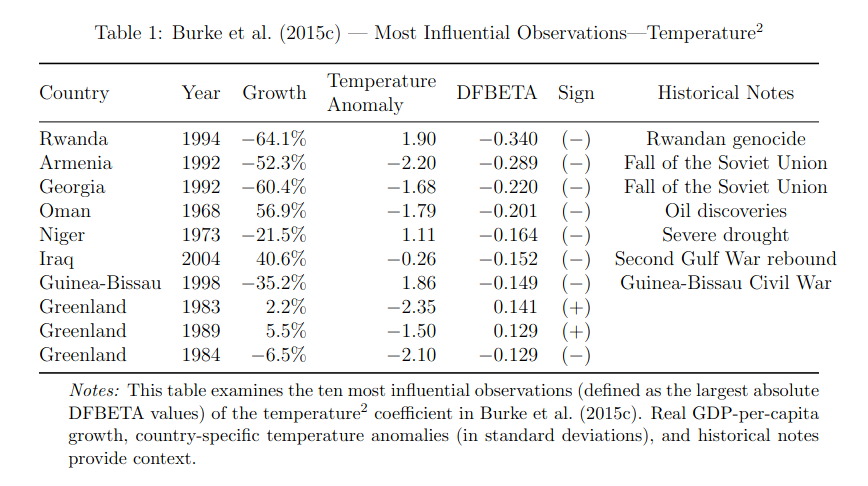
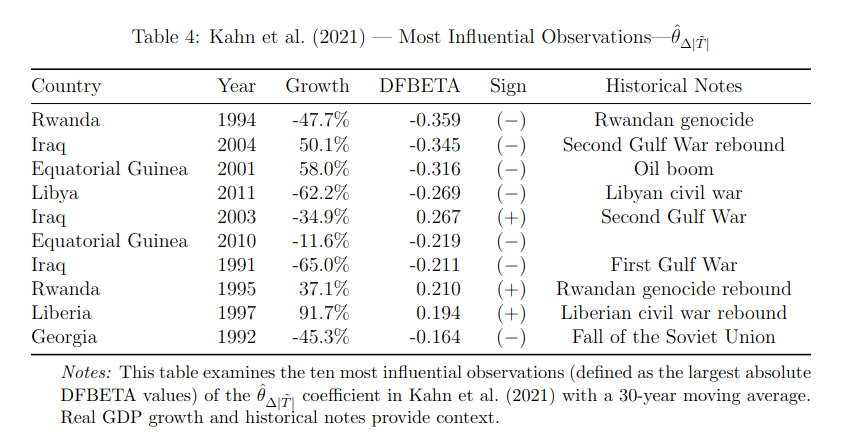
13/n) These influential observations make salient which countries receive more weight. Rwanda (with its hot-year genocide) and Armenia (with its cold-year USSR collapse) implicitly predict how America will experience climate change in such models.
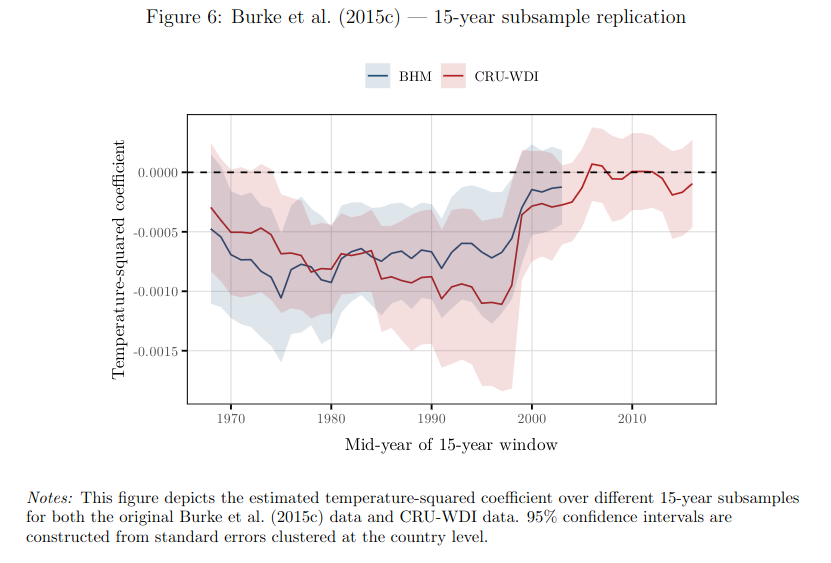
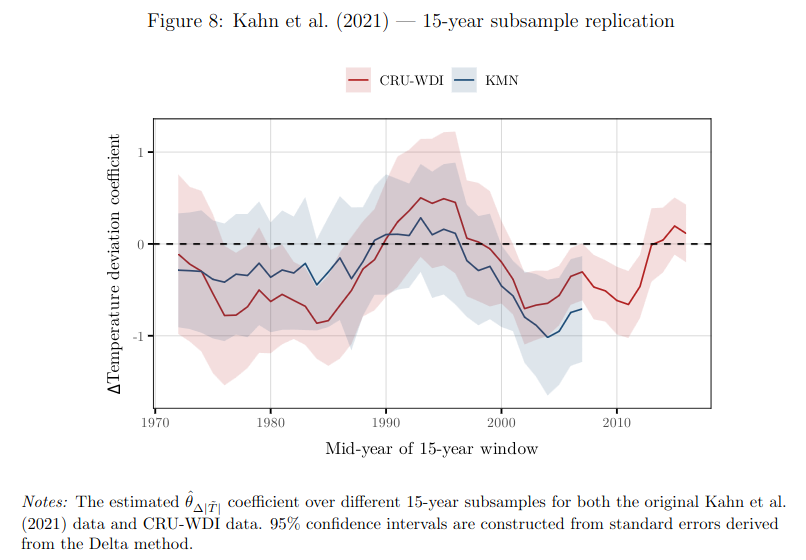
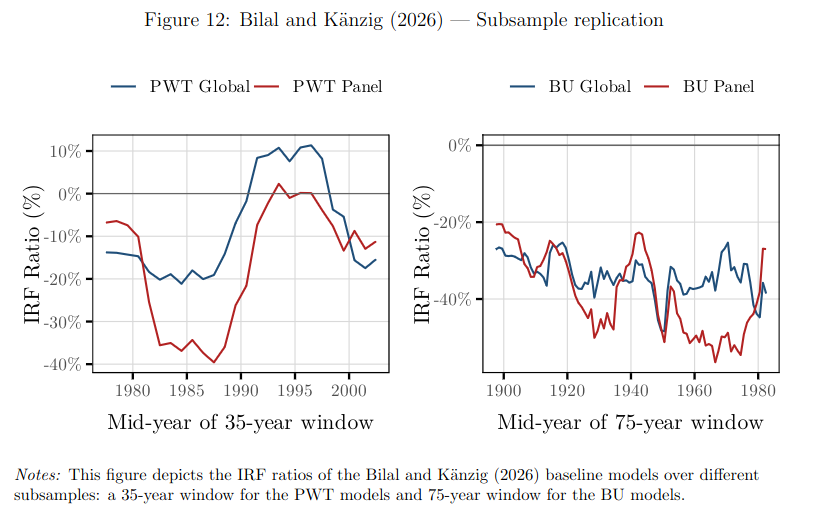
14/n) Restricting the data sample to certain time periods generates unstable estimates in all three papers, some of which attenuate over time. If the climate-economy relationship is temporally unstable, estimates are not externally valid for future projections.
15/n) We argue that Bilal and Känzig (2026) rely on an unrealistic exclusion restriction: temperature shocks affect GDP only through temperature levels. If shocks coincide with other climate phenomena (e.g., ENSO), the effect isn’t well-identified.
16/n) The methodology of Bilal and Känzig (2026) requires that 0.1°C of climate change induce the same effect as 0.1°C of warming from ENSO, solar cycles, etc. Such is the result of reducing climate (and climate change) to a single variable.
17/n) Bilal and Känzig (2026) use two datasets (PWT and BU). PWT results (used to calibrate their damage function) are ENSO-sensitive.
They are also sensitive to a bandstop filter and long-run controls.
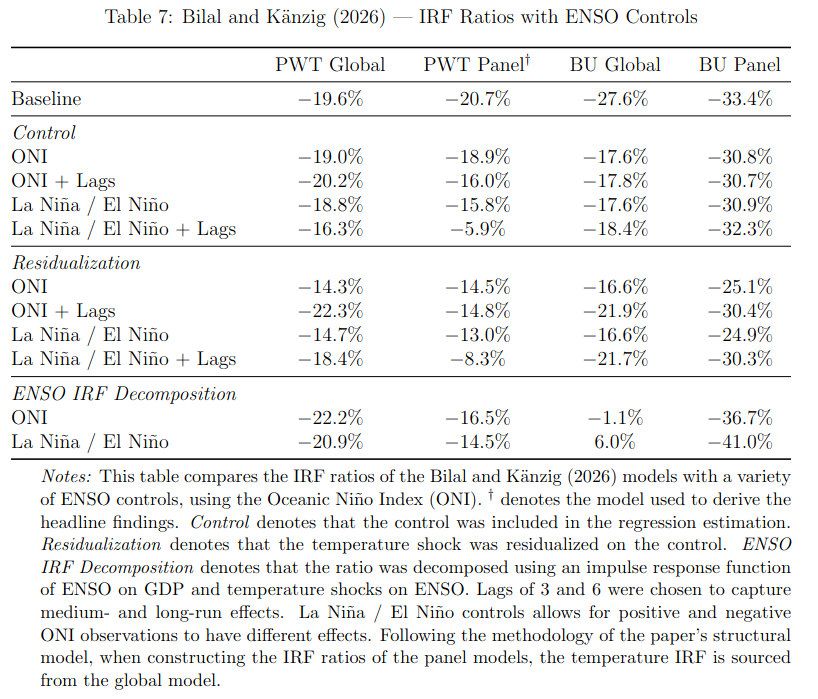
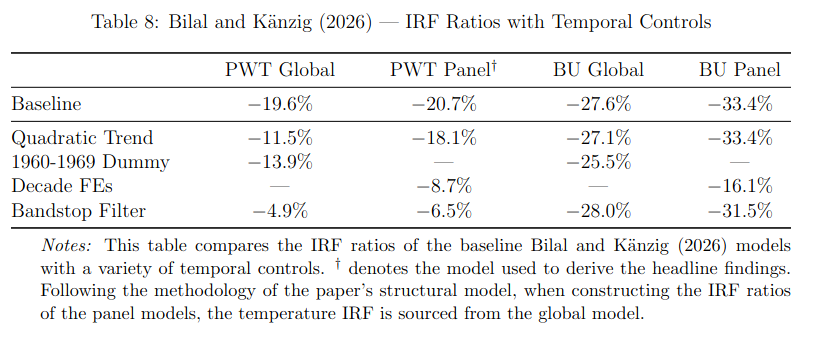

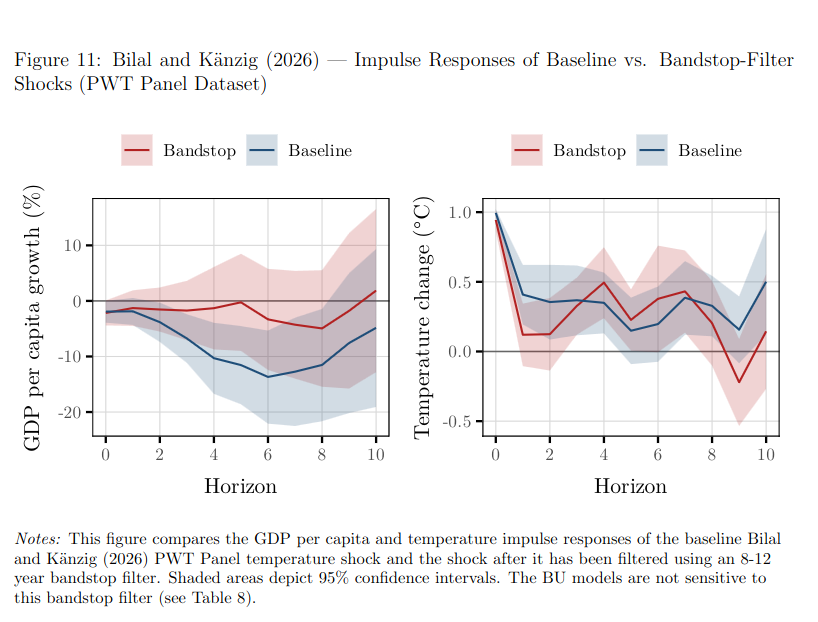
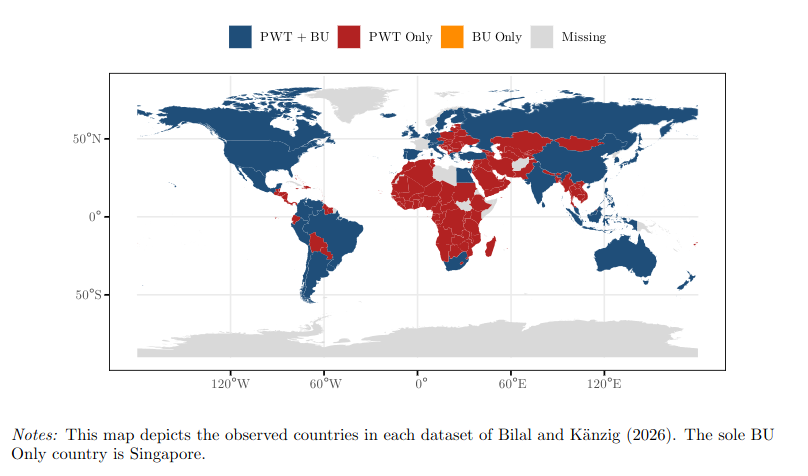
18/n) BU results are more robust, but the BU dataset excludes many of the most climate-sensitive countries, which raises the questions of what’s driving the estimated effect and what does it mean for future projections?
19/n) Read the paper for much more detail.
What does all this mean for climate policy?
20/n) There is no SCC or projection of climate damages that is “the answer.” (An “answer” which seems to change depending on who is in the White House.) Climate damages are deeply uncertain, and policy makers should truly grapple with decision making under deep uncertainty.
22/n) Importantly: we are *not* claiming that climate change is economically harmless. We're arguing that the magnitude of damages is deeply and irreducibly uncertain, and trillion-dollar decisions need to stop being made as if it isn't.
23/END) We thank the authors of these papers, as well as colleagues at the University of Wyoming and University of Colorado-Boulder, for their thoughts and suggestions.
We welcome any feedback for improvements!

Finbar Curtin
@FinbarCurtin
2nd-year economics PhD student @ University of Wyoming | climate + development + macro
Missing some tweets in this thread? Or failed to load images or videos? You can try to .