
Elliott Ash@ellliottt
Apr 24
18 tweets
Can AI agents read a social science paper and write the code from scratch to reproduce its results?
No access to original code. Just text + data.
New paper with Ben Kohler, @David Zollikofer, @Johanna Einsiedler, and @Alexander Hoyle


How we do it.
Agents:
→ extract methods from the paper
→ reimplement the analysis
→ reproduce every table cell
→ compare to original
→ trace errors

Our testbed is 48 published papers in econ and poli sci – with verified reproducibility, thanks to the amazing @I4R.
The challenge: fill in 14,214 empty cells in 222 redacted tables.

The contenders.
Heavy hitters: GPT-5.3 / 5.4; Claude Opus 4.6  Underdog: GLM-5 (open weights)
  Two of the jockies (GPT-5.4 and GLM-5) steer multiple horses. Each LLM takes a turn strapped into the @OpenCode and SWE-Agent harnesses (on top of GPT-5.4 running in its native Codex CLI).
Underdog: GLM-5 (open weights)
Two of the jockies (GPT-5.4 and GLM-5) steer multiple horses. Each LLM takes a turn strapped into the @OpenCode and SWE-Agent harnesses (on top of GPT-5.4 running in its native Codex CLI).Main result:
Agents recover most published findings.
 Sign of coefficients correct: ~80–90%
Within 95% CI: >70% (best models: >80%)
That’s real progress toward automated reproducibility.
Sign of coefficients correct: ~80–90%
Within 95% CI: >70% (best models: >80%)
That’s real progress toward automated reproducibility.
Sign of coefficients correct: ~80–90%
Within 95% CI: >70% (best models: >80%)
That’s real progress toward automated reproducibility. 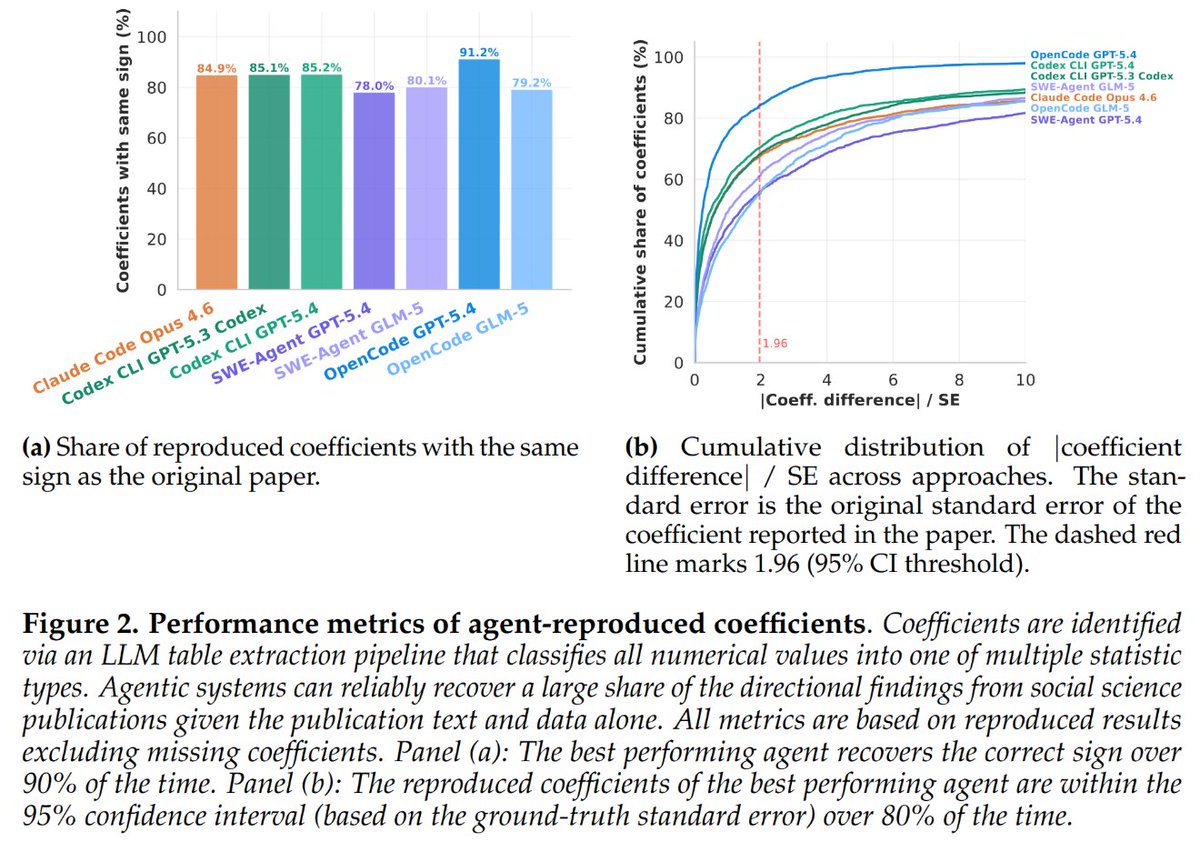
Best setup: GPT-5.4 running on @OpenCode:
• ~91% correct coefficient signs
• >80% within 95% CI
Other LLMs (Claude, GLM-5) and scaffolds (Codex, SWE-agent) trail behind.
E.g. SWE-agent + GPT-5.4:
→ ~78% correct coeff. sign (worst of the lot)
Same base model. Very different outcomes.
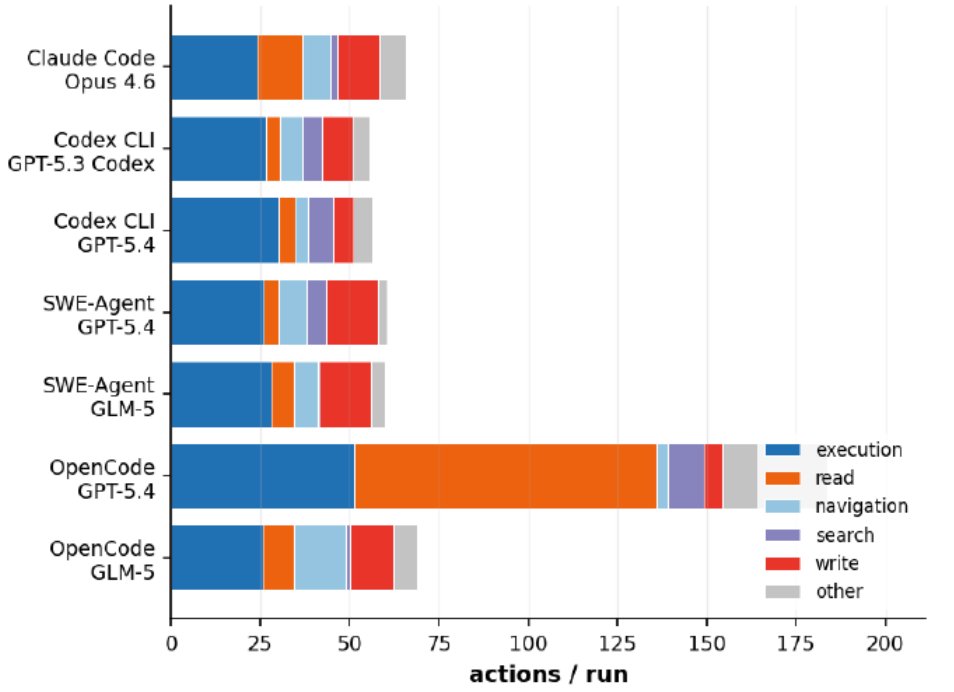
Better agent systems don’t just “think better”
They:
 use more tokens

 run longer
 explore more
Performance = capability × compute
explore more
Performance = capability × compute
use more tokens
run longer
explore more
Performance = capability × compute 
Here’s the real surprise.
Failures are mostly not AI mistakes.
They come from the papers.
Underspecified methods. Missing details. Ambiguity.

Example:
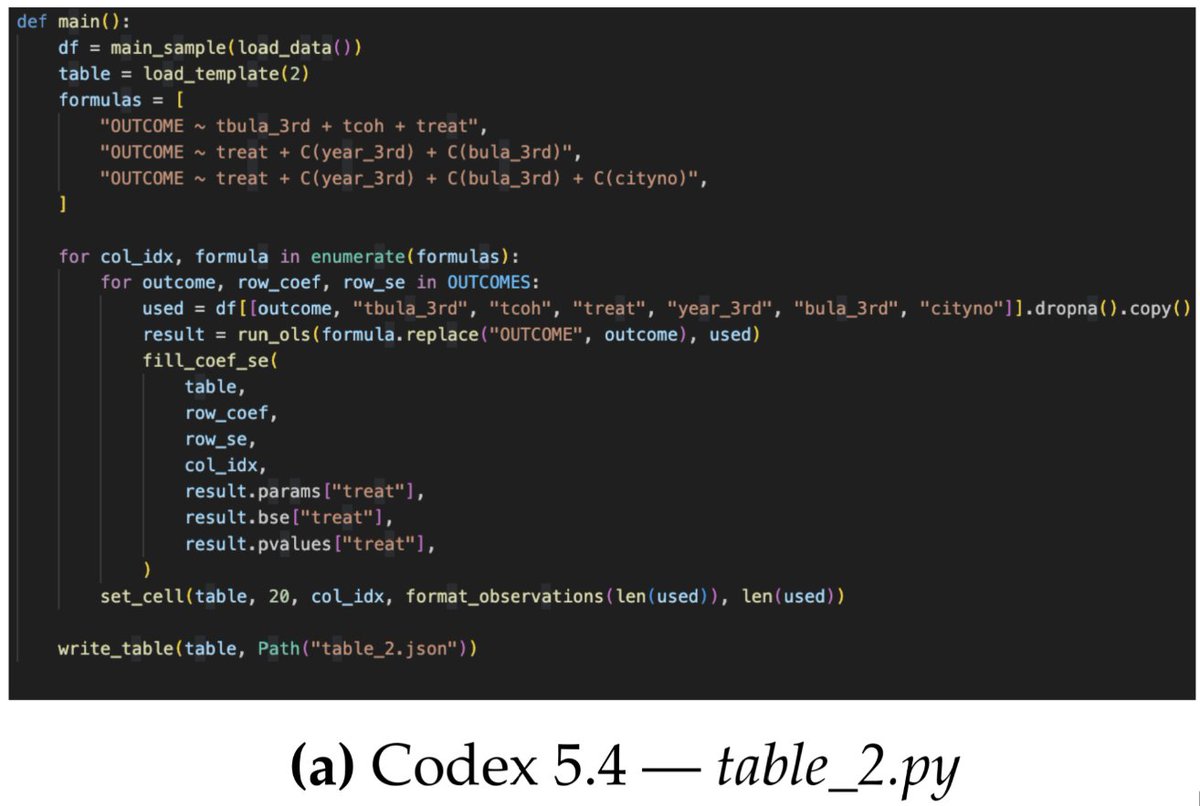
Paper says “controls included”
Code actually uses specific variables, filters, transformations
That gap forces the agent to guess.
Different agents → different guesses → different results

Upshot  Even without code, agents can:
• reconstruct regressions
• rebuild pipelines
• recover datasets
• match published tables
The original papers were in Stata or R. The agents rewrote everything in Python.
This is reimplementation, not just rerunning code.
Even without code, agents can:
• reconstruct regressions
• rebuild pipelines
• recover datasets
• match published tables
The original papers were in Stata or R. The agents rewrote everything in Python.
This is reimplementation, not just rerunning code.
Even without code, agents can:
• reconstruct regressions
• rebuild pipelines
• recover datasets
• match published tables
The original papers were in Stata or R. The agents rewrote everything in Python.
This is reimplementation, not just rerunning code.

Quick sidenote:
We believe that successful reproductions are not due to training-data leakage.
In a side analysis, we compared performance on some reproduction packages published before/after the model knowledge cutoffs, and results were similar.

What does this mean for research?
The bottleneck is shifting.
Not model capability
→ documentation quality
Reproducibility depends on how precisely methods are written.

A deeper question: If they are not the source of truth, then what are papers for?
One idea:
→ Code defines what was done.
→ Paper explains why.

Another idea:
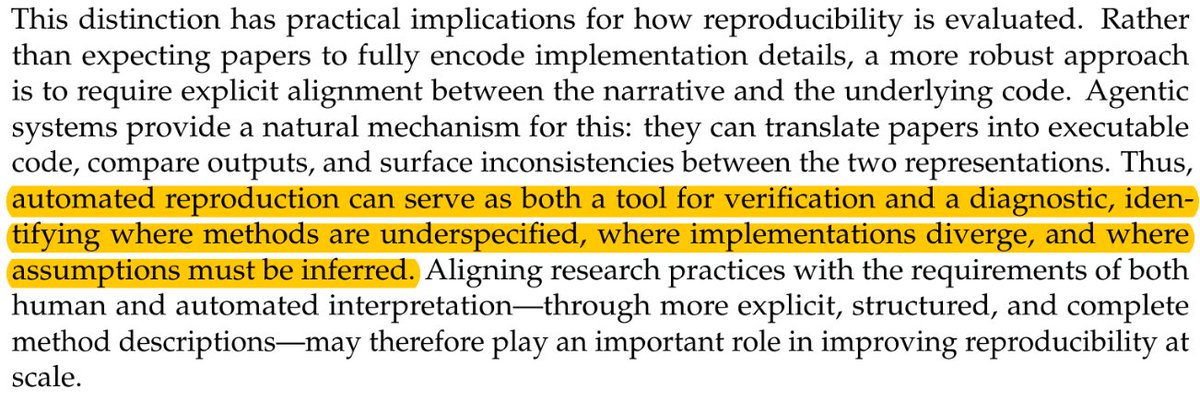
Agentic reproduction systems can serve a diagnostic function for verifying paper/code alignment. 
Where this goes next.
What if agents:
• reconstruct missing data?
• infer methods from questions?
• run robustness checks automatically?
This is not just reproducibility.
It’s the start of automated science.
There are still many gaps to close.
But for the first time:
AI can read the paper and write the code.
And that changes how we think about scientific verification.
elliottash.com/wp-content/upl
@Andy Hall @Alex Imas @Ethan Mollick @scott cunningham @Chris Blattman @D. Yanagizawa-Drott @Soumitra Shukla @Brian Nosek (@briannosek@nerdculture.de) @Metaphysical Science @Stuart Buck @Andrew @Andrej Karpathy @Yiqing Xu @Daniel Kang @Sayash Kapoor @Arvind Narayanan @benediktstroeblQuick
And here is the reproduction code:
github.com/benjamin-kohle
to be added soon: a guide to help run it on your own paper / dataset.


Elliott Ash
@ellliottt
Prof @ETH Zurich: Law, Economics, and Data Science; @cepr_org affiliate (PE). Developing https://t.co/pK9haDXZ6z.
Missing some tweets in this thread? Or failed to load images or videos? You can try to .