
loki loptr@lokiloptr154668
Jun 2
53 tweets
General Soleimani Narrates His Memories from the Iran-Iraq War
Excerpts from many interviews
Megathread

In 1980, the IRGC was a volunteer force of young guys poorly armed. The Iraqis had the most modern weapons. A Gulf country (Saudi Arabia) was giving them $200 million a month to fight Iran. Imam Khomeini said that if this money had been used against Israel, Israel would disappear

The first battle in which our unit participated in the Holy Defense was fought in April 1981. During this period, the young men of the unit, whose hearts burned with a thirst for martyrdom, constantly urged our commander to organize a military operation where they could take part

I was then 23-24 years old, these brothers were 16-17 years old, all volunteers. Our commander, in turn, tried to calm them down and convince them of the necessity of first establishing our base and preparing all the necessary reinforcements.

A deep spiritual bond developed between the men of the unit. The first operation organized, prepared & executed by our unit was on Friday 17 April 1981, in which 120 men participated, including me. A few days after the planning was completed, the operation began at 6 pm on Friday

Sardar Motavaselian, head of the southwestern front, came to our base especially for this operation, as it was a new experience for us. The brothers were saying goodbye to each other, not knowing if they'd return alive to see each other again, their souls yearning for martyrdom.

I was in the assault team. The plan was to infiltrate the target we nicknamed “the mother of all trenches” (Umm-e-Khanadeq). When we reached within 30-40 meters of the target, we were surprised to find that the enemy was on full alert.

There were 16 targets that our soldiers were attacking in total, targets that filled this area, in addition to the two bases we had planned to attack. However, their guard was alert: we saw them and noticed that they saw us. As we approached, the bullets began to rain down on us.

We returned fire, but when the crossfire broke out, we crouched for cover and were unable to raise our heads until nightfall. At night we retreated to our base. There were five support groups: four returned in good condition but one got lost and remained missing until midnight.

Ahmad Kermani was the first brother to fall in this battle. He was firing a heavy machine gun when he was hit by a mortar. He was an excellent brother, may God rest his soul. This battle was an important milestone in our unit's history, as we attracted more volunteers from Kerman

After this operation, we conducted other operations to gain more experience in fighting the enemy hand-to-hand. For a month, battles continued under the general command of Sardar Rashid, of whom I have said many times and will say it again that he is my teacher in the art of war.

Operation Fath ol-Mobin lasted ten days. We were in conflict with the Iraqis in Dasht-e Abbas. Kamarsorkh was in our hands and we controlled the area with the embankment we had built next to Imamzadeh. One of our companies survived. Most brothers were either wounded or martyred.

After several days of fighting, we were very tired on the seventh day of the war. We could no longer move. Seven days of fighting with limited resources with the enemy's armored army and Katyushas, while we only had one artillery barrage commanded by Artesh (regular Army).

The war with the armed enemy had really exhausted us. It was twelve o'clock at night and I could no longer move due to fatigue. I was sleeping behind the supplies trench for a few moments when one and half past midnight, the brother Gholam Hossein Bashardoost arrived & woke me up

He had searched for a while to find me. Hassan Bagheri was waiting for me by the side of Dasht-e Abbas Road. God bless Hassan. He played a valuable role in the operations, especially Tariq al-Quds, Thamen al-Aemeh and Beit ol-Maqaddas.

In my opinion, Hassan Bagheri was for our military science the equivalent of what Ayatollah Beheshti was for our religious teaching. To put it more correctly, he was Imam Khomeini of military science. Hassan was sitting in the car. Mohammad Ali Iranmanesh was also there.

He said to me, “Haj Mohsen Rezaei told me that you must close Abu Ghraib Strait tonight.” They had a map of Abu Ghraib Strait to justify me to close the strait and prevent the enemy from entering the Fath ol-Mobin area. It was almost one in the midnight and we had no facilities.

The three battalions that were fighting for almost a whole week were exhausted. However, we had to close Abu Ghraib Strait so that the Iraqi Army's escape route would be closed. We had not seen Abu Ghraib Strait. Hassan showed Abu Ghraib Strait on the map.
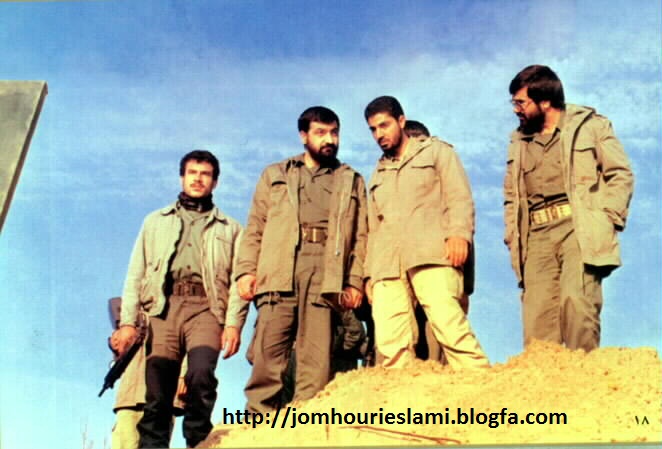
We did a trick. Our trick was to tell the guys of our staff— we didn't even have a general staff at that time - to the same guys who were doing tasks of the headquarters to collect all the cars you have so that they can go to the enemy from the oil well with their lights on.

There were also a number of the construction jihad’s cars and donations, and Mr. Torkan, then governor of Ilam, who was responsible for building an embankment in Dasht-e Abbas, had a number of cars. We moved ten or twelve dump trucks towards the enemy, all with their lights on.

That is, we pretended to bring forces and equipment. There was a long line of cars that when they moved, the enemy supposed a fresh force were going toward it and it might lower the Iraqis' morale. This operation made Iraqis afraid. They either ran away or stopped resisting.

Secondly, the martyr Hamid Arabnejad was supposed to lead us with a loader and shoot the first shot. That night, we were following each other with a distance of about twenty meters. At 8:30 in the morning, we started moving towards the Iraqis, but there was no sign of them.

We climbed to the hill and saw that there were no Iraqis. Hamid Arabnejad, who died a martyr in Khorramshahr, moved forward with a loader. The Iraqis had calibrated weapons and RPGs, and Arabnejad's action was very dangerous.

It was decided that Hamid Cherik (means guerilla) & Tahami would move with the next company behind Arabnejad. Hamid went missing for a while at the end of Fath ol-Mobin. Later, we heard from him that he had been captured, & according to his words, Imam Zaman (AS) saved him.

He used to say, “I was injured by a shrapnel or RPG & lost consciousness. I woke up at 11 a.m. the next day & was surrounded by twenty Iraqis. I pretended to die & prayed: O Imam Zaman! Everything I did was for God's sake and for promotion of Islam; save me yourself."

He said "The Iraqis left thinking I was dead. Later two Iraqi soldiers approached. Again I pretended to die. But these Iraqi brothers with a lump in their throat called me a soldier of Imam Khomeini & when they checked my pockets, they took out Turbah, Quran & a picture of Imam."

"They cursed Saddam & said: this is a soldier of Ali & Muhammad. I had a premonition that this is grace of Imam Zaman & I made a move that showed them I was alive. They took me to their trench & fed me. Some Iraqis who can speak Farsi said they were forcibly brought to the front"
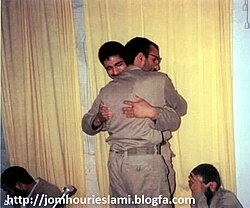
Hamid then said "Their doctor examined and bandaged me. My body was full of quivers and it was painful. They put me on a tank to take me back, but I had asked God to die a martyr, but not to be captured."

Hamid said "So at one point, when the tank crew dismounted & I saw there was no one around the tank, I took advantage of the opportunity & crawled a little & ran towards our trenches. When I saw the guys, I prostrated & thanked God. They took me to Ahvaz Hospital by helicopter.”

Hamid was very nimble. He had a strange courage. As soon as he knew that there is a need for initiative or risk in a corner of the front line, the first person who was willing to take the task of leading the troops and go into action was Hamid Iranmanesh.

Hamid had the character that he was always leader of the battalion. If he was the battalion commander, he would have gone with the first platoon, he would have gone with the first team of the platoon, not with its third team. He would go ahead, demine & open the path for the guys

In the Liberation of Khorramshahr, he first crossed the canal, so the guys dared to follow him. They bypassed the enemy's embankments, and Hamid destroyed Iraqi trenches by throwing grenades. There were only a few trenches left to clear when the fleeing Iraqis shot him.

He was shot four times in the stomach. The brothers bandaged his stomach with his own Keffiyeh to prevent bleeding. But Hamid didn’t perish. No matter how hard it was, he stands up and says "you go, don't wait for me." Finally, he recited his Shahada.

Once we were in Shalamcheh—before the Karbala 5 Operation—2 of our brothers named Hossein Sadeqi and Akbar Mousaiepour left to gather intelligence but never returned. There was one of our brothers who had a mystical union with God. He was a young student, yet very mystical.

There were probably not many like him in practical mysticism. He had reached a point where many mystic gurus reach after 70 or 80 years. He contacted me and asked to meet me. We used Racal military radios at the time, and I was in Ahvaz when he contacted me. I went to meet him.

He told me Akbar Mousaiepour and Sadeqi had not returned, but he had. I was very saddened. I told him that we had not even started yet and the enemy had taken prisoners from us and that the whole operation was exposed. I talked to him angrily. His name was Hossein.

He told me that Akbar Mousaiepour would return the following day. I told him, Hossein, what are you talking about? He smiled & said Hossein, son of Qolam Hossein says so. His father’s name was Qolam Hossein, a valuable teacher. His mother also a teacher. He was son of 2 teachers.

He too was like a teacher in his teens. When people spoke of Mr. Hossein, they meant him. There were many Hosseins. But only one was meant by Mr. Hossein. I asked him what he was talking about. He said: tomorrow Akbar Mousaiepour will return & Sadeqi will return next.

I asked him where this was coming from. He said: just stay here. I stayed. We had a military binocular positioned in a fortification made with sandbags. It was 1 pm when brothers from intelligence who were using the binocular saw something on the water. I went to see for myself.

There was a body on the water. Brothers retrieved it. It was Akbar. The next day Sadeqi came. It's amazing that the water despite its turbulence had returned them to their point of departure. They were both martyred in the water & the water returned their bodies to the same point

It was so amazing. I asked Hossein, “Hossein! How did you know?!” He told me: “I had a dream the previous night & in my dream, I saw Akbar Mousaiepour who told me were not taken captives, we were martyred. I will return tomorrow at this hour & Sadeqi will come back the next day”

Then Hossein told me something important. He asked me: do you know why Akbar could talk to me? Because he had two key virtues. First, he was married. Second, he always performed his night prayers, even when in the water. It was his virtue that enabled him to visit me in my dream.

In Karbala-5, Hossein was again with us. The Iraqis bombed our positions non-stop for 4 days. Then their tanks were ordered to open fire, and immediately the artillery followed, so that shells and mortars fell from every direction. The sky rained bombs and the Earth rained lava.

Finally, the Iraqi infantry attacked. Hossein told me “I want to be in the front line of fire!” I replied “No, you stay at the radio control with the brothers.” Hossein accepted, saying: “Allah is sufficient for us, & He is the best of judges.” He sat at the entrance underground.

I went deeper into the room, to a place underground that was apparently safe from the bombs, and we coordinated the fighters via radio control. Suddenly a tree, hit by an Iraqi bomb, fell on the entrance, so Hossein sat under this tree and began to recite the Quran.

Meanwhile, the bombing continued like rain: bombs, planes, and mortars were falling from all sides. With all this happening around him, Hossein was saying, “O Allah, grant me martyrdom for Your sake today! O Allah, do not deny me martyrdom on this blessed day.”

He told me, “The bullets passed in front of my nose, in front of my ears, and I thought with certainty, ‘Now I will finally become a martyr.’” I watched him finish reciting five ayas of the Quran while volcanoes erupted from above and below & the whole world seemed to be on fire.

It was an attack the like of which I had never experienced, not even in the terrible battles of al-Faw when the Iraqis attacked us with chemical weapons (poison gas) not even in the 2006 Lebanon War with the Zionists. The Iraqi counterattack in Karbala-5 is the fiercest I've seen

We were sitting with Hossein under the fallen tree at the entrance to the tunnel that we had as a control room and he began to recite the sixth aya of the Quran in a row after first saying, “O Allah, if You are not going to give me martyrdom, then at least give me a wound, Lord!”

He read the sixth aya, the seventh, for four hours straight he read, but martyrdom did not come. While he was reading, I had to coordinate the radio control of the rest of the fighters from the control room. The branches of the tree above us began to break and fall on us.

The planes now began to attack and drop huge bombs. The control room below me shook, causing a brother to come out of the room and say in his Syrian accent: "Oh Hossein, for God's sake! Come here immediately! Don't do this, my brother! Don't put your life in danger, we need you!"
So, Hossein finally went down to the control room, which was deeper in the tunnel and out of danger from the bombs, sad that he was not martyred! Iran had such heroes, who seek martyrdom, love it like a child loves its mother, and are sad when God does not give it to them.

That is how we were when we fought the Sacred Defense struggle (in the Iran-Iraq war). It is this spirituality and longing for martyrdom that connects us Iranian Guardsmen with our Hezbollah brothers in Lebanon, who are also like that, and makes us inseparable after forty years.


Missing some tweets in this thread? Or failed to load images or videos? You can try to .