
Ukraine’s summer offensive – will the war be decided by the end of 2026?
The offensive against Russian logistics, which has been underway since 29 May and extends up to 200 km behind the front line, is only part of the overall plan for a strategic offensive which, ideally, should lead to the liberation of Crimea and thus decide the war
What we have seen so far:
- Since February, increasing Ukrainian pressure on the front line, gradually wresting the initiative from the Russians
- Initially, attacks on supply lines in the Donetsk area extending up to around 60 km behind the front – presumably a trial run for the offensive starting on 29 May.
- Since April, a massive drone campaign against refineries and pumping stations, which is currently crippling up to 40% of refining capacity and has been causing fuel shortages across large swathes of RU territory for several days
- At the same time, pressure on the front line is being stepped up again with FPV drones – bucking the long-standing trend, losses of artillery and vehicles continued to rise in April and May
- From 29 May, a massive drone offensive within a range of 30–200 km along the entire front line, initially in the occupied territory, where an interference-proof connection is available via Starlink. In the following days, fire control is established over all major motorways; rail traffic is also targeted
- At the same time, drone attacks on the front are intensified once more, driving RU personnel losses up by a third to a 14-month high, despite the seasonally improved cover and camouflage opportunities
- From 4 June: attacks on fuel depots in the east of Crimea, as well as on ships and ports in the Sea of Azov
- Since 6 June: attacks in Belgorod have been extended at least 80 km deep into the Russian hinterland
- 7 June: attack on the main road link from the north to Crimea
These offensive operations are accompanied by propaganda campaigns. Zelensky’s decree ‘permitting’ the 9 May parade and his open letter, which once again - predictably in vain - offered a ceasefire, both demonstrate self-confidence and weaken Putin’s position at home, as he is unable to counter them. The attacks on St Petersburg around the SPIEF also fall under the propaganda category: the Russian public is being shown the weakness of its leadership, which cannot even protect the largest cities during such events. The attack on Kronstadt, which is actually militarily superfluous, fits into this picture too – the tsars’ historic naval base lies unprotected. The discontent, particularly among the pro-war faction in Russia, is growing audibly
The de facto closure of Crimea to tourism will also have an impact domestically, especially as returnees will report empty petrol stations and supermarket shelves. Together with the fuel shortage in large parts of the country, this is likely to increase domestic political pressure and cause the number of war supporters to dwindle
However, UA’s objectives clearly go far beyond this. The systematic ‘siege’ of the entire front, particularly in the south, where there are no direct links from the combat zone to the RU hinterland and supply routes are consequently more exposed, will limit the troops’ combat capability. Casualties exceeding recruitment rates and the commitment of forces to the makeshift protection of supply routes by mobile anti-aircraft units and additional drone observers on vehicles will further weaken the front. In principle, this is a greatly magnified version of the RU Kherson dilemma of 2022 – one holds an area with relatively strong forces that the UA are unable to storm, yet cannot hold it any more due to a lack of logistics
For there will be no major breakthrough battle; the heavy armoured forces required for this would be detected whilst still in the staging area and, at the latest when advancing to their starting positions, would come under massive attack from FPV drones. However, locally limited attacks have already been successfully tested in recent months; incursions up to 20 km wide and 10 km deep within a few days are apparently possible. Ideally, this – combined with the increasingly poor supply situation at the front – will lead to a situation similar to that on the Western Front in the summer of 1918. Operationally, the Allied victory at Amiens on 8 August was not particularly significant; psychologically, however, the Germans’ morale was shattered and they were forced to cede more and more ground until their eventual surrender on 9 November.
The increasing isolation of Crimea, even from the occupied territories in southern Ukraine, points to the actual objective of the offensive: the liberation of Crimea – a success that would decide the war. A direct assault is out of the question; the UA lacks all the necessary capabilities for this, both amphibious and in terms of air superiority. A more realistic scenario, however, is increased partisan activity – Atesh has been well organised for years and appears not to have been infiltrated by the Russian forces so far – plus special operations (SOF) activities, as have occurred sporadically in the past, both in Crimea and east of the Dnipro as far as Melitopol, through which local successes can be achieved and Russian frontline units tied down.
The front near Kherson, which is already the most exposed and should by now be largely cut off from supplies, will be further weakened as a result, making Ukrainian advances from the small bridgeheads increasingly possible. Even a geographically limited collapse of the Russian forces could then lead to the liberation of parts of southern Ukraine, a link-up with the partisans in Crimea, and thus the fall of the entire peninsula. The minimum objective here would be Melitopol, to avoid ending up in the same situation in Crimea as the Russian forces are in now, where drones can prevent an orderly supply of provisions. It is more likely, however, that if events unfold in this way, the entire southern front would collapse and the advance would reach at least Berdyansk
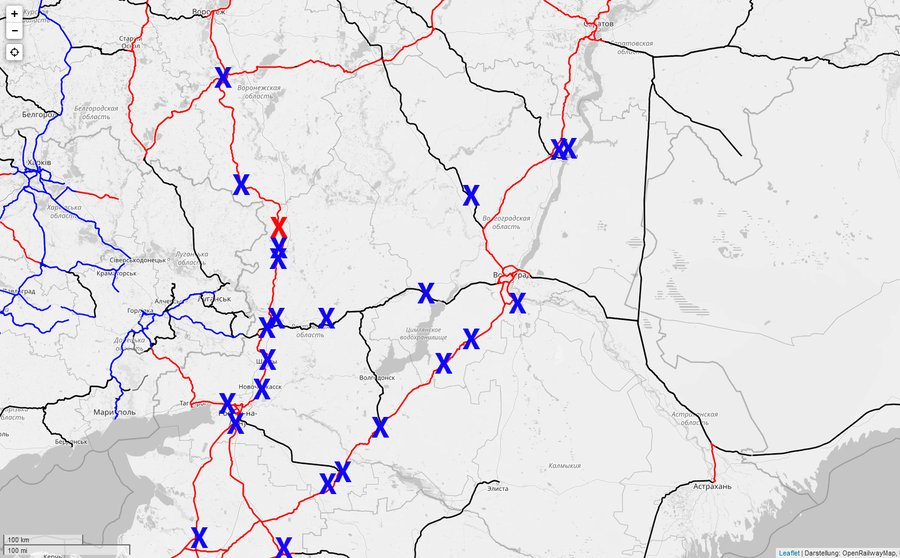
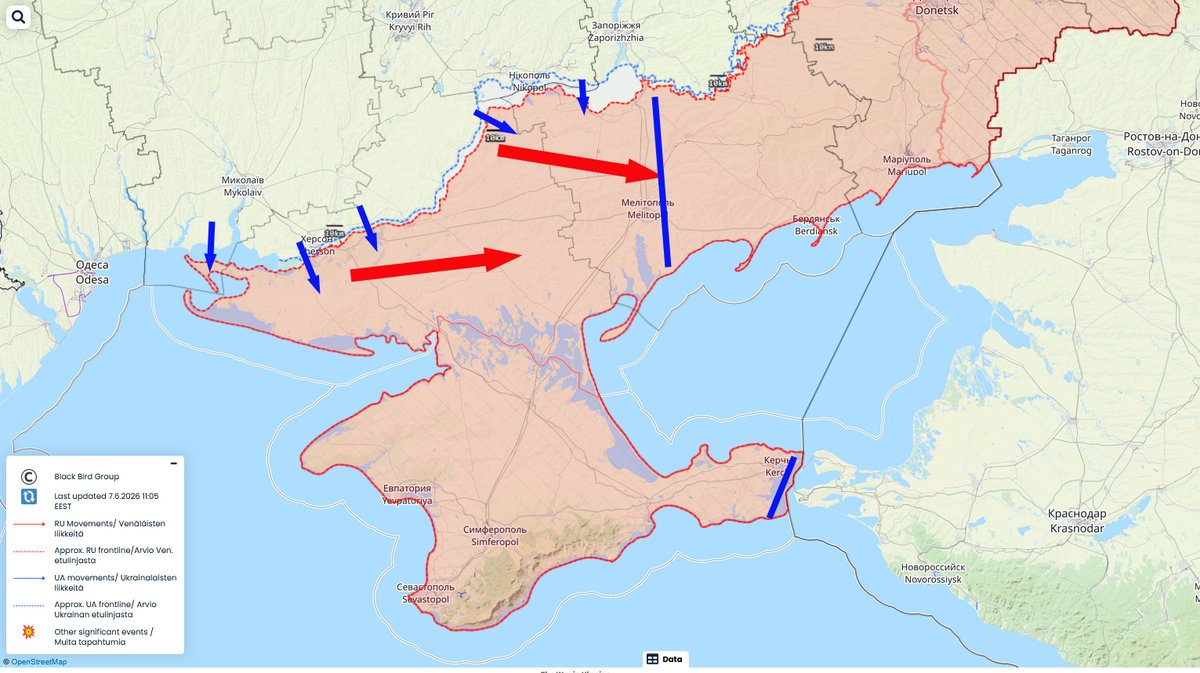 A prerequisite for such a far-reaching success, however, is that the UA can continue and, if possible, expand its air offensive against RU logistics. One possibility, for example, is a massive strike against rail transport in southern Russia; the attacks on substations a year ago may have been a test run for this, which could be repeated at a faster pace using more and heavier drones. A temporary collapse of rail transport would dramatically exacerbate the Russian Federation’s logistical situation
 In order to take Crimea by siege, the destruction of the Kerch Bridge will also be inevitable at some point in the near future; a first attempt using Neptune is said to have been made last night. In my view, it is more likely that they will wait until the Russian forces, in their desperation, send fuel trains across the railway bridge again – a tanker carriage set alight by a drone strike is likely to have a greater impact than a strike by one Neptune.
At the same time, the attacks on logistics in the other sectors of the front are hindering both the deployment of reinforcements to the south and larger relief offensives.
Of course, complete success is by no means guaranteed; much depends on how long RU takes to counter UA’s current superiority in the drone war; most likely by building up sufficient capabilities of their own within a range of up to 150 km, so as to be able to sustainably disrupt UA supplies. The advantage of this scenario, however, is that even partial successes are valuable. The uncertainty within RU society is already a gain; if, for example, they were to succeed in shifting the southern front 20 km southwards, that would already be a victory, as it would demonstrate that RU’s slow advance is not a law of nature. Liberating Crimea and large parts of southern Ukraine would probably not be synonymous with an end to the fighting, but the war would thereby be decided in UA’s favour – although parts of the Donbas, now completely ravaged by war since 2022, would have been lost, Crimea would have been regained. A renewed large-scale Russian advance would then be far less likely than Putin’s downfall and the new rulers’ attempt to prevent a complete collapse and salvage at least parts of the spoils in the Donbas through a swift ceasefire
The GSUA must certainly seek to exploit the current window of opportunity; it will close again in one way or another within six months at the latest – it is unlikely to take longer for RU to develop the means to return to a stalemate – whether its plans follow the lines suggested here remains to be seen
Translated with DeepL.com (free version) with minor corrections by the author
In order to take Crimea by siege, the destruction of the Kerch Bridge will also be inevitable at some point in the near future; a first attempt using Neptune is said to have been made last night. In my view, it is more likely that they will wait until the Russian forces, in their desperation, send fuel trains across the railway bridge again – a tanker carriage set alight by a drone strike is likely to have a greater impact than a strike by one Neptune.
At the same time, the attacks on logistics in the other sectors of the front are hindering both the deployment of reinforcements to the south and larger relief offensives.
Of course, complete success is by no means guaranteed; much depends on how long RU takes to counter UA’s current superiority in the drone war; most likely by building up sufficient capabilities of their own within a range of up to 150 km, so as to be able to sustainably disrupt UA supplies. The advantage of this scenario, however, is that even partial successes are valuable. The uncertainty within RU society is already a gain; if, for example, they were to succeed in shifting the southern front 20 km southwards, that would already be a victory, as it would demonstrate that RU’s slow advance is not a law of nature. Liberating Crimea and large parts of southern Ukraine would probably not be synonymous with an end to the fighting, but the war would thereby be decided in UA’s favour – although parts of the Donbas, now completely ravaged by war since 2022, would have been lost, Crimea would have been regained. A renewed large-scale Russian advance would then be far less likely than Putin’s downfall and the new rulers’ attempt to prevent a complete collapse and salvage at least parts of the spoils in the Donbas through a swift ceasefire
The GSUA must certainly seek to exploit the current window of opportunity; it will close again in one way or another within six months at the latest – it is unlikely to take longer for RU to develop the means to return to a stalemate – whether its plans follow the lines suggested here remains to be seen
Translated with DeepL.com (free version) with minor corrections by the author

HC Strien
@Strien9
Linksliberal. Gegen Extremisten von rechts, links und sonstwo. Team Wissenschaft (Archäologie).
auch @hcstrien.bsky.social - zu Syrien nur dort
Missing some tweets in this thread? Or failed to load images or videos? You can try to .