
RE:2026 - Capcom’s Roadmap Is a Good Window Into Where AAA Research Is Going
A specific slide from Capcom’s RE:2026 presentation caught my eye.
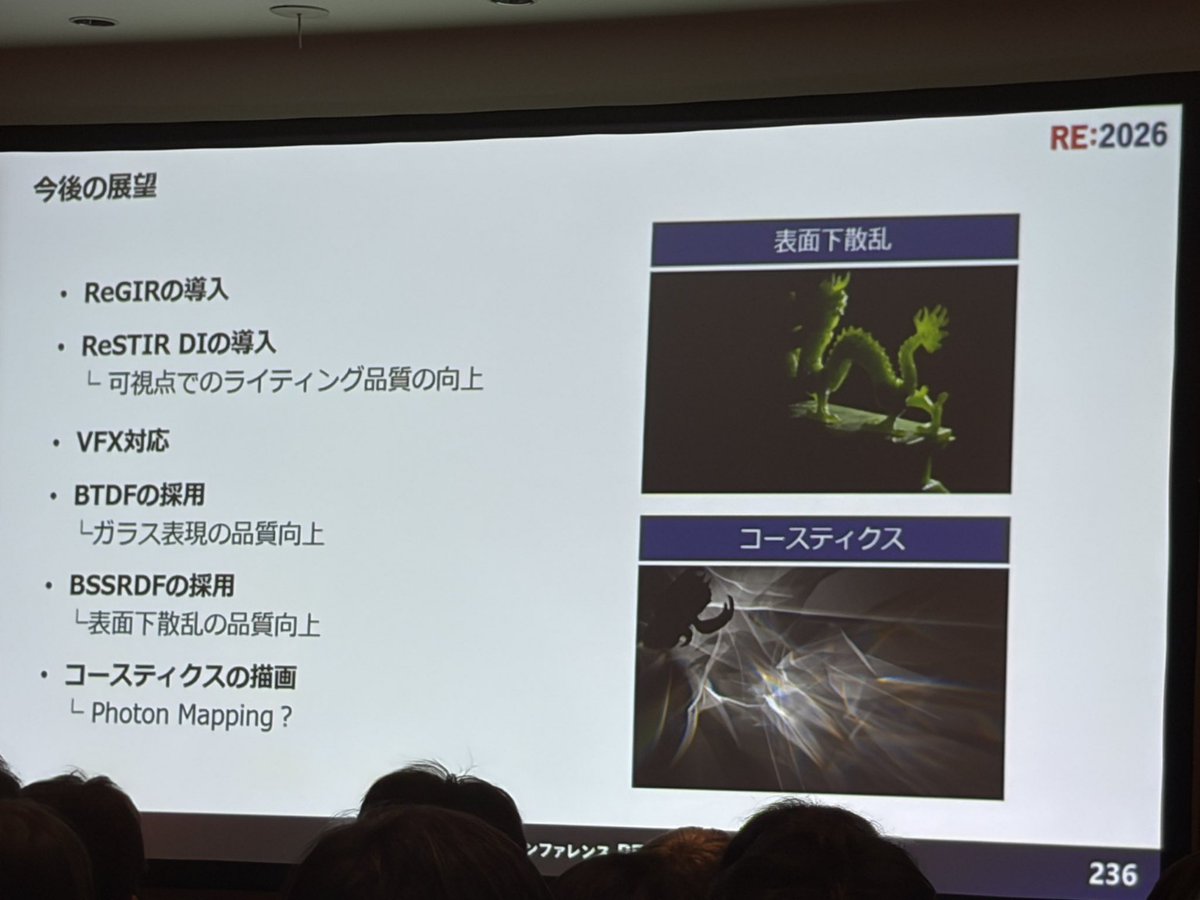 Courtesy of @mizuki_izuna
I try to follow graphics research closely, and roadmaps like this are useful because they show what happens after the papers: which ideas an AAA engine team actually considers important enough to integrate into a production renderer.
There is also a useful comparison point. In March 2026, Capcom presented Implementing Real-Time Path Tracing in RE ENGINE for Resident Evil Requiem and PRAGMATA at GDC. The talk was given by Hitoshi Mishima and described the path tracer that Capcom had integrated into RE ENGINE.
Only a few months later, this new RE:2026 roadmap is noticeably more specific.
The four parts I find most interesting are:
- ReGIRの導入 — Introduction of ReGIR
- ReSTIR DIの導入 — Introduction of ReSTIR DI
- BTDFの採用 — Adoption of BTDF, to improve glass rendering
- BSSRDFの採用 — Adoption of BSSRDF, to improve subsurface scattering
The interesting part is how directly these map onto limitations Capcom had already described in March.
Where RE ENGINE was in March
Direct lighting used NEE with Streaming RIS. Capcom generated candidates using a simplified BSDF, culled punctual lights through a world-space Light-Grid, explicitly sampled emissive polygons, used two or three shadow rays on the first bounce, and one on later bounces.
Reference: CAPCOM, Implementing Real-Time Path Tracing in RE ENGINE for ‘Resident Evil Requiem’ and ‘PRAGMATA’, GDC 2026, slide 12.
For punctual lights, that Light-Grid was a 16×128×128 3D texture. Each cell stored a bit mask of lights affecting that region, allowing Streaming RIS to avoid evaluating irrelevant lights at the current shading point.
Reference: CAPCOM, same presentation, slide 14.
Indirect lighting was already further along: ReSTIR GI was implemented in RE ENGINE and could be enabled on a title-by-title basis. Capcom specifically used it to reduce indirect-light variance and make DLSS Ray Reconstruction more stable.
Reference: CAPCOM, same presentation, slides 26–27.
So the March architecture was roughly:
Streaming RIS + Light-Grid for direct lighting → path tracing → optional ReSTIR GI for indirect lighting.
The roadmap at the end of that presentation then listed ReSTIR DI, position-dependent emissive sampling for huge scenes, transparent/translucent path tracing with BTDF, and several other areas as future work.
Reference: CAPCOM, same presentation, slide 58, Future work.
1. ReGIR: the unnamed March problem now has a concrete solution
This is probably the biggest change.
In March, Capcom said its existing emissive-polygon sampler was pretty decent for its current titles, but that large scenes were primarily illuminated by emissive polygons would require a position-dependent sampling method.
Reference: CAPCOM, Implementing Real-Time Path Tracing in RE ENGINE for ‘Resident Evil Requiem’ and ‘PRAGMATA’, GDC 2026, slide 58.
ReGIR looks very much like the concrete answer to the problem described in March.
ReGIR is Reservoir-based Grid Importance Resampling. It builds a world-space light sampling structure. Instead of starting every shading point from essentially the global light population, spatial cells contain reservoirs biased toward lights relevant to that part of the world. NVIDIA's RTXDI documentation describes precisely this role and notes that ReGIR can feed ReSTIR as its initial sample generator. NVIDIA DOCS (github.com/NVIDIA-RTX/RTXDI/blob/main/Doc/Integration.md?...)
So we have:
March: “large worlds need position-dependent light sampling.”
RE:2026: “introduce ReGIR.”
2. ReSTIR DI: from “too expensive” to explicit integration target
ReSTIR DI was already on Capcom’s March roadmap, but there was an important qualifier.
Capcom said it could significantly improve direct lighting, but that they were not currently using it because of the cost balance.
Reference: CAPCOM, Implementing Real-Time Path Tracing in RE ENGINE for ‘Resident Evil Requiem’ and ‘PRAGMATA’, GDC 2026, slide 58.
I think that as ReSTIR DI is not currently shipping since the slide is still titled 今後の展望 which is future outlook if AI translation is correct.
But the wording is more concrete than March. It is no longer just a potentially useful technique whose cost is problematic. It also naturaly complements ReGIR rather than replacing it.
ReGIR handles world-space candidate quality. ReSTIR DI adds temporal and spatial reuse at visible surfaces.
That combination is also how NVIDIA describes the technologies in RTXDI. NVIDIA DOCS (github.com/NVIDIA-RTX/RTXDI/blob/main/Doc/Integration.md?...)
3. BTDF: from generic translucency support to a specific glass-quality target
BTDF itself is not new to Capcom’s roadmap. The March future-work slide already grouped:
Transparent/Translucent Path Tracing → BTDF.
But there is useful context elsewhere in that presentation. Capcom’s current frosted-glass implementation takes the path-traced result and applies a blur effect afterward. They then need a special DLSS RR guide because that treatment can produce reconstruction artifacts.
Reference: CAPCOM, Implementing Real-Time Path Tracing in RE ENGINE for ‘Resident Evil Requiem’ and ‘PRAGMATA’, GDC 2026, slide 58.
The new roadmap is much more explicit:
Adopt BTDF to improve glass rendering quality.
That suggests the direction is moving away from treating some glass behavior as a reconstruction/post-process problem and toward representing transmission as part of the actual light-transport model.
For now it does not tell us which BTDF model Capcom intends to use.
4. BSSRDF is new item
Firs of all I checked what is BSSRDF since I was not familiar with it and that's why it caught my attention the most.
At the most basic level, BRDF + BTDF = BSDF: reflection plus transmission form the general scattering model used to represent most ordinary surfaces, and this is the same basic framework Unreal Engine’s Substrate material system is built around.
A BSSRDF targets a different class of material behavior: instead of assuming light enters and leaves at the same surface point, it allows light to enter at one position, scatter through the material, and exit somewhere else. That spatial transport is what makes it suitable for skin, wax, marble, and other strongly subsurface-scattering materials.
This one was not on the March future-work list. RE ENGINE currently implements subsurface scattering using screen-space blurring. Capcom showed that feeding this result into Ray Reconstruction could create flickering on skin, requiring an SSS guide buffer to stabilize it.
Reference: CAPCOM, same presentation, slides 30–31.
The new slide now says:
Adopt a BSSRDF to improve subsurface-scattering quality.
A BSSRDF treats scattering as transport between different surface locations rather than simply blurring already-computed surface lighting in screen space.
The new roadmap therefore appears to be pushing RE ENGINE toward more of the difficult material transport being handled inside the path-tracing model itself, rather than repaired afterward.
That is probably the most interesting material-rendering change in the new slide.
The NVIDIA UE5.8 RTX branch is converging on the same sampling architecture
I also checked the attached NvRTX 5.8 Runtime and Shaders source rather than only comparing feature names. There is overlap with the sampling side.
ReGIR is already deeply integrated In:
Renderer/Private/RTXDI/SampledLightRendering.cpp
the default local-light presampling mode literally says:
Presample lights using ReGIR (sampling on world-space grid)
The same file exposes cell size, grid dimensions, hierarchy levels and samples per cell, and BuildReGIRStructures() maintains ReGIR buffers with temporal reuse.
Shaders/Private/RTXDI/PresampleReGIR.usf
then constructs reservoirs per world-space cell by evaluating a light-volume target function and streaming candidates through RIS.
So on ReGIR, the overlap with Capcom’s new direction is direct. ReSTIR DI is also a full pipeline:
Renderer/Private/RTXDI/SampledDirectLighting.cpp
contains separate production passes for:
- ReSTIRDI Initial
- ReSTIRDI Temporal
- ReSTIRDI Spatial
- final sampled-light evaluation
The sequence is visible around
SampledDirectLighting.cpp
The important caveat is that:
r.SampledLighting.Direct
defaults to 0 at
SampledDirectLighting.cpp
So the implementation exists in this branch already. This is also consistent with NVIDIA positioning RTXDI as a library containing ReSTIR DI, ReSTIR GI and ReSTIR PT for importance sampling. NVIDIA Developer (developer.nvidia.com/rtx-kit/?utm_source=chatgpt.com)
NvRTX 5.8 similarly has explicit temporal and spatial GI reservoir passes under:
Shaders/Private/RTXDI/IndirectLighting/ApplyTemporalResamplingGI.usf
Shaders/Private/RTXDI/IndirectLighting/ApplySpatialResamplingGI.usf
and its C++ integration even contains ReSTIR PT permutations in SampledIndirectLighting.cpp.
My take from this roadmap
The interesting shift is that real-time path tracing research in production engines is no longer mainly about whether games can trace multiple bounces. The harder problems are increasingly about making those few rays count:
world-space importance sampling → ReGIR
spatiotemporal direct-light reuse → ReSTIR DI
indirect-path reuse → ReSTIR GI / PT
proper transmission → BTDF
proper subsurface transport → BSSRDF
Capcom’s March presentation showed the compromises required to ship a real-time path tracer. The RE:2026 slide is interesting because it shows where they want to remove some of those compromises next.
And the fact that NVIDIA’s UE5.8 RTX branch is independently implementing much of the same sampling stack makes this a useful snapshot of where high-end real-time rendering research is currently converging.
Conclusion
I hope we get the full RE:2026 slides soon, for more context.
Given the current hardware limits, I also expect this work to keep leaning heavily on DLSS Ray Reconstruction, neural upscaling, and similar reconstruction techniques. Real-time path tracing is progressing faster than raw raster hardware power so its inevitable.
We will probably see this roadmap mature gradually across future RE ENGINE titles rather than the next game. The useful part is that some of the same research direction can already be explored in the new NvRTX 5.8 branch, especially around ReGIR and ReSTIR.
For me, that is what made this slide worth digging into: it is a small but useful glimpse at where AAA rendering research is heading. It caught my eye enough that I am still here at 22:00 on a Friday comparing presentation slides and renderer source code.
#RE2026CAPCOM #PathTracing #ReSTIR #RTX #UE5
Courtesy of @mizuki_izuna
I try to follow graphics research closely, and roadmaps like this are useful because they show what happens after the papers: which ideas an AAA engine team actually considers important enough to integrate into a production renderer.
There is also a useful comparison point. In March 2026, Capcom presented Implementing Real-Time Path Tracing in RE ENGINE for Resident Evil Requiem and PRAGMATA at GDC. The talk was given by Hitoshi Mishima and described the path tracer that Capcom had integrated into RE ENGINE.
Only a few months later, this new RE:2026 roadmap is noticeably more specific.
The four parts I find most interesting are:
- ReGIRの導入 — Introduction of ReGIR
- ReSTIR DIの導入 — Introduction of ReSTIR DI
- BTDFの採用 — Adoption of BTDF, to improve glass rendering
- BSSRDFの採用 — Adoption of BSSRDF, to improve subsurface scattering
The interesting part is how directly these map onto limitations Capcom had already described in March.
Where RE ENGINE was in March
Direct lighting used NEE with Streaming RIS. Capcom generated candidates using a simplified BSDF, culled punctual lights through a world-space Light-Grid, explicitly sampled emissive polygons, used two or three shadow rays on the first bounce, and one on later bounces.
Reference: CAPCOM, Implementing Real-Time Path Tracing in RE ENGINE for ‘Resident Evil Requiem’ and ‘PRAGMATA’, GDC 2026, slide 12.
For punctual lights, that Light-Grid was a 16×128×128 3D texture. Each cell stored a bit mask of lights affecting that region, allowing Streaming RIS to avoid evaluating irrelevant lights at the current shading point.
Reference: CAPCOM, same presentation, slide 14.
Indirect lighting was already further along: ReSTIR GI was implemented in RE ENGINE and could be enabled on a title-by-title basis. Capcom specifically used it to reduce indirect-light variance and make DLSS Ray Reconstruction more stable.
Reference: CAPCOM, same presentation, slides 26–27.
So the March architecture was roughly:
Streaming RIS + Light-Grid for direct lighting → path tracing → optional ReSTIR GI for indirect lighting.
The roadmap at the end of that presentation then listed ReSTIR DI, position-dependent emissive sampling for huge scenes, transparent/translucent path tracing with BTDF, and several other areas as future work.
Reference: CAPCOM, same presentation, slide 58, Future work.
1. ReGIR: the unnamed March problem now has a concrete solution
This is probably the biggest change.
In March, Capcom said its existing emissive-polygon sampler was pretty decent for its current titles, but that large scenes were primarily illuminated by emissive polygons would require a position-dependent sampling method.
Reference: CAPCOM, Implementing Real-Time Path Tracing in RE ENGINE for ‘Resident Evil Requiem’ and ‘PRAGMATA’, GDC 2026, slide 58.
ReGIR looks very much like the concrete answer to the problem described in March.
ReGIR is Reservoir-based Grid Importance Resampling. It builds a world-space light sampling structure. Instead of starting every shading point from essentially the global light population, spatial cells contain reservoirs biased toward lights relevant to that part of the world. NVIDIA's RTXDI documentation describes precisely this role and notes that ReGIR can feed ReSTIR as its initial sample generator. NVIDIA DOCS (github.com/NVIDIA-RTX/RTXDI/blob/main/Doc/Integration.md?...)
So we have:
March: “large worlds need position-dependent light sampling.”
RE:2026: “introduce ReGIR.”
2. ReSTIR DI: from “too expensive” to explicit integration target
ReSTIR DI was already on Capcom’s March roadmap, but there was an important qualifier.
Capcom said it could significantly improve direct lighting, but that they were not currently using it because of the cost balance.
Reference: CAPCOM, Implementing Real-Time Path Tracing in RE ENGINE for ‘Resident Evil Requiem’ and ‘PRAGMATA’, GDC 2026, slide 58.
I think that as ReSTIR DI is not currently shipping since the slide is still titled 今後の展望 which is future outlook if AI translation is correct.
But the wording is more concrete than March. It is no longer just a potentially useful technique whose cost is problematic. It also naturaly complements ReGIR rather than replacing it.
ReGIR handles world-space candidate quality. ReSTIR DI adds temporal and spatial reuse at visible surfaces.
That combination is also how NVIDIA describes the technologies in RTXDI. NVIDIA DOCS (github.com/NVIDIA-RTX/RTXDI/blob/main/Doc/Integration.md?...)
3. BTDF: from generic translucency support to a specific glass-quality target
BTDF itself is not new to Capcom’s roadmap. The March future-work slide already grouped:
Transparent/Translucent Path Tracing → BTDF.
But there is useful context elsewhere in that presentation. Capcom’s current frosted-glass implementation takes the path-traced result and applies a blur effect afterward. They then need a special DLSS RR guide because that treatment can produce reconstruction artifacts.
Reference: CAPCOM, Implementing Real-Time Path Tracing in RE ENGINE for ‘Resident Evil Requiem’ and ‘PRAGMATA’, GDC 2026, slide 58.
The new roadmap is much more explicit:
Adopt BTDF to improve glass rendering quality.
That suggests the direction is moving away from treating some glass behavior as a reconstruction/post-process problem and toward representing transmission as part of the actual light-transport model.
For now it does not tell us which BTDF model Capcom intends to use.
4. BSSRDF is new item
Firs of all I checked what is BSSRDF since I was not familiar with it and that's why it caught my attention the most.
At the most basic level, BRDF + BTDF = BSDF: reflection plus transmission form the general scattering model used to represent most ordinary surfaces, and this is the same basic framework Unreal Engine’s Substrate material system is built around.
A BSSRDF targets a different class of material behavior: instead of assuming light enters and leaves at the same surface point, it allows light to enter at one position, scatter through the material, and exit somewhere else. That spatial transport is what makes it suitable for skin, wax, marble, and other strongly subsurface-scattering materials.
This one was not on the March future-work list. RE ENGINE currently implements subsurface scattering using screen-space blurring. Capcom showed that feeding this result into Ray Reconstruction could create flickering on skin, requiring an SSS guide buffer to stabilize it.
Reference: CAPCOM, same presentation, slides 30–31.
The new slide now says:
Adopt a BSSRDF to improve subsurface-scattering quality.
A BSSRDF treats scattering as transport between different surface locations rather than simply blurring already-computed surface lighting in screen space.
The new roadmap therefore appears to be pushing RE ENGINE toward more of the difficult material transport being handled inside the path-tracing model itself, rather than repaired afterward.
That is probably the most interesting material-rendering change in the new slide.
The NVIDIA UE5.8 RTX branch is converging on the same sampling architecture
I also checked the attached NvRTX 5.8 Runtime and Shaders source rather than only comparing feature names. There is overlap with the sampling side.
ReGIR is already deeply integrated In:
Renderer/Private/RTXDI/SampledLightRendering.cpp
the default local-light presampling mode literally says:
Presample lights using ReGIR (sampling on world-space grid)
The same file exposes cell size, grid dimensions, hierarchy levels and samples per cell, and BuildReGIRStructures() maintains ReGIR buffers with temporal reuse.
Shaders/Private/RTXDI/PresampleReGIR.usf
then constructs reservoirs per world-space cell by evaluating a light-volume target function and streaming candidates through RIS.
So on ReGIR, the overlap with Capcom’s new direction is direct. ReSTIR DI is also a full pipeline:
Renderer/Private/RTXDI/SampledDirectLighting.cpp
contains separate production passes for:
- ReSTIRDI Initial
- ReSTIRDI Temporal
- ReSTIRDI Spatial
- final sampled-light evaluation
The sequence is visible around
SampledDirectLighting.cpp
The important caveat is that:
r.SampledLighting.Direct
defaults to 0 at
SampledDirectLighting.cpp
So the implementation exists in this branch already. This is also consistent with NVIDIA positioning RTXDI as a library containing ReSTIR DI, ReSTIR GI and ReSTIR PT for importance sampling. NVIDIA Developer (developer.nvidia.com/rtx-kit/?utm_source=chatgpt.com)
NvRTX 5.8 similarly has explicit temporal and spatial GI reservoir passes under:
Shaders/Private/RTXDI/IndirectLighting/ApplyTemporalResamplingGI.usf
Shaders/Private/RTXDI/IndirectLighting/ApplySpatialResamplingGI.usf
and its C++ integration even contains ReSTIR PT permutations in SampledIndirectLighting.cpp.
My take from this roadmap
The interesting shift is that real-time path tracing research in production engines is no longer mainly about whether games can trace multiple bounces. The harder problems are increasingly about making those few rays count:
world-space importance sampling → ReGIR
spatiotemporal direct-light reuse → ReSTIR DI
indirect-path reuse → ReSTIR GI / PT
proper transmission → BTDF
proper subsurface transport → BSSRDF
Capcom’s March presentation showed the compromises required to ship a real-time path tracer. The RE:2026 slide is interesting because it shows where they want to remove some of those compromises next.
And the fact that NVIDIA’s UE5.8 RTX branch is independently implementing much of the same sampling stack makes this a useful snapshot of where high-end real-time rendering research is currently converging.
Conclusion
I hope we get the full RE:2026 slides soon, for more context.
Given the current hardware limits, I also expect this work to keep leaning heavily on DLSS Ray Reconstruction, neural upscaling, and similar reconstruction techniques. Real-time path tracing is progressing faster than raw raster hardware power so its inevitable.
We will probably see this roadmap mature gradually across future RE ENGINE titles rather than the next game. The useful part is that some of the same research direction can already be explored in the new NvRTX 5.8 branch, especially around ReGIR and ReSTIR.
For me, that is what made this slide worth digging into: it is a small but useful glimpse at where AAA rendering research is heading. It caught my eye enough that I am still here at 22:00 on a Friday comparing presentation slides and renderer source code.
#RE2026CAPCOM #PathTracing #ReSTIR #RTX #UE5

Missing some tweets in this thread? Or failed to load images or videos? You can try to .