ABC and the FCC are squaring off in the US District court for DC in a hearing over ABC's lawsuit over the government's ongoing jawboning against the network, which culminated in the agency forcing the network to defend all 8 of its broadcast licenses in an early renewal proceeding.
2/ TechFreedom, along with Protect Democracy and others, filed an amicus brief on behalf of former FCC commissioners, chairs, and senior staff:
techfreedom.org/fcc-threatens-
3/ The government, with a straight face, is telling the court that this is all about the FCC's investigation into alleged employment discrimination -- despite the fact that Brendan Carr has outright admitted that this is not the case -- most recently by saying that ABC's decision not to air Trump's speech live on-air would be examined in the proceedings.
4/ As we pointed out in our brief, the FCC has plenty of tools with which it can seek additional information in the employment discrimination investigation if it feels answers so far have been insufficient. Yet it has chosen the nuclear option, in order to create maximum content-based pressure.
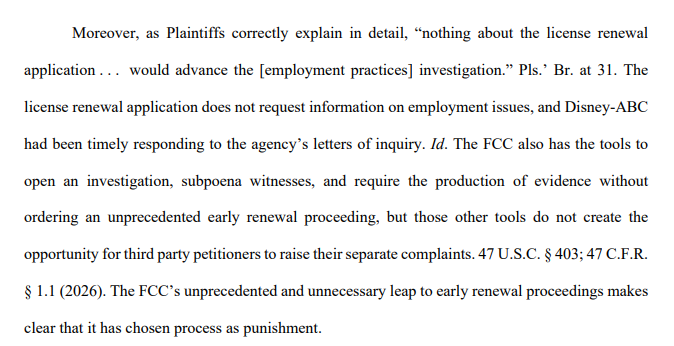
5/ ABC's counsel points out that the FCC cannot renew licenses more than 30 days before expiration -- and some of the license at issue aren't up for renewal for YEARS.
So the only reason to call for early renewal is to deny -- but if they framed the action as a revocation, they would have the burden. By calling for early renewal, they are placing the burden on ABC.
Which all points to process as punishment.
6/ The court wants to hear about jurisdiction first. It's a bit in-the-weeds (on my last podcast episode I had @Berin Szóka and Bob Corn-Revere on to help explain: podcast.techfreedom.org/episodes/440-t
7/ Simplified: Congress has established a particular method for challenging FCC actions. But ABC says it is not challenging the ultimate merits or decisions of the FCC. What they are challenging is the unconstitutional jawboning that the FCC proceedings are being used for.
8/ To make them wait until the FCC has finished the process in order to go to court would allow the FCC to accomplish exactly what it has set out to do (punish ABC for its speech and pressure it to change it) and make it effectively unredressable.
9/ ABC: "Our editorial decisions are being affected right now in covering an election that [we] have right to cover without any fear of intimidation or of retaliation. So I think you just underscored the immediacy of the harm."
10/ The judge likens it to a qualified immunity argument, where the immunity is from having to endure suit (or in this case administrative process) in the first place.
ABC agrees and notes that Justice Kagan has made the same comparison. Says that it is not asking the court to stop the EEO investigation, just the brazen retaliation aimed at coercing them to change their protected expression.
11/ ABC says the government is saying "if you are really being chilled, why aren't you trying to stop all the other things we've done to you" which is...chutzpah at its finest. But ABC says (and the judge agrees) that they don't want to be here in the first place. They don't want to have to run to court, they want relief from the jawboning, not for the FCC to be unable to perform its job legitimately.
12/ Government's turn
13/ Govt says ABC could have challenged the early renewal order to the commission itself and then taken the decision on that challenge to the DC Circuit
14/ Judge: If the FCC had sat on a challenge to the order, how could they have brought that to court?
Govt: The court of appeals has the authority to preserve its jurisdiction, so if the FCC delayed then the CoA could use the All Writs Act and evaluate unreasonable delay - but not the district court
15/ Judge: What do you make of the argument that the First Amendment nature of the challenge means the court doesn't even have to consider the Thunder Basin factors (relating to when litigants can escape Congressionally-mandated review procedures). Again, for deeper explanation on that: podcast.techfreedom.org/episodes/440-t
16/ Govt: The case where the chief judge said that involved FTC investigative demands, which the plaintiffs could ultimately only challenge through the district court, so it didn't matter, which distinguishes it from this case where Congress said the DC Circuit has jurisdictioh in the first instance, not the district court
17/ Judge: What if you guys renewed the licenses? How would they then challenge the jawboning?
Govt: There would be no FCC order for them to challenge in the CoA.
Judge: So then how does that not support ABC's claim that the claim here is separate and distinct from the merits of the early renewal proceedings? They would seem to have no recourse for the jawboning as long as the ultimate decision was in their favor (with the punishment having already been imposed via process).
18/ Govt: They would have some recourse ::waves government hands::
19/ Govt: ABC concedes that it is not challenging the agency's authority to do these things (e.g., investigate EEO violations or call for early renewal). They are challenging the facts of this particular application, and that's for the CoA.
[N.B. the government is consistently failing to engage with the fact that jawboning is...not the kind of agency action that Congress intended to include in its process for reviewing actual agency decisions on their merits]
20/ [They must fail to engage with it, because it is damning for them]
21/ Judge: What about the argument that you can't even renew licenses more than 30 days before expiry?
Govt: This isn't about the licenses (um, then why is it called early license renewal?), it's about ABC's failure to adequately reply to EEO investigation requests (literally nobody believes this, even Brendan Carr)
22/ Govt: it's squarely within the agency's expertise to determine whether ABC is acting within the public interest, so this falls within Congressionally-mandated review processes.
[N.B. They are all but admitting that early renewal is going far beyond the EEO investigation]
23/ ABC: The government's position is nuts! It is suggesting that parties can challenge all manners of interim orders in court without final agency action. Surely it -- and the courts -- would say "you haven't exhausted administrative remedies, come back with a final order"
24/ ABC: The government has not been able to rebut that there is retaliatory speech-chilling. There is a here-and-now injury, and they simply cannot come up with a refutation that this is the case. Their only argument has to be "you should have sued us in the CoA"
25/ ABC: Discovery disputes happen all the time. What makes this pretextual is that after the president got mad at ABC in late April. A couple of days later the FCC issued the early renewal order without ever having told us that they thought our responses were insufficient -- we even had a scope agreement! They only emailed any issues they had with the discovery until 17 days later (an obvious ploy to backstop justification).
26/ ABC: "The government's statement that the early renewal order isn't about the licenses is a fatal admission. Why do you need to use the tool that is explicitly about licenses if it's not about them? If it's all about discovery, there are specific processes made just for that!"
27/ Judge: I appreciate that you used the guillotine analogy instead of the Sword of Damocles analogy, which has been a bit played out at this point
#PractiiceNote
28/ On to the First Amendment side of the argument
29/ Judge: Maybe the government's action is pretextual, but the pretext isn't to violate the First Amendment, it's to bring you in line with the discovery obligations?
ABC: When people tell you who they are, and what they're going to do, believe them. And the government has been explicit about what it is doing here. It cannot defend either the timing or choice of tools, and certainly not both of them in light of each other.
30/ We're back.
ABC: Carr explicitly said that networks have a chance to "correct course" on speech Trump doesn't like (e.g., Kimmel's jokes) before license renewal comes up. And then almost immediately issued the early renewal order.
31/ Judge: Do you think the burden-shifting actually applies, or that it's just a helpful way to understand it?
ABC: Whatever standard you want to impose on us, we've met it
32/ Judge: Defendants makes a curious argument that because you're a huge company that can absorb costs, that should impact the analysis. What do you make of that, because I find it, um...::trails off::
[N.B. I noted the absurdity of that exact argument in the podcast podcast.techfreedom.org/episodes/440-t]
33/ ABC: At absolute best it is irrelevant
34/ Government's turn.
Judge: I take it you aren't contesting that they are engaged in protected speech?
Govt: We are not
35/ Judge: So why should ABC's deep pockets mean that it can't be chilled?
Govt: It's a regulated entity being subjected to regulatory action by its regulator. They say they are being harmed, but ::waves government hands again::
36/ Judge: Do you dispute that the president saying outright that the networks should be carrying his speech is important?
Govt: The statements are the statements, but they were to a different audience (oh?)
37/ Govt: the chairman has repeatedly said that this is all above-board so we shouldn't be worried about this (ah, the government version of "trust me, bro")
38/ Govt: The reason the early renewal order was issued was the EEO investigation. Now that there are proceedings ongoing, there are petitions from the public that the FCC is obligated to address.
[N.B. this is an outrageously and transparently bogus argument. At a bare minimum, the FCC chose this mechanism so that those petitions would be filed and it could claim basis to go beyond the EEO investigation]
39/ Judge: Chairman Carr has said it's been more than 50 years since early renewal has been used. Is that correct?
Govt: Yes
Judge: What other tools does the FCC have in the EEO investigation?
Govt: Will have to get back to you on that [N.B. lol]
40/ Judge: Given that there has been this iterative discovery process over months, why did the FCC all of a sudden decide that it needed early renewal proceedings?
Govt: it shows that there was an attempt to engage but it culminated in the decision that a stronger tool was needed
41/ Judge: What happens if you become satisfied? Would you rescind the proceedings?
Govt: The FCC could close the process but I can't speculate
42/ Judge: Can you tell me why all 8 licenses were called for renewal at once when some don't expire until 2030?
Govt: The EEO investigation necessarily impacts all 8 licenses
Judge: Has the FCC ever used early renewal for discovery issues? It seems the past ones have all been about misrepresentations to the commission or criminal activity?
43/ Govt: I think Bilingual Bicultural Coalition points to this because ::thing that is not at all similar to what's going on here::
44/ Judge: I'm sure you have a lot of discovery disputes, so what is it about this that requires such a step?
Govt: Tries to go back to jurisdiction, saying that this shows that the court would have to examine the merits which places this back into the mandated CoA review process [N.B. this is not true; the court could decide the retaliation claims irrespective of merits. Remember that Vullo held that even a legitimate government regulatory interest cannot be used in a retaliatory way]
45/ Judge: I would like to know what other discovery tools the FCC has. Discuss amongst yourselves.
46/ ABC: There's a thing called "notice of apparent liability" which the FCC has used frequently
47/ Govt: ::lists a few things::
Judge: Asks the government for a supplemental filing for these alternatives on Oct 9 with response due on the 14th
48/ Judge moves on to irreparable injury
ABC: The irreparable injury is the chilling of ABC's editorial decisions, which as we've explained in our filings we have already had to modify in response to government pressure
49/ ABC: Points to the Kimmel fracas, reticence to inviting political candidates to The View because Carr started attacking them and asking them to prove that they qualify for the bona fide news interview exemption to the equal time rule (contrary to decades and decades of practice)
50/ ABC: And once there's a determination of First Amendment retaliation, balance of the equities and public interest is effectively established
51/ Govt: On irreparable harm, since ABC has narrowed the case, and the statute says that they retain the license through the administrative proceeding and any subsequent judicial review, the harm they are alleging is not irreparable [N.B. - that ignores how jawboning works. Just because they can keep the license for now does not mean speech chilling doesn't occur in the meantime]
52/ Govt: The only evidence I have seen on changes to editorial decisions is the declaration in Docket No. 25, and when I read paragraphs 23-37, it focuses on The View and ties it to the discussion on the bona fide interview declaratory judgment order which ABC has disclaimed challenging [N.B. again, it's the pattern of jawboning of which this is just one piece, that has caused those changes]
53/ Judge: Does the government agree that speech-chilling can cause irreparable harm?
Govt: It could but that merges the inquiry. If there's irreparable injury any time a constitutional wrong is found then every case is subject to the extraordinary remedy of a preliminary injunction
54/ Judge: How do you square that with Media Matters (citing longstanding precedent} that the loss of First Amendment rights, even for a brief period, is irreparable harm.
Govt: ::tries to distinguish Media Matters, but not engaging with the underlying jurisprudence that is not reliant on the facts of MM::
55/ ABC: In Slaughter, Justice Gorsuch warned of the injury that can be imposed by the unitary executive against disfavored parties -- and this is an extreme example of exactly that [N.B. - Gorsuch was indeed writing about exactly this case]
56/ Judge: The government says that the chilling you're alleging happened before the early license renewal proceedings.
ABC: Well yea, of course we were also chilled by that, and we could have gone to court. But this has made it so much worse and so much more obvious. When Carr said that refusal to broadcast Trump's speech would be part of the license renewal proceedings, that's when we really had no choice.
57/ Matter taken under advisement, hearing adjourned

Ari Cohn
@AriCohn
First Amendment & defamation lawyer.
Free Speech Counsel @TechFreedom (x2)
Prev: @theFIREorg (x3), BigLaw
Illini/music junkie/oofnik.
Tweets are my own.
Missing some tweets in this thread? Or failed to load images or videos? You can try to .