
Anton Gerashchenko@Gerashchenko_en
5h
1 tweets
Where is the national interest of the United States?
I have written before that Moscow sees negotiations as "business in exchange for war," while the US perceives them as "peace in exchange for business." The Kremlin’s main objective is to buy American consent to the normalization of the war Russia is waging against Ukraine.
At this stage of the negotiations between Russia and the US, I can see the Kremlin’s interests. I can see Putin’s personal interests. I can see benefits for certain American business groups. But can someone explain what the national interest of the United States is in all this? Because "a few people will make a lot of money" is a rather modest answer for a country with global ambitions.
Putin celebrated his birthday on October 7, and the "gifts" from Washington arrived two days later: permission to trade Russian diesel fuel and a new attack on the International Criminal Court, which issued a warrant for his arrest.
Moscow has already received the first gift. President Trump announced more than 300,000 tons immediately, 500,000 tons in November, then one million and then three million more, depending on the condition of Russian oil refineries. The US authorized these transactions until April 7, 2027. The license contains no requirement for Russia to end the war or halt strikes on Ukraine’s energy infrastructure.
President Trump wants cheaper fuel and is betting that this news will have a positive effect on his approval ratings and the elections. For Putin, it means additional revenue and a huge political victory.
The next step could be a US demand that Ukraine stop striking Russian oil refineries. Trump has already promised lower prices and now has his own incentive to put pressure on Kyiv.
Protecting Russian refineries would give Russia far more than simply fulfilling a contract. The plants could be repaired without repeated strikes, the fuel shortage could be reduced, fuel supplies to the military could become more stable, and export revenues could be restored. Behind the talk of cheap diesel lies a very practical question: who will ensure the recovery of Russia’s war economy?
Diesel may be just the beginning of the bargaining. Reuters reported on negotiations involving an American investor in Nord Stream, while Eric Lipton, a journalist with The New York Times, reported on a deal involving Russian oil assets that would benefit business partners of people close to American negotiators. The pattern is becoming clear: profits for American businesses, a return to Western markets for Russia. Ukraine and the EU bear the losses.
Putin’s second gift is sanctions targeting the ICC as an institution. On October 9, the Trump administration moved from imposing restrictions on individual officials to targeting the court’s financial and technological support systems. Officially, the measures are intended to protect Americans and their allies. Putin is celebrating.
Meanwhile, Moscow itself is labeling the judges as defendants. On October 8, Russia’s Prosecutor General’s Office announced it had sent requests to the Netherlands and other countries to arrest and extradite nine current and former ICC officials, including the court’s president, Tomoko Akane. They were convicted in absentia following a prosecution launched in retaliation for the arrest warrants against Russia’s leadership. Russia is demanding the extradition of the judges pursuing its leaders, while the US strikes at the court’s own resources the following day. A coincidence?

Anton Gerashchenko@Gerashchenko_en
Sep 07
View on Twitter
Some further thoughts on the new round of peace negotiations with Putin over Ukraine.
Moscow is offering the United States not "peace in exchange for business," but rather "business in exchange for war." The Kremlin is offering Washington major Russian-American deals, access to energy resources, the Arctic, critical minerals, infrastructure and investment projects. The main objective is to buy American consent to the normalization of the war Russia is waging against Ukraine.
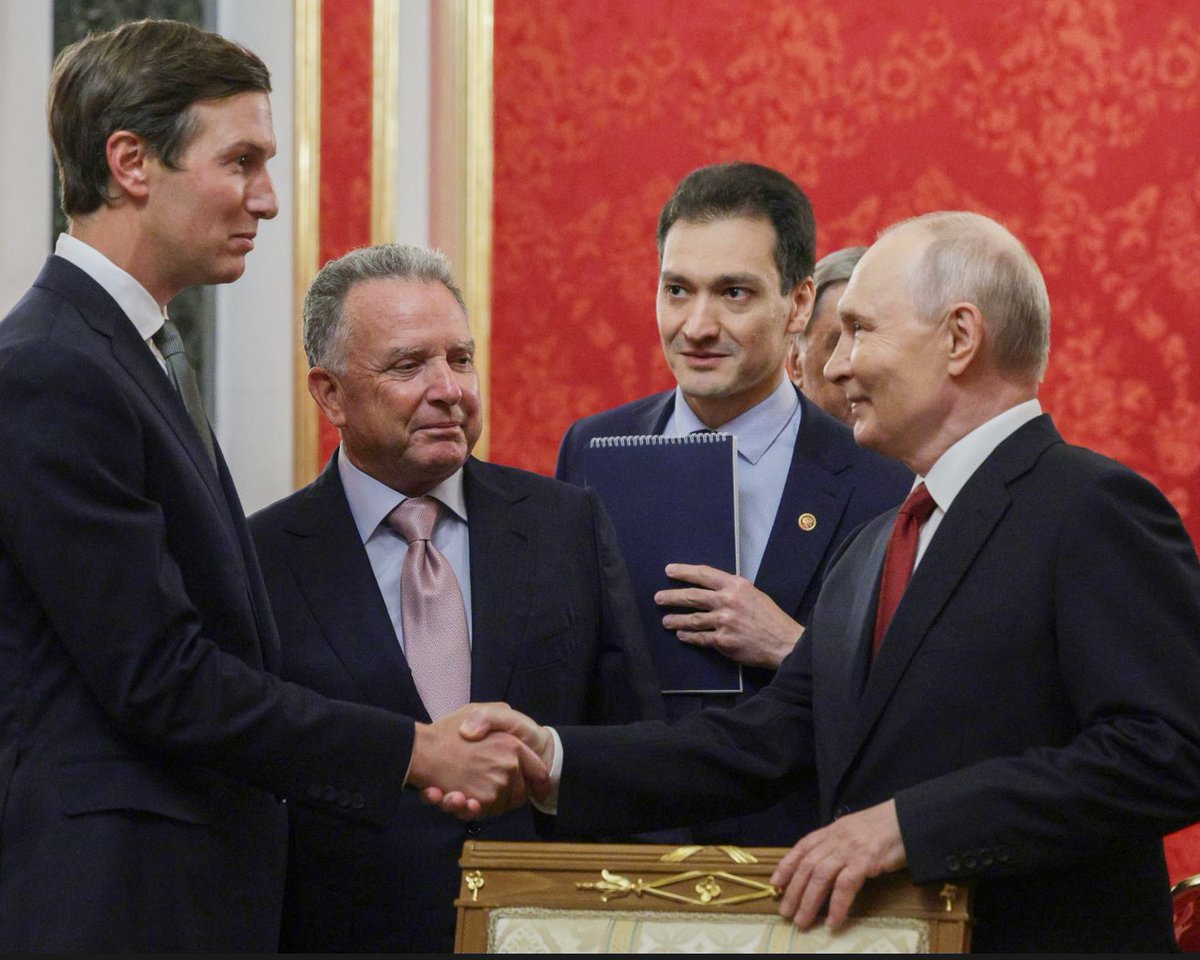
Kirill Dmitriev is effectively selling Washington precisely this model of future relations. The head of the Russian Direct Investment Fund and Putin’s special envoy has been systematically working through the channels of Steve Witkoff and Jared Kushner, whose value lies exactly in their direct access to Trump’s inner circle. Following the meeting with Putin on September 5, the Kremlin once again separately reported that major Russian-American projects had been discussed in detail.
At the same time, Moscow is offering an entire package of economic "normalization." It includes Arctic oil and gas, LNG, heavy oil, lithium, copper, nickel, platinum, rare earth metals, nuclear energy, infrastructure and aviation. Long-term purchases of American aircraft have been discussed, which would require the lifting of aviation sanctions, as well as compensation for American companies for losses incurred after leaving Russia.
Energy and the Arctic are the central components of the proposal because this is where Russian and American interests could potentially be linked for decades. Russia needs technology, capital and sanctions relief to develop difficult oil and gas fields and LNG projects. American companies are being offered access to resources. For the Kremlin, the main benefit would come when American companies invest billions of their own dollars in these projects. After that, imposing new sanctions on Russia would also mean losses for American businesses.
Sakhalin-1 demonstrates how Moscow is trying to create such mutual interests in practice. On August 15, 2025, the day of the Trump-Putin summit in Anchorage, Putin signed Decree No. 559, which opened a legal pathway for the return of foreign investors. For Exxon, this concerns its former 30% stake and approximately $4.6 billion written off after the company left Russia. Exxon has publicly denied plans to return, but talks continued: Reuters reported on a non-binding framework agreement between Exxon and Rosneft, while the Wall Street Journal reported contacts between Neil Chapman and Igor Sechin, and Darren Woods discussed the issue with Trump. Putin has meanwhile extended the deadline for transactions involving the stake until January 1, 2027. Moscow is effectively offering Exxon the opportunity to recover billions in lost value in exchange for restoring an economic relationship with Russia.
Gentry Beach and Novatek show that such a model can be put into practice. According to The New York Times, the Dallas-based investor, who has ties to the Trump family, signed an LNG agreement with Novatek after the Anchorage summit. Beach himself said that the project had been discussed “at the highest levels” in Moscow and Washington. This is already a concrete American private-sector interest for which improved relations with Russia have financial value.
Moscow is using critical minerals to exploit American dependence on China. Putin has offered American companies access to Russian deposits of lithium, nickel, platinum and rare earth metals. But in February 2025, he explicitly included the so-called “new territories” - the Ukrainian territories occupied by Russia - in the proposal. This makes the Russian offer particularly revealing: American businesses are effectively being offered an economic interest in resources located in territories seized by Russia as a result of the war.
The Zaporizhzhia Nuclear Power Plant illustrates even more clearly how business can become an instrument for normalizing the consequences of the war. Bloomberg reported on options involving American participation in or control over the plant, with the electricity it generates potentially being divided between the parties. In other words, a Ukrainian facility seized by Russia is no longer being discussed solely as an issue of occupation, but also as the subject of a potential economic agreement.
Even the proposals concerning aluminum follow the same model - access to the Russian market in exchange for the lifting of restrictions. In February 2025, Putin proposed returning approximately 2 million tonnes of Russian aluminum per year to the US market.
Separately, he proposed an approximately $15 billion project in Russia’s Krasnoyarsk Krai involving a hydroelectric power plant and new aluminum production.
There are also more extravagant proposals designed to sell Trump the image of a grand historic deal. In October 2025, Dmitriev proposed a “Putin-Trump tunnel” beneath the Bering Strait: 112 km long, costing approximately $8 billion and taking up to eight years to build, potentially with the involvement of Elon Musk’s Boring Company. The economic feasibility of such an estimate is questionable. But the political product is obvious: a major project, Trump’s name and a symbol of a new US-Russia partnership.
The same function is served by the $14 trillion figure Dmitriev uses to describe the potential of economic cooperation. It emerged after Zelenskyy said on February 6, 2026, that Ukrainian intelligence had obtained documents concerning a so-called “Dmitriev package” worth approximately $12 trillion. Following The Economist’s publication, Dmitriev called the $12 trillion figure “fake news,” but immediately raised the estimate to more than $14 trillion and claimed that American businesses had already lost more than $300 billion because of sanctions. There is no documentary evidence confirming the realism of this figure. For now, it is a populist argument aimed at an American audience: confrontation with Russia costs you money, while cooperation could bring in far more.
And American capital is already responding to the opportunities, although so far largely outside Russia itself. On January 29, 2026, Lukoil announced a deal with Carlyle to sell LUKOIL International GmbH, which holds international assets with a book value of approximately $22 billion. The deal is subject to OFAC approval. Reuters also reported competing bids from Chevron and Quantum Capital, as well as interest from Exxon and ADNOC. In other words, when Russian assets become available and the Treasury allows a transaction to proceed, major American businesses immediately show interest.
On the other hand, the Carlyle example currently demonstrates the willingness of American capital to buy Russian assets, rather than the willingness to invest in Russia. Lukoil is selling its foreign assets precisely because of sanctions pressure. This is effectively a consequence of pressure on Russia, rather than evidence of successful normalization. For the Kremlin, the next step is much more important: to ensure that American money flows not into the purchase of assets from Russia, but into new projects inside Russia itself.
OFAC demonstrated another vulnerability in the sanctions system in 2026: American interests can outweigh the desire to maintain pressure on Russia. In March, General Licenses 133 and 134 were issued, followed later by 134B and 134C, allowing transactions involving certain shipments of Russian oil, including cargoes belonging to Rosneft, Lukoil and sanctioned tankers. The reason was the US-Israeli war against Iran, problems surrounding the Strait of Hormuz and the threat of an oil shortage. Dmitriev did not cause this. But Moscow saw the lesson clearly: if Russian oil is needed by the US to solve another problem, sanctions can become secondary.
The main obstacle to the Russian model currently lies in Congress. On August 7, the Senate voted 86-11 in favor of the Lindsey O. Graham Sanctioning Russia and Iran Act of 2026, which provides for increased pressure on Russia’s energy sector, financial system, shadow fleet and major buyers of Russian energy. A companion bill introduced by McCaul and Hoyer has already been submitted to the House of Representatives. The 86-11 vote shows that, outside the president’s inner circle, the idea of a rapid return to business as usual with Russia does not yet have political consensus.
Moscow is therefore not currently working with the entire American system, but with its most receptive elements.
Opposing this are a significant part of Congress and the security establishment. The Treasury Department is taking a more situational approach: sanctions can be eased when broader American interests require it.
Why does Moscow need economic cooperation with the US if China and Chinese capital are available next door? China already buys Russian resources, but it cannot lift American sanctions, return Russia to the dollar-based financial system, or weaken the transatlantic sanctions regime. American investment offers the Kremlin much more: capital and technology, political legitimacy, less dependence on China, and potentially an American lobbying constituency interested in maintaining stable relations with Russia.
Moscow already has some initial results, but they remain contradictory.
There is Beach-Novatek, the negotiations surrounding Sakhalin-1, Carlyle and Lukoil’s international assets, interest from Chevron and Quantum, and a series of OFAC exemptions. But Carlyle is benefiting from a sanctions-driven asset sale, Exxon is seeking to recover its own losses, and OFAC eased restrictions because of an energy crisis. This is still not the systemic normalization that the Kremlin wants.
Moscow’s real success will begin when American businesses start investing new money directly into Russia and become interested in protecting those investments from future sanctions. An even more significant threshold will be reached if American capital becomes willing to enter projects connected to occupied Ukrainian territories and assets seized during the war.
The struggle is therefore no longer about whether individual US-Russia deals are possible - they are. The question is whether the Kremlin can turn these deals into a system in which American domestic interests emerge that would favor accepting Russia’s aggressive policy on the European continent.

Anton Gerashchenko
@Gerashchenko_en
Ukrainian patriot. Advisor to Internal Affairs Minister (2021-2023). Institute of the Future founder. Support volunteer translators https://t.co/nWSASMUo29
Missing some tweets in this thread? Or failed to load images or videos? You can try to .