
TheKOOKReport@thekookreport
Oct 17
21 tweets
 $ASTS WEEK IN REVIEW
It feels like a battle. Let's evaluate what we know. That, and more, on this week's Weekly…
$ASTS WEEK IN REVIEW
It feels like a battle. Let's evaluate what we know. That, and more, on this week's Weekly… 
 Feels like Doom
And it is. But it's turned before. It might turn again.
x.com/tuff_4r/status


 We're Now At the Center of the Market
I guess we never asked how…f-!
x.com/SpacBobby/stat
x.com/barronsonline/

Barron's@barronsonline
Oct 14
View on Twitter
AST SpaceMobile Is the New Battleground Stock trib.al/5WyuVjv

 Why Everyone Cares
The TAM is not what you think it is. Like people dismissing Elon's flying car, anyone who thinks a phone today is what we consider a phone tomorrow will be in for a big surprise.
x.com/spacanpanman/s

Anp nman@spacanpanman
nmanOct 15
View on Twitter
$ASTS: The number of connected devices requiring 100% coverage is going to be absolutely mind blowing
 Prior Competitive Shocks
Here is a walk down memory lane
x.com/thekookreport/
TheKOOKReport@thekookreport
Oct 13
View on Twitter
 $ASTS Halloween Special
A walk down memory lane of prior market "shocks" from competitive moves. Spoiler alert, $ASTS grinds through and always goes higher.
 1/n

 Here Comes The Terrestrial Rollout
What's old is new
x.com/ASTS_Investors
x.com/ASTS_Investors
sxcontent9668.azureedge.us/cms-assets/ass

ASTS Investors @ASTS_Investors
Oct 12
View on Twitter
STARLINK TO USE TOWERS TO ROLL OUT 800MHz SPECTRUM
It appears Starlink won't be manufacturing low band satellites and will be relying on other methods to use the spectrum.
This makes it even more likely that AST will be the JV choice as SpaceX wouldn't be able to provide connectivity with the MNO's lowband spectrum.
$ASTS $SPCX $T $VZ $TMUS
 Establishing Services
It's about the developers, developers, developers
x.com/thekookreport/
TheKOOKReport@thekookreport
Oct 12
View on Twitter
This is what I was talking about last night on my Spaces. Starlink Mobile is going to attract the ire of not just the MNOs, but the device manufacturers. Are you going to just switch to Starlink Mobile if they offer a worse service at a higher price (their cost basis will be higher than the current MNOs)? Without all the device incentives, it will look worse.
If Starlink comes out with a phone, are you ready to leave your existing walled garden? Will app developers make the things you want on a Starlink operating system?
$ASTS
 Starship Constraints
Reality applies to everyone. Starship has a lot of lifting to do.
x.com/Defiantclient2

Kevin Chen@Defiantclient2
Oct 13
View on Twitter
$ASTS $SPCX: Great point by @Clear Street regarding the required cadence of Starship launches to align with Starlink’s deployment plan. I don’t see many analysts covering this angle.
Note that in addition to this, SpaceX not only needs to launch Starlink Mobile V2 payloads but also Starlink V3 for fixed broadband and their orbital data centers project.
Much of SpaceX’s plan rests on ramping Starship which is currently unproven.
 The MNO Position Could Not Be Clearer
It's all the MNOs against SpaceX
x.com/Rick_in_Miami/
x.com/PCMag/status/2

PCMag@PCMag
Oct 13
View on Twitter
Deutsche Telekom's CEO warns other mobile carriers against forming a Mobile Virtual Network Operator (MVNO) partnership with SpaceX. pcmag.com/news/t-mobiles

 SpaceX Deleted
Why are all the MNOs erasing SpaceX?
Anpnman@spacanpanman
nmanOct 16
View on Twitter
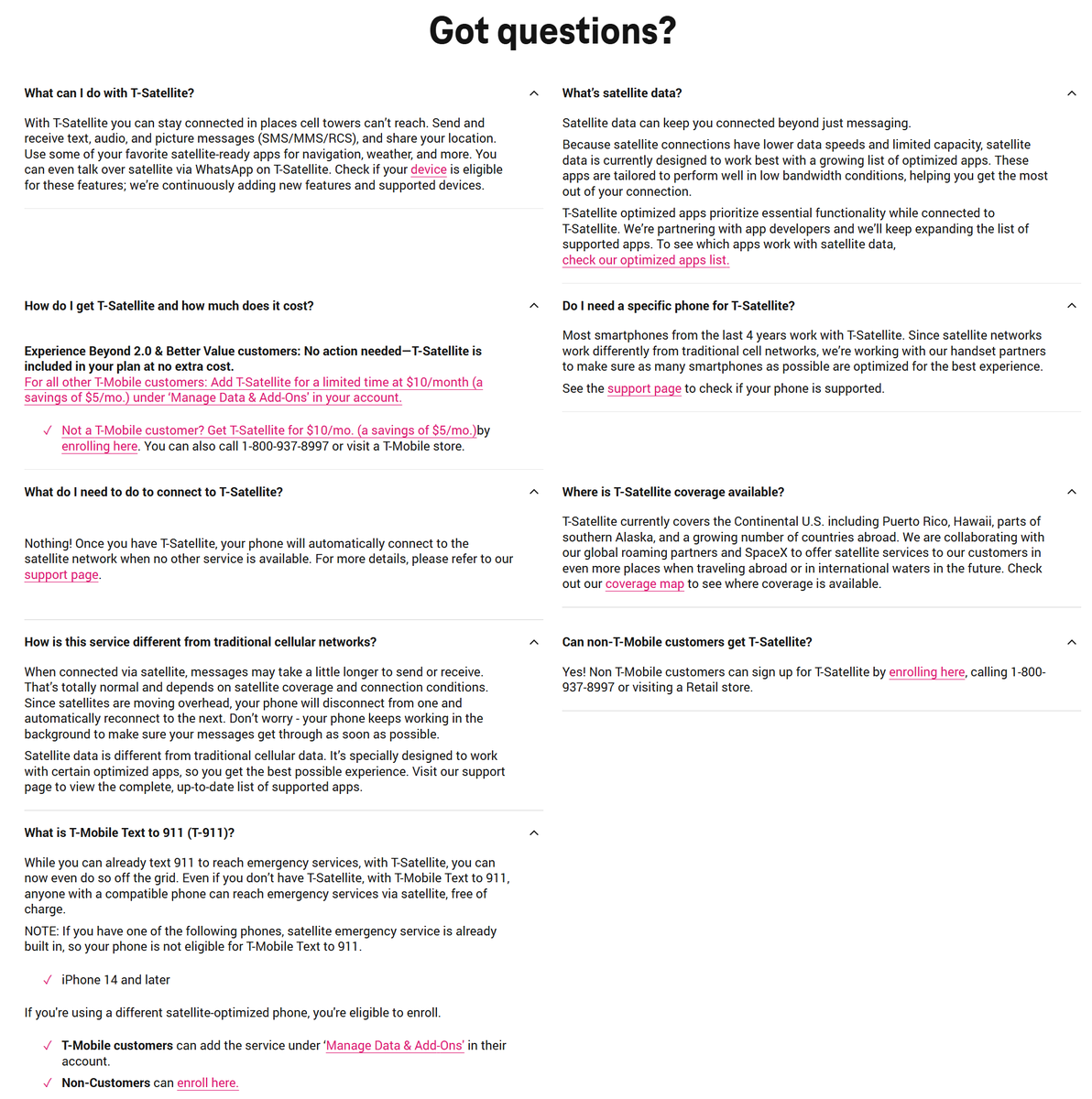
$ASTS $TMUS: All references to Starlink have been removed from T-Mobile's T-Satellite FAQ section
 The Ukraine Shockwave
What did Elon do?
x.com/elonmusk/statu
x.com/Defiantclient2
x.com/Defiantclient2
Kevin Chen@Defiantclient2
Oct 14
View on Twitter
$ASTS $SPCX: Yes. This is why sovereign satellite solutions are so important.
@Abel Avellan thought this through and through with @AST SpaceMobile's transparent bent pipe architecture.
 Cable Businesses Aren't Safe
SpaceX and Amazon going after Fiber
x.com/retail_mourinh

Retail Mourinho@retail_mourinho
Oct 13
View on Twitter
So you’re telling me $AMZN is now competing with MNOs for customers as well?
So $ASTS has literally no competition?  Jesus, just think about the margins if MNOs become dependent on ASTS.
And the commercial side will account for only around 50% of revenue
 I’ve genuinely never seen such an asymmetric setup, if the thesis plays out.
-RM
Jesus, just think about the margins if MNOs become dependent on ASTS.
And the commercial side will account for only around 50% of revenue
I’ve genuinely never seen such an asymmetric setup, if the thesis plays out.
-RM
 Clearstreet Report
Funny, this report almost exactly mirrors my tweet. Am I doxed?
x.com/spacanpanman/s
Anpnman@spacanpanman
nmanOct 13
View on Twitter
$ASTS: CLEAR STREET REITERATES $115 PRICE TARGET AND BUY RATING
Summary
AST faces launch constraints today, and the market is watching every slip closely. AST currently depends on Falcon 9, a rocket owned by competitor SpaceX (SPCX, Buy, $217 PT). That pressure could ease if other rockets return to service, particularly New Glenn, which carries up to eight BlueBirds per flight versus three on Falcon 9. Our model continues to see AST reaching commercial broadband service by mid-2027E.
On the flip side, we think the market is underappreciating SpaceX's own launch risk. Its next-generation V2 phone satellites are how it hits its timeline, and they depend on Starship, which remains unproven. Flight 15 has already slipped from October 19 to November 8 at the earliest, and reaching service in early 2028E would require roughly 24 Starship flights in six months. Both companies are in this race and both carry launch risk. We think AST remains positioned about six months ahead of SPCX.
Key Points
SpaceX's phone leap is parked behind Starship, and the math is demanding. The real threat to AST is SpaceX's FCC-approved V2 constellation, which SpaceX says Starship will launch. We don't see the larger V2s flying in volume on Falcon 9. SpaceX's stated goal is initial global coverage of about 1,200 satellites within six months of starting launches in mid-2027, at roughly 50 per Starship. By our math, that is about 24 Starship flights in six months, roughly one a week, from a rocket with no regular cadence: Flight 15 has already slipped from October 19 to November 8 at the earliest. Service lands in early 2028 at best.
New Glenn's December return is the pivotal event for AST. It has been grounded since the May 28 pad explosion. A clean return in December would reopen AST's high-capacity rocket, but we expect it to take until mid-2027 to turn into satellites on orbit. One flight carries up to eight BlueBirds, almost three Falcon 9 flights' worth. Vulcan helps indirectly by pulling Amazon and Space Force demand off Falcon 9.
AST keeps winning where the contracts are signed. Japan's ministry initially selected the AST SpaceMobile (ASTS)-Rakuten Group (TSE: 4755, NC) venture for its ~$1B J-LEO program over a KDDI (TSE: 9433, NC)-SpaceX bid, and a U.S.-Japan joint statement then named the partnership.
What would change our mind. A New Glenn return that slips, or Starship reaching a regular cadence well ahead of SpaceX's mid-2027 plan.
Maintain $115 PT, Buy Rating: We maintain our Buy rating and $115 price target, implying 20x 2029E EBITDA of $2.0B which translates to ~$12x our revenue. ASTS sits on a fortified capital base with $3.7B in pro forma cash and restricted cash (inclusive of the July $1.15B convertible note issuance).
Investment Thesis
The AST-versus-SpaceX race is the market's favorite debate, and both sides carry launch risk. AST's is microanalyzed, with every BlueBird slip priced in real time. SpaceX's (SPCX, Buy, $217 PT) is underappreciated: its next-gen phone satellites depend on a Starship that has yet to prove a regular cadence, and its EchoStar spectrum doesn't arrive until around late 2027.
Meanwhile, ASTS is becoming the "orbital tower," a wholesale, neutral-host provider for 60+ global MNOs rather than a retail competitor. Q2 confirmed the pivot from customer acquisition to system integration, with nearly 50 gateways in various stages of completion, installation, and planning, leaving launch cadence as the one bottleneck. Management is also de-risking the commercial timeline by stacking high-margin government and defense revenue (Radar/AI Edge) ahead of full D2D service, and the initial J-LEO selection in Japan is a blueprint for future sovereign wins.
Valuation: We maintain our Buy rating and $115 PT. Shares trade at 26x our 2028E EBITDA and 11x our 2029E EBITDA, an attractive entry for an emerging wholesale infrastructure giant.
Catalyst and Risks to Watch
The next few weeks look mostly constructive for ASTS. The clearest positive is the FCC's October 29 vote on satellite spectrum leasing rules, which supports AST's carrier-partnership model. A firm launch date for BlueBirds 14–16 would also help settle the launch-pace debate. The negatives sit mainly on the SpaceX side. The October 24 SpaceX share unlock could pressure ASTS by association, and the FCC's October 29 vote on the 25 MHz auction gives SpaceX a path to build a network next to spectrum AST already uses. Two undated items could land at any time and cut both ways. A T-Mobile partnership decision in AST's favor would be the biggest upside surprise, while a SpaceX/Grain FCC filing seeking fast approval of the 800 MHz deal would be a sentiment negative.
CLEAR STREET REITERATES $115 PRICE TARGET AND BUY RATING
Summary
AST faces launch constraints today, and the market is watching every slip closely. AST currently depends on Falcon 9, a rocket owned by competitor SpaceX (SPCX, Buy, $217 PT). That pressure could ease if other rockets return to service, particularly New Glenn, which carries up to eight BlueBirds per flight versus three on Falcon 9. Our model continues to see AST reaching commercial broadband service by mid-2027E.
On the flip side, we think the market is underappreciating SpaceX's own launch risk. Its next-generation V2 phone satellites are how it hits its timeline, and they depend on Starship, which remains unproven. Flight 15 has already slipped from October 19 to November 8 at the earliest, and reaching service in early 2028E would require roughly 24 Starship flights in six months. Both companies are in this race and both carry launch risk. We think AST remains positioned about six months ahead of SPCX.
Key Points
SpaceX's phone leap is parked behind Starship, and the math is demanding. The real threat to AST is SpaceX's FCC-approved V2 constellation, which SpaceX says Starship will launch. We don't see the larger V2s flying in volume on Falcon 9. SpaceX's stated goal is initial global coverage of about 1,200 satellites within six months of starting launches in mid-2027, at roughly 50 per Starship. By our math, that is about 24 Starship flights in six months, roughly one a week, from a rocket with no regular cadence: Flight 15 has already slipped from October 19 to November 8 at the earliest. Service lands in early 2028 at best.
New Glenn's December return is the pivotal event for AST. It has been grounded since the May 28 pad explosion. A clean return in December would reopen AST's high-capacity rocket, but we expect it to take until mid-2027 to turn into satellites on orbit. One flight carries up to eight BlueBirds, almost three Falcon 9 flights' worth. Vulcan helps indirectly by pulling Amazon and Space Force demand off Falcon 9.
AST keeps winning where the contracts are signed. Japan's ministry initially selected the AST SpaceMobile (ASTS)-Rakuten Group (TSE: 4755, NC) venture for its ~$1B J-LEO program over a KDDI (TSE: 9433, NC)-SpaceX bid, and a U.S.-Japan joint statement then named the partnership.
What would change our mind. A New Glenn return that slips, or Starship reaching a regular cadence well ahead of SpaceX's mid-2027 plan.
Maintain $115 PT, Buy Rating: We maintain our Buy rating and $115 price target, implying 20x 2029E EBITDA of $2.0B which translates to ~$12x our revenue. ASTS sits on a fortified capital base with $3.7B in pro forma cash and restricted cash (inclusive of the July $1.15B convertible note issuance).
Investment Thesis
The AST-versus-SpaceX race is the market's favorite debate, and both sides carry launch risk. AST's is microanalyzed, with every BlueBird slip priced in real time. SpaceX's (SPCX, Buy, $217 PT) is underappreciated: its next-gen phone satellites depend on a Starship that has yet to prove a regular cadence, and its EchoStar spectrum doesn't arrive until around late 2027.
Meanwhile, ASTS is becoming the "orbital tower," a wholesale, neutral-host provider for 60+ global MNOs rather than a retail competitor. Q2 confirmed the pivot from customer acquisition to system integration, with nearly 50 gateways in various stages of completion, installation, and planning, leaving launch cadence as the one bottleneck. Management is also de-risking the commercial timeline by stacking high-margin government and defense revenue (Radar/AI Edge) ahead of full D2D service, and the initial J-LEO selection in Japan is a blueprint for future sovereign wins.
Valuation: We maintain our Buy rating and $115 PT. Shares trade at 26x our 2028E EBITDA and 11x our 2029E EBITDA, an attractive entry for an emerging wholesale infrastructure giant.
Catalyst and Risks to Watch
The next few weeks look mostly constructive for ASTS. The clearest positive is the FCC's October 29 vote on satellite spectrum leasing rules, which supports AST's carrier-partnership model. A firm launch date for BlueBirds 14–16 would also help settle the launch-pace debate. The negatives sit mainly on the SpaceX side. The October 24 SpaceX share unlock could pressure ASTS by association, and the FCC's October 29 vote on the 25 MHz auction gives SpaceX a path to build a network next to spectrum AST already uses. Two undated items could land at any time and cut both ways. A T-Mobile partnership decision in AST's favor would be the biggest upside surprise, while a SpaceX/Grain FCC filing seeking fast approval of the 800 MHz deal would be a sentiment negative.

 J-LEO
Let's get going! I really hope it's the clean $1bn that flows back to $ASTS for satellite purchases with a leaseback and also comes with a commitment from MHI to diversify launch and get the Spacemob going to Japan
x.com/BrendanCarrFCC
x.com/niwaX3_niwator
x.com/ASTS_Investors

niwatori@niwaX3_niwatori
Oct 16
View on Twitter
後でまとめるけどJ-LEO交付はまもなく。現在調整中とのこと(MIC)。実際のユースケースの話もあって個人的には良かった。
 Expansion in Japan?
Interesting - are the Japanese MNOs doing the same as the US MNOs?
x.com/CytoplasmicANA

Mike@CytoplasmicANA
Oct 15
View on Twitter
What is most interesting about the recent $ASTS FCC filing on recommendations for WRC27 is Appendix A (2nd tweet). They have a few bands which are usually exclusive to Japan, namely B18/26 which maps to KDDI and B19 to DoCoMo. If you combine this with knowledge that B8 is being tested already, you might surmise that a JV for all Japanese carriers is a likely outcome from the JLEO project.
Even without this data, hard to think the Japanese Government is going to fund JLEO and not expect the carriers that include 95% of Japanese subscribers (SoftBank, KDDI, and DoCoMo + MVNO using these 3) participate in some way.
The erosion of Starlink Mobile's Tier 1 MNO's continues.

 The Sovereign Solution Debate
Not perfect, but likely the best answer that governments have
x.com/TomChataFitnes
x.com/peterlindmark/



Peter LINDMRK@peterlindmark
RKOct 15
View on Twitter
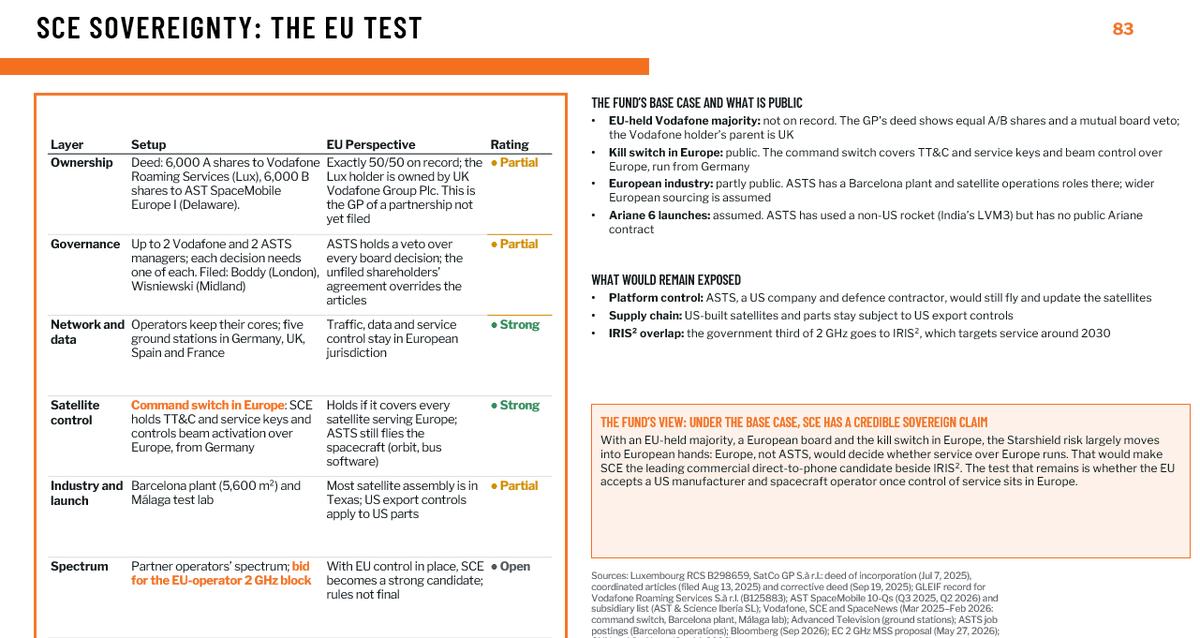
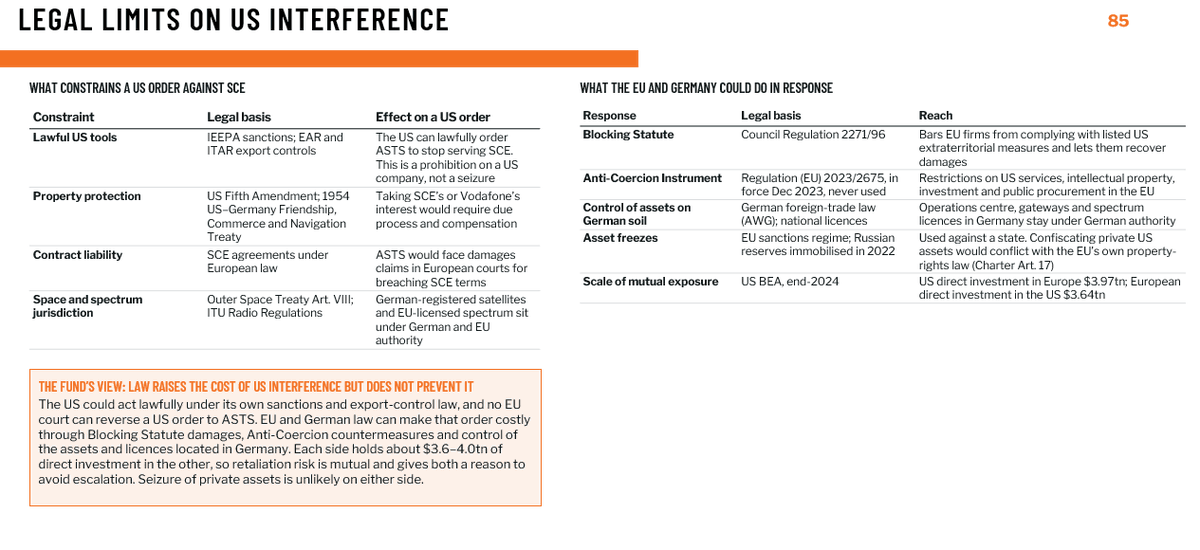
$ASTS The JV SatCo (Satellite Connect Europe) with @AST SpaceMobile as one 50% owner and Vodafone as the other, is indeed only half-European in ownership. 95% of the satellites are manufactured in the USA. But the BlueBird has a technology that makes it compliant to enable European operators to run a sovereign constellation.
The wish and the wishful thinking in Europe is to have a constellation that is not Elon Musk, and to have a European-made alternative that Europe can control. Hence the talks of the JV with the old hags Thales, Aribus and Leonardo (yesteryeas's tech). And there is yet another project that has already commenced: IRIS2, where the LEO satellites will be manufactured in Charleroi, Belgium, and the MEO satellites in Kockelscheuer, Luxembourg. But they have just started. They are YEARS behind.
Meanwhile, there will be an alternative constellation of BlueBirds commercially ready in 2027. Satellite Connect Europe has agreements in nearly all EU (and other European) countries with major MNOs to serve millions of customers.
AST’s transparent bent-pipe architecture functions as a pure radio relay. Phone signals uplink to the satellite and immediately downlink to a local gateway inside the same country. The satellite never demodulates, processes, or routes user data. The local mobile operator retains the baseband units, core network, billing, and all traffic on its own soil under national jurisdiction.
Versus:
Starlink’s regenerative design demodulates and processes signals onboard, then uses inter-satellite links that can route data across borders under SpaceX control.
Even though both firms are American, AST’s model leaves critical infrastructure and data sovereignty with the host country’s operators and regulators.
 Government Contracts On The Way
It's fairly straight forward speculation.
x.com/Defiantclient2
x.com/one_won_juan/s

One Won Juan@one_won_juan
Oct 15
View on Twitter
$ASTS Michael Pollack, Executive VP for Government Operations at ASTS, was Keynote speaker at the MILCOM 2026 Classified Programs event at John Hopkins  The panel required security clearance to attend, his specifically required Secret level at least
 ASTS Doing the Background Work
Wiring up the wireless
x.com/Defiantclient2
Kevin Chen@Defiantclient2
Oct 15
View on Twitter


 Blue Origin Shock and Awe
Well, perhaps I should be more specific b/c they definitely shocked and awed us a few times, but going forward, potentially in a more helpful and positive way
x.com/StockMKTNewz/s
x.com/NASASpacefligh
x.com/SciGuySpace/st
x.com/CatSE___ApeX__

Eric Berger@SciGuySpace
Oct 16
View on Twitter
Four pads. Three landing ships. Up to 150 upper stages a year. It's a big commitment to New Glenn.
arstechnica.com/space/2026/10/

 The High Road
A very interesting dynamic where the skeptics find an on-ramp. Some graciously.
x.com/peter_adderton
x.com/CatSE___ApeX__

CtSE@CatSE___ApeX___
tSEOct 17
View on Twitter
Strategic realignment / Incumbent pivot.
This is the process by which established players—telecom executives, carriers, regulators, or other authorities—shift from skepticism, caution, or active resistance toward engagement, partnership, or support once a disruptive technology moves from speculative to material and the competitive or operational threat becomes concrete.
The view among senior telecom executives and reflected in recent analyst notes is shifting more positively toward AST SpaceMobile as a preferred or complementary “neutral” D2D partner, mainly because of SpaceX’s competitive moves.
Here is one example of a bear turning slightly positive.
$ASTS
Sunday after whatever professional sporting event distracts us from the chaos of the world!
Missing some tweets in this thread? Or failed to load images or videos? You can try to .