
Gabriel Epstein@GabrielEpsteinX
Oct 22
6 tweets
A new Hamas-run Gaza Health Ministry 2025 annual report on reproductive health states that the neonatal mortality rate (meaning deaths within the first 28 days after birth) in 2025 was 9.1/1,000 births. That appears in line with pre-war World Bank data for Gaza and the West Bank, well below the Arab world average, and slightly below the figures for nearby countries like Syria, Lebanon, and Egypt.
However, previous MOH reports place the neonatal mortality rate for Gaza in 2018-2022 at between 6-7/1,000 births. It's not clear what accounts for the discrepancy: the MOH and World bank metrics could be slightly different or the West Bank may simply exhibit higher rates of all of these negative reproductive health metrics (pulling the World Bank figure, which includes both, up). The second explanation is unlikely, however, since the West Bank outperforms Gaza on almost all metrics.
Looking at MOH data alone, there is a clear increase in neonatal mortality between 2022 and 2025. In either case, neonatal mortality remains much higher than the rate in high-income countries, however, including Western countries, the Gulf monarchies, and Israel (2-3/1,000). 


The MOH report places the prevalence of low birth weight (under 2.5 kg or 5.5 pounds) in Gaza in 2025 at 10%. This is comparable to the last estimated figure provided to the World Bank in 2020 (10%), which was then lower than the rate in Jordan (19%) or Lebanon (13%) and only slightly higher than the rate in Israel (9%).
Again, however, there is discrepancy with MOH figures from 2022, which place low birth weight prevalence at 7-8%. If accurate, that would mean that the share of infants born with low birth weight was higher in Israel than Gaza pre-war, which seems counterintuitive.
There is variation throughout 2025, with an elevated period from April-October amid food shortages. The slight decrease from May to July, though the rate remains elevated, is worth looking into.


The MOH report also states that stillbirths (a child born without signs of life after 7 months of gestation) in 2025 occurred at a rate of 10/1,000 births. This is slightly elevated from the 2023 figure reported for the West Bank and Gaza (9.1), and in the middle of the rates for nearby countries.
The report states that the miscarriage (spontaneous abortion -- the loss of a pregnancy prior to 20 weeks) rate in Gaza for 2025 was 96.2/1,000 live births. Many miscarriages occur very early in pregnancies and go undetected, and this is not an issue that is tracked comprehensively globally. The MOH has published data stating that the pre-war (2022) miscarriage rate was 137/1,000 live births, meaning that the miscarriage rate in 2025 was lower than 2022.


Some other notable data points:
- 98.4% of births occurred at hospitals (comparable to the U.S. rate) -- that indicates that data about births and related indicators are well-tracked in the moment
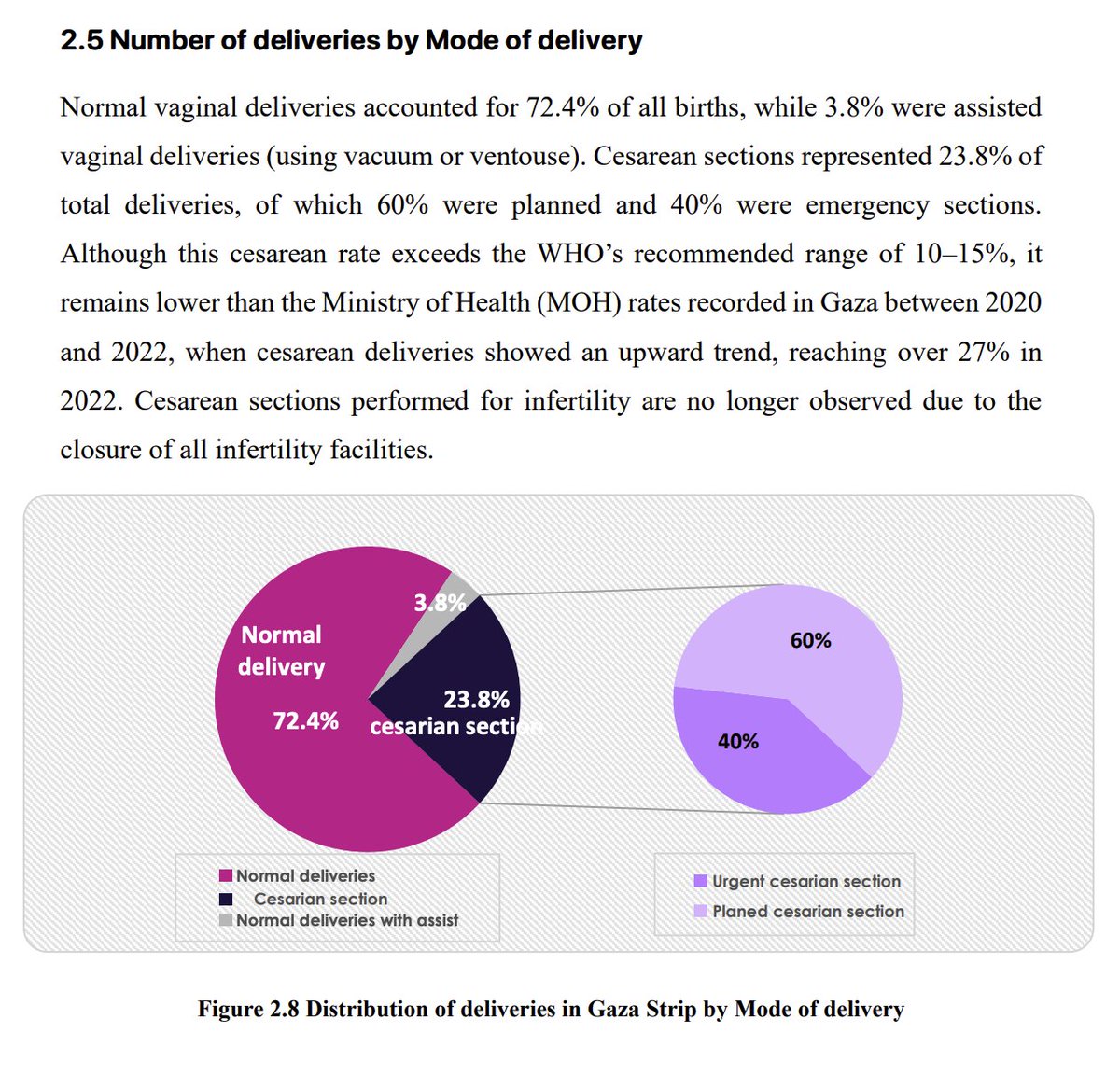
- C-sections accounted for 23.8% of births, lower than pre-war figures (much lower than the U.S.' estimated 32%, but higher than the WHO-recommended 10-15% and Israel's 18-20% rate)
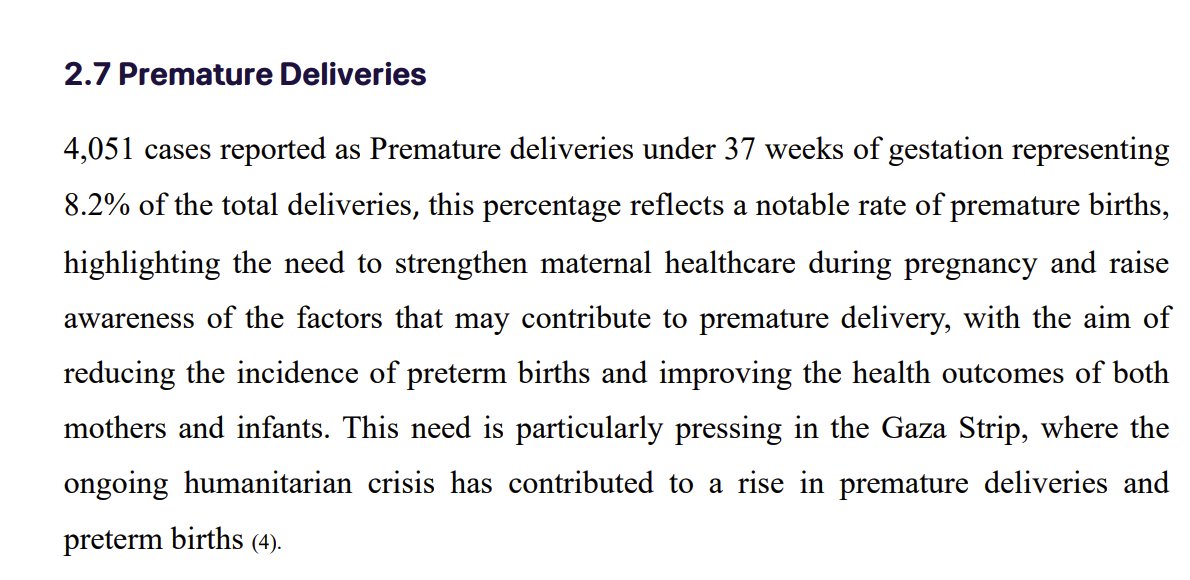
- Premature deliveries accounted for 8.2% of the total, lower than the figure in 2022 (11.7%)

In all, it seems like 2025 saw some moderate increases in negative reproductive health outcomes depending on dataset (low birth weight, neonatal mortality), but some indicators moved in the other direction (miscarriages) and others remained stable (premature deliveries, births in hospital). The 2025 figures also indicate that Gaza's reproductive health outcomes last year were, similar to the pre-war period, better than that of most surrounding Arab countries. The difference between MOH reports and figures from the World Bank is worth exploring more.
As a reminder, projecting backwards from 2025, which saw around 4.5 months of ceasefire but also had a severe food crisis in the spring/summer, to 2023-2024 or forward into 2026 is unlikely to be accurate or useful.
Links:
MOH 2025 reproductive health report: moh.gov.ps/portal/the-pri (odd URL) or moh.gov.ps/portal/wp-cont (PDF)
MOH 2022 annual report: moh.gov.ps/portal/annual- or moh.gov.ps/portal/wp-cont (PDF)
MOH 2022 miscarriage figure: facebook.com/MOHGaza1994/po
World Bank figures:
data.worldbank.org/indicator/SH.D (neonatal mortality rate)
data.worldbank.org/indicator/SH.S (Low-birthweight prevalence)
genderdata.worldbank.org/en/indicator/s (stillbirth rate)

Gabriel Epstein
@GabrielEpsteinX
Senior Policy Associate @IsraelPolicy4m. Former Research Assistant @WashInstitute. Graduate @SAISHopkins.
Missing some tweets in this thread? Or failed to load images or videos? You can try to .